Area Model
Partial Products
Word Problems
Area Model Multiplication
Random
100
Explain how to set up 23 × 15 using an area model.
Split 23 into 20 and 3, and 15 into 10 and 5. Draw a box, label sections, and multiply each part (20×10, 20×5, 3×10, 3×5). Add the partial products.
100
Break 24 × 13 into partial products then solve
(20×10) + (20×3) + (4×10) + (4×3) = 312
100
Lisa buys 23 packs of markers with 14 markers each. How many total markers?
23 × 14 = 322 markers.
100
Solve 34 x 65
2,210
100
Solve 98 × 76 using any method.
7,448
200
Solve 34 × 12 using an area model.
(30×10) + (30×2) + (4×10) + (4×2) = 408
200
Solve 56 × 21 using partial products.
(50×20) + (50×1) + (6×20) + (6×1) = 1,176
200
A farm has 45 rows of 26 plants. How many plants?
45 × 26 = 1,170 plants.
200
Solve 21 x 78
1,638
200
Solve 74 × 58 using both methods and compare.
Both should give 4,292
300
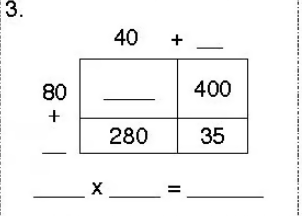 Fill in the missing box in this area model.
Your teacher will look at your response.
300
What is the largest partial product in 78 × 34?
A: 70×30 = 2,100
300
A stadium has 63 sections with 72 seats each. Find the total seats.
63 × 72 = 4,536 seats.
300
349 x 6
2,094
300
I am the answer to a multiplication equation.
Product
400
Explain the Distributive Property for multiplication.
Break apart the numbers. Multiply each part. Add the products together.
400
Explain why partial products work.
They break multiplication into smaller steps, making it easier to solve and understand.
400
A truck delivers 84 boxes with 39 cans each. How many cans?
84 × 39 = 3,276 cans.
400
58x63
3,654
400
Solve 99 × 99
(99 × 100) - 99 = 9,801
500
Create your own area model for 47 × 29 and solve.
Answers will vary but should correctly split 47 into 40 and 7, and 29 into 20 and 9, then solve using an area model.
500
Solve 92 × 47 using partial products.
(90×40) + (90×7) + (2×40) + (2×7) = 4,324
500
Create your own word problem using 2-digit multiplication.
Answers will vary but must include a real-world multiplication scenario.
500
852x6
5,112
500
Find the mistake: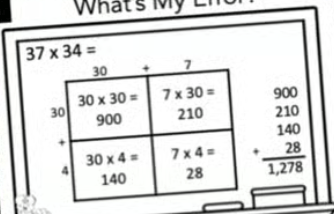
30 x 4 + 120 not 140
So, the final product would be : 1,258