MMT
ROM
Special Tests
LE Anatomy
LE Anatomy
Random
Random
100
Five reps of calf raises receives a grade of ____.
4 (good).
100
What should the end feel be for knee extension.
Firm.
100
What does McMurray's Test check for? Describe it.
Meniscal damage. Patient is supine, grasp the distal leg and palpate the knee with the other hand. With knee fully flexed, therapist medially rotates the tibia and extends the knee. Repeat with lateral rotation.
Test is positive if click or pronounced crepitus present.
100
Why is the peroneus tertius a dorsiflexor and not peroneus longus and brevis?
Peroneus tertius is the only one of the three peroneal muscles that does not thread behind the lateral malleolus.
100
What structures make up the femoral triangle?
Bonus: Name the contents and posterior musculature.
Inguinal Ligament, Sartorius, Adductor Longus.
Bonus Answer: Femoral vein, artery, and nerve. Iliacus and Pectineus.
100
What three muscles insert into the Pes Anserinus?
Sartorius, Gracilis, Semi-Tendinosis.
100
Define effusion.
Increased volume of fluid within a joint capsule.
200
When conducting MMT of the iliopsoas, what additional muscle is assisting the movement?
Rectus Femoris.
200
Name the landmarks for the axis, stationary arm, and movement arm for the goniometer when measuring joint angles of the knee. What is the normal ark of range for the knee?
Axis: lateral epicondyle
Stationary Arm: lateral midline of femur to greater trochanter
Movement Arm: lateral midline of fibula to lateral malleolus
Normal Range: 0-135°
200
Name two interventions you would implement with a positive piriformis test. What is another test you might perform?
Piriformis stretch and manual therapy to piriformis.
Slump test.
200
The lumbar plexus includes levels _____ to _____.
T12 to L4.
200
Name the 5 adductors of the hip. What common innervating nerve do they share?
Adductor Brevis, Add. Longus, Add. Magnus, Gracilis, Pectineus.
Obturator Nerve.
200
Give anatomical examples in the LEs of second and third class levers.
2nd class: calf raise
3rd class: HS curls
200
What is the average ROM for ankle inversion and eversion in a healthy adult?
Inversion: 35 (ppt says 30)
Eversion: 15 (ppt says 25)
300
With the patient in sidelying with the top knee extended and leg at 45 degrees flexion, the therapist stabilizes the pelvis and applies resistance to the lateral distal thigh. What muscle is this testing. Name a substitution that might occur if the muscle is weak.
TFL.
Rotation of the hip or increased hip flexion.
300
When measuring hip ER ROM in sitting 90/90, what muscles is the patient using to perform the motion?
Superior Gemellus, Obturator Internus and Externus, Inferior Gemellus, Quadratus Femoris, Glute Max.
300
What does Lachman's Test check for? Demonstrate it.
ACL Damage.
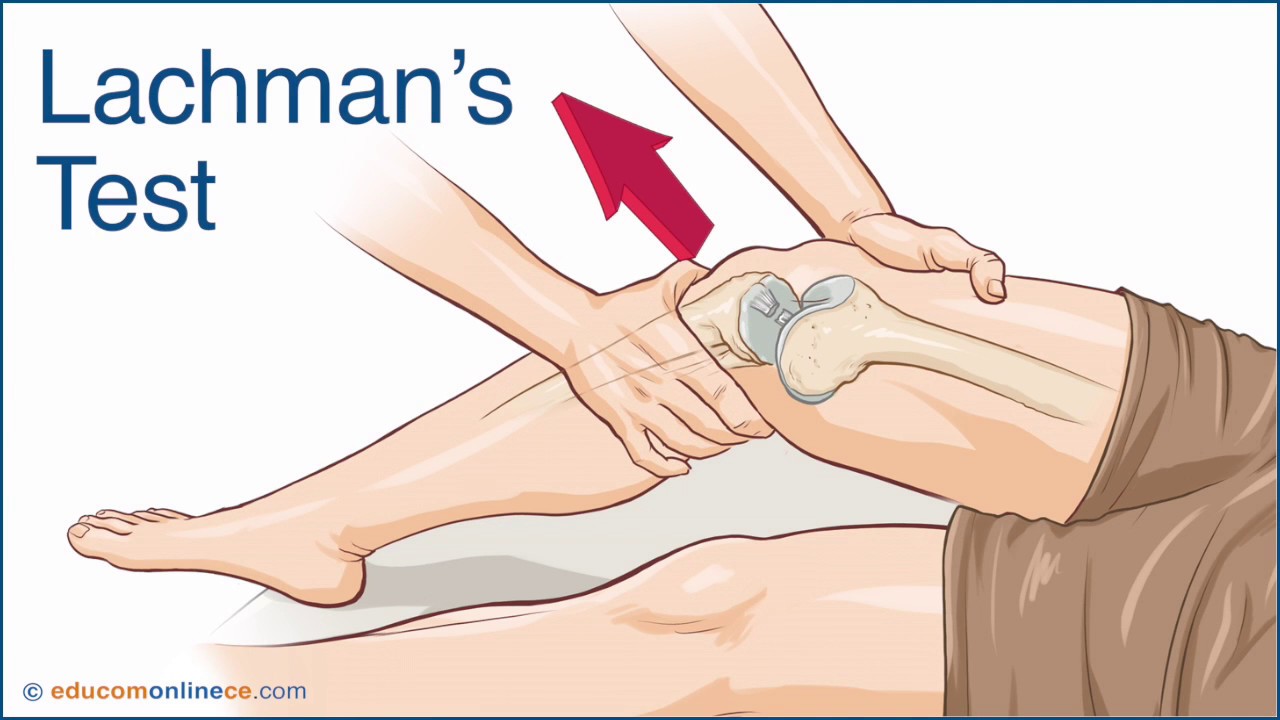
300
List the 5 actions of the sartorius.
Hip flexion, abduction, and external rotation.
Knee flexion, and internal rotation.
300
Name the Origin, Insertion, and Innervating Nerve of the Gluteus Maximus.
Origin: Sacrum
Insertion: Iliotibial Tract (IT Band)
Nerve: Inferior Gluteal N,
300
What does Ober's test check for? How is the test performed?
Tightness in the IT band or TFL.
Subject is side lying on non-test side with bottom leg flexed. Test leg is supported by therapist, straight, and moved into abduction and extension. Therapist slowly lowers test leg.
300
What substitutions would occur when testing the anterior tibialis? Name two muscles that would try and assist the movement.
Any toe movement.
Extensor digitorum longus and Extensor hallucis longus.
400
What is a compensation you might see when testing the piriformis?
Elevation of the pelvis on opposite side or excessive foot movement.
400
Name the landmarks for the axis, stationary arm, and movement arm for the goniometer when measuring hip flexion and extension. What is the normal ark of range for hip flexion/extneion?
Axis: lateral aspect of hip (greater trochanter for reference)
Stationary Arm: lateral midline of pelvis
Movement Arm: lateral midline of femur
Normal Range: 120° into flexion, 30° into extension. Total 150° of motion.
400
What does the Monkey Walk test for? How is it performed? What is the positive sign for this test?
Patellofemoral dysfunction, sometimes associated with Osgood Slaughter disease.
Patient walks in fully crouched position.
Pain at the knee or tibial tuberosity.
400
What are the two stirrup muscles? Give origin and insertion.
Peroneus Longus and Tibialis Posterior.
PL Origin & Insertion: Fibula & Base of 1st Metatarsal and Medial Cuneiform.
TP Origin & Insertion: Upper half of posterior shaft of Tibia & Navicular.
400
Name the insertion for the semitendonosis and semimembranosis.
Semitendonosis: pes anserinus.
Semimembranosis: medial condyle of the tibia.
400
Describe the loose and close packed position of the hip.
Loose: 30° flexion, 30° abduction, slight external rotation.
Close: Full extension with internal rotation.
400
Q Angle is increased by what four anatomical features?
Increased pelvic width, Femoral anteversion, Tibial external rotation, Ankle pronation.
500
Why is inversion required for MMT of the anterior tibialis?
The origin of the anterior tibialis is the lateral shaft of the tibia and the insertion is the medial cuneiform and base of the first metatarsal.
500
Which grade of joint mobilization is being utilized when large amplitude is used up to the limit of range.
Grade III.
500
What is the Wells Criteria Score for? List the Wells Criteria.
Predicting DVT.
Clinical symptoms present, symptoms have no other logical cause, tachycardia, history of DVT, immobilization or surgery in past 4 weeks, coughing blood (hemoptysis), malignancy within last 6 months.
500
Name 7 muscles innervated by the femoral nerve.
Vastus medialis/intermedialis/lateralis, Rectus femoris, pectineus, sartorius, iliacus.
500
For 700 points, the Tibial Nerve serves as the primary source of innervation for what muscles?
Popliteus, Gastrocnemius, Plantaris, Soleus, Posterior Tibialis, Flexor Digitorum Longus, Flexor Hallucis Longus.
500
Discuss the osteo- and arthro- kinematic motions of the talocrural joint, specifically in open vs closed chain movements.
Convex: talus
Concave: tibia and fibula
Open Chain: convex moving on concave, opposite direction
Closed Chain: concave moving on convex, same direction
500
An athlete can squat to 90/90 with weights and return to standing with no issue. When they deepen the squat with the same weights they require the help of a spotter to exit the squat. What principle is at play here? Why?
Passive Insufficiency.
Length Tension Relationship.
