Algebra
Graph
Exponents
Geometry
Random
100
Solve for x:
4x-7=21
x=7
100
A line passes through
(2,3) and (6,11)
Find its slope.
(11-3)/(6-2) = 2
100
Simplify:
x^4 x^7
x^11
100
How many degrees do triangles corners add up to?
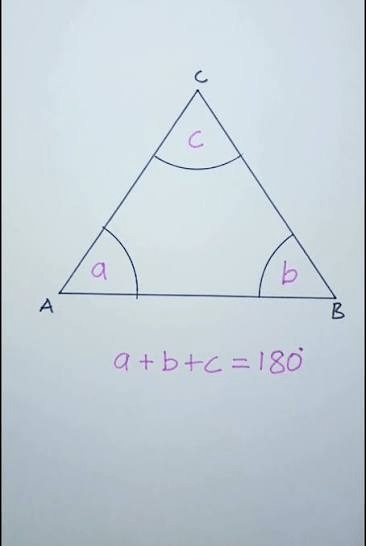
100
Evaluate:
−4^2 +20
The exponent happens first:
−(4^2)+20
−(16)+20
4
200
Solve for x:
3(2x−5)+4=25
x=6
200
Write the equation of a line with slope 3 and y -intercept -5 .
y=3x−5
200
Rewrite without negative exponents:
2x^(-4)
2/x^4
200
A right triangle has legs of 9 and 12.
Find the hypotenuse.
9^2+12^2 = c^2
81+ 144 =c^2
sqrt(225)=sqrt(c^2)
c=15
200
Complete the pattern:
2, 6, 18, 54, ___
162
300
3(x+2)=3x+6
Infinitely many solutions!
300
Given
f(x)=2x^2−3
find f(−2) .
f(−2)=2(−2)^(2)−3
=8−3
=5
300
Simplify:
(12x^7)/(3x^3)
4x^4
300
Find the midpoint between:
(−4,8)
and
(6,−2)
((-4+6)/2 , (8+(-2))/2)
(-1,3)*x^*x^2)2) (-1,3)
300
Which number is irrational?
sqrt(16), sqrt(20), 7/4, -3
sqrt(20)
400
Solve this system of linear equations
{(2x,+,3y,=,13),(3x,-,y,=,3):}
Answer:
(2,3)
400
Line A has equation
y=−1/2x+7
What slope would a line perpendicular to Line A have?
Negative reciprocal:
2
400
Simplify completely:
(2x^3 y^2)^3
8(x^9 y^6)
400
Find the distance between
(1,2)
and
(7,10).
d=sqrt((7-1)^2 + (10-2)^2)
sqrt(100)
10
400
Which is larger?
7/12 or 5/8
Common denominator 24:
7/12 = 14/24
5/8=15/24
Therefore
5/8
is larger
500
What is the quadratic formula?
x=(−b±sqrt(b^2−4ac))/ (2a)
500
A line passes through (5,−1).
and (−3,7)
Find its equation.
First find the slope:
m=(-1-7)/(5-(-3))=-8/8=−1
Use:
y=mx+b
7=−(−3)+b
7=3+b
b=4
Therefore: y=−x+4
500
Simplify:
((3x^2 y^-1)^2)/(9x^-1)
Numerator: 9x^4 y^-2
So: (9x^4 y^-2)/(9x^-1)
=x^5 y^-2
Without negative exponents:
x^5 / y^2
500
A rectangle has perimeter 50 units.
Its length is 5 units greater than its width.
Find its dimensions.
Let width =x.
Length:
x+5
Perimeter:
2x+2(x+5)=50
4x+10=50
4x=40
x=10
So:
Width=10, Length=15
500
Is this statement always, sometimes, or never true?
Squaring a number makes it larger.
Sometimes!
3^2 = 9 > 3
but (1/2)^2 = 1/4 < 1/2