Vocabulary
Natural Selection
Moths/Finches
Moths/Finches
Natural Selection
Data Nuggets
Data Nuggets
Natural Selection
Elephants & More
Elephants & More
DNA Modification Potato & IV/DV
100
Define "survival of the fittest"
It is where organisms that are best adapted to their environment are most likely to survive and reproduce. It was coined by Herbert Spencer and adopted by Charles Darwin; "fitness" refers to reproductive success and passing on traits, rather than just physical strength
100
What is the typical beak size of a finch on a Galapagos island with LOTS of annual rainfall over several years?
Small 7mm
100
Can an organism "CHOOSE" to evolve and change?
No, organisms CANNOT CHOOSE to change their genes or traits!
100
In an arctic environment, which would survive longer: red foxes or white foxes?
White foxes
100
What is the Independent Variable in an experiment? Provide an example.
It is what we change as a scientist, such as: time, present/absent anole, short/long stamen, poaching/non-poaching environment, lake/river environment.
200
The process by which individuals that are better adapted to their environment survive and reproduce more successfully than less well adapted individuals
Natural Selection
200
What is most likely to happen to moth populations in the picture shown?
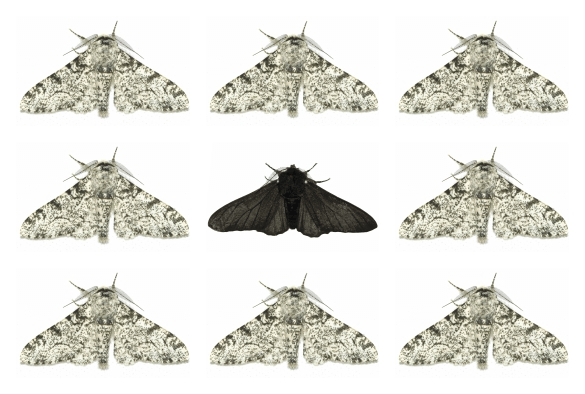
Dark moths--hunted easily, dark moths--population decreases.
200
What is one benefit for the mustard seed plant for having an adaptation of both LONG and SHORT stamen?
Its pollen is able to be saved for future visitors to each plant, especially on the short stamen, from honey bees, flies, and small bees, who will bring the pollen to other plants for reproduction of the mustard plant.
200
Which is more likely to survive in the summer instead of the winter: white rabbits or brown rabbits? Explain why.
Brown rabbits because they are able to camouflage more with their environment to hide from predators (wolves), and therefore survive and reproduce, passing on that trait to their offspring.
200
What is the Dependent Variable in an experiment?
It is the DATA we collect / what is MEASURED. For example: the % population of moths, % population of elephants, perch height, body depth, % pollen taken, beak depth.
300
What is a change in a gene that results in a new trait?
What is a mutation?
300
The trees these moths used to live on were white, but have been covered in soot from coal factories. Which moth will be more successful in this environment?
Dark moth
300
What niche was changed for the green anole when the brown anole were present in Florida?
The perch height (living area on the tree)
300
Darwin began to hypothesize that organisms developed traits over time because of the differences in their ___________.
Environments
300
What is the genetically modified potato called?
The NewLeaf potato
400
A TRAIT that helps an organism to survive and reproduce in its environment
What is Adaptation?
400
Darwin observed that the shape of these finches _________ were well matched with the seeds available in their own distinct environment.
Beaks
400
What TRAIT was affect in the goby population in rivers vs lakes?
Body size measurements and caudul peduncle ("KAW-DUL PUH-DUNG-KUL") depth (They were smaller in the river)
400
What TRAIT was affected in elephant populations due to high poaching environments?
Having tusks / being tuskless from birth (more were born tuskless)
400
Which species (bug) is affected by the genetically modified potato?
The Colorado Potato Beetle
500
The occurrence of hereditary or nonhereditary differences between different individuals of a population
Variation
500
State the beak size of finches on Galapagos islands where there is drought and EXPLAIN WHY.
The beak size is large 13mm because when there is no rain, no new plants grow. If no new plants grow, there are no little new seeds from those plants. All the little seeds are eaten by birds with little beaks. When all the little seeds are eaten, there is no food left for the little beaks so they all die and cannot reproduce to pass on that trait. Only the big seeds are left behind which can only be eaten by big beaks. Those finches with big beaks survive, reproduce, and pass on the trait for big beaks. However, there is a limit on the food so the population stays small, because no new food is being made.
500
Using DATA from one of the Data Nuggets or labs from your choosing, construct a CER that answers the scientific question. You may (and should) use your packets.
Answers will vary.
500
Which gender of elephant was found to be tuskless as adults? WHY?
Only females because the juvenile tuskless males were killed in battle with other males when competing for mates.
500
How is the genetically modified potato actually genetically modified? Explain.
It is injected with harmful bacteria with a gene gun. The harmful bacteria take over each part and live in each part of the potato; it is being produced in each part and is in the DNA. The bacteria melt away and liquify the insides of bugs.