First law
Second law
Third law
Our presentation
Bonus (random facts)
100
Newton's first law states that:
The first law states that an object in motion will stay in motion.
(or anything similar)
100
Newton's second law states that:
To equally change the motion of two objects of different mass, more force must be applied to the more massive object.
(or anything similar)
100
Newton's third law states:
For every action, there is an equal and opposite reaction.
(or anything similar)
100
What was the style of background?
Gradients
100
What the myth that brought Newton to think of his laws.
That an apple fell on his head.
200
What is friction?
Friction is a force that happens when two objects rub together. It slows objects that are moving.
200
What is the important equation mentioned in this law?
F=ma
200
Finish the sentence:
Force always occur ___.
In pairs.
200
What was the example on slide 3?
Caleb throwing a paper ring.
200
When was newton born?
Despite being born on January 4, he was born on Christmas Day.
I know, confusing. At the time of his birth, the Gregorian calendar hadn't been adopted by England. This lead to him being born on Christmas even though at the time it was January 4.
300
Explain how friction is related to Newton's first law.
Friction acts on moving objects and slows them down. This is why objects don't continue to move forever.
300
Solve this problem for acceleration.
A mass of 64g is hit with a force of 7n.
448 meters per second squared.
(PLEASE have the units)
300
What is an example of forces in pairs?
This will need to judge this something like A gun being shot with kickback.
300
What was our sponsor?
(Thanks Caleb)
Sports gas
300
How old was he when he made these laws?
23
Closest will get the points
400
Explain why when you stop/go in a car you move forward/back.
Your body doesn't want to move forward/stop at first. You body is staying in motion while the car stops. your body is resting when the car is moving.
400
Around the room you see the balances. Up here with we have the cars. When I say go send one person from your group to come up and get one. You job is to calculate the force generated if the acceleration was 15 mps^2.
Go!
We discovered that the cars have slightly different masses. The answer should be around 825 n. Please tell mass of car so we can verify your answer.
400
In the top picture, Kent is pulling upon a rope that is attached to a wall. In the bottom picture, Kent is pulling upon a rope that is attached to an elephant. In each case, the force scale reads 500 Newton. Kent is pulling ...
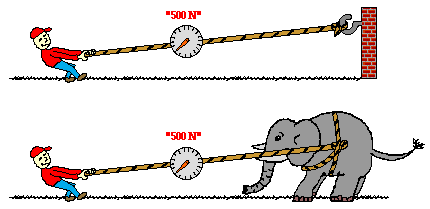
a. with more force when the rope is attached to the wall.
b. with more force when the rope is attached to the elephant.
c. the same force in each case.
C
400
How many pictures were of our experiments?
(closest wins)
4
We will give points to the closest.
400
Where were the three laws presented in?
Principia Mathematica Philosophiae Naturalis
500
What is Newton's first law (the whole law as stated by Newton) word for word.
(we will take it if it's very close)
An object at rest stays at rest and an object in motion stays in motion with the same speed and in the same direction unless acted upon by an unbalanced force.
500
What is Newton's second law (the whole law as stated by Newton) word for word.
(we will take it if it's very close)
The acceleration of an object as produced by a net force is directly proportional to the magnitude of the net force, in the same direction as the net force, and inversely proportional to the mass of the object.
Note F=ma
500
What is Newton's third law (the whole law as stated by Newton) word for word.
(we will take it if it's very close)
When one body exerts a force on a second body, the second body simultaneously exerts a force equal in magnitude and opposite in direction on the first body.
500
Who were the scientists in slide 3 (the example slide)
Bill Nye and Neil Tyson
(2 points possible)
500
What year were the Laws of Motion presented?
1686