Complex Numbers
Complex Numbers
Complex Numbers
Complex Numbers
Complex Numbers
100
Closure Property
The sum of two real numbers is a real number.
The product of two real numbers is a real number.
Example.
2.5 + 3 = 5.52.5+3=5.5
100
Polar Form of a Complex Number
When a complex number is denoted by the length (or magnitude) and the angle of its vector.
Example.
z=rcos+r(sin)iz=rcos+r(sin)i
100
FOIL Method
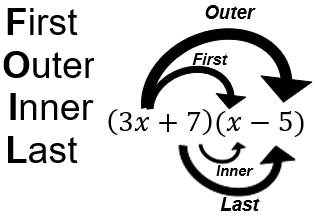
A method for multiplying binomials, where FOIL is a mnemonic reminder for the repeated use of the distributive property (First Outer Inner Last)
100
Inverse Element
Any number plus its opposite or any number multiplied by its inverse is 1
Example.
5 + (-5) = 05+(−5)=0
5 \times \frac{1}{5} = 15×51=1
100
Complex Numbers
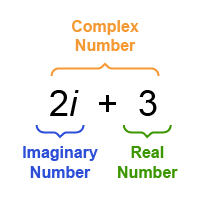
A polynomial comprised of a real number and an imaginary number. The real number can be 0 and not written.
Example.
3 - 5i3−5i
200
Multiplicative Inverse of a Complex Number
The number that would make 11 when multiplied with the original.
Example.
z=a+biz=a+bi has a multiplicative inverse of \frac{1}{a+bi}a+bi1 since a+bi \times \frac{1}{a+bi}=1a+bi×a+bi1=1
200
Radian
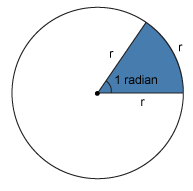
A unit of measure for angles. One radian is the angle made at the center of a circle by an arc whose length is equal to the radius of the circle.
Example.
Whereas a full circle is 360°, a full circle is just over 6 radians
200
Complex Plane
Cartesian coordinate axes with real numbers along the horizontal axis and imaginary numbers along the vertical axis
200
Identity Element
Any number plus zero or any number multiplied by one is that number
Example.
4 \times 1 = 44×1=4
4 + 0 = 44+0=4
200
Conjugate of a Complex Number
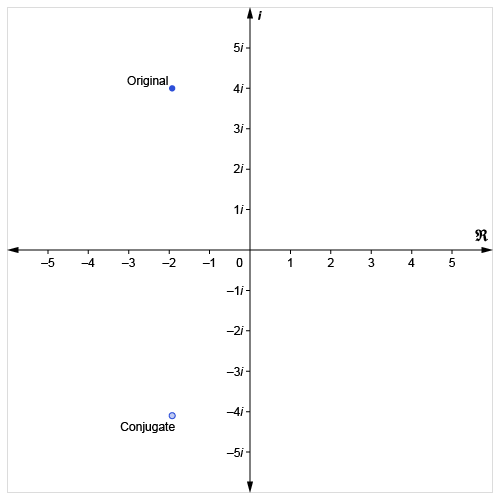
A complex number with an equal real part and an imaginary part that has an opposite sign but equal magnitude.
Example.
z=a+biz=a+bi has a conjugate of a-bia−bi
300
Distributive Property
a number in front of a group of terms will multiply all terms in the grouping individually
Example.
a(b+c) = ab + aca(b+c)=ab+ac
300
Modulus of a Complex Number
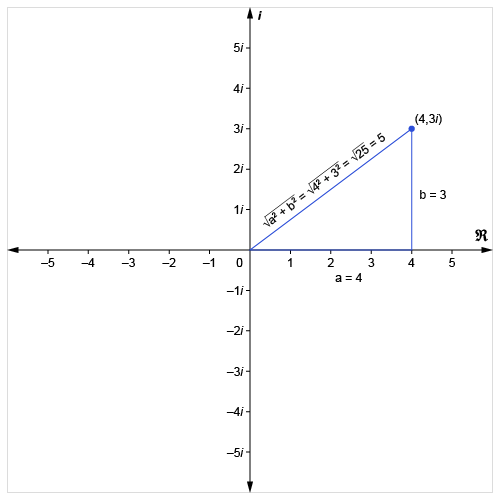
The distance between the origin (0, 0) and a point (a, b) in the complex plane.
300
Distance in the Complex Plane
The distance between point (a, b) and point (p, q) in the complex plane.
Example.
The distance between two points in the complex plane (a, b) and (p, q) is found by:
d=\sqrt{ \left( p-a \right) ^{2}+ \left( q-b \right) ^{2}}d=(p−a)2+(q−b)2
300
Polar Coordinates
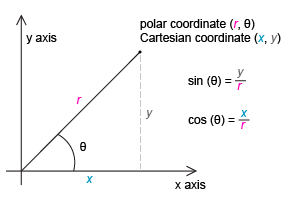
a 2D coordinate system where each point is determined by the distance from the origin and an angle from x=0
300
Rationalize
The process of eliminating a radicals or imaginary number from the denominator of an algebraic fraction.
Example.
\frac{c}{\sqrt{a}} \times \frac{\sqrt{a}}{\sqrt{a}}=\frac{c\sqrt{a}}{\sqrt{a^{2}}}=\frac{c\sqrt{a}}{a}ac×aa=a2ca=aca
400
Aultiplicative Identity of a Complex Number
A number that, when multiplied by any complex number, always yields that number. These are 1 or any form of 1 such as \frac{a+bi}{a+bi}a+bia+bi.
400
Magnitude
size of a number
Example.
7 has a greater magnitude than 2
400
Commutative Property
An operation is commutative if changing the order of terms does not change the outcome
Example.
a + b = b + aa+b=b+a
400
Additive Identity of a Complex Number
A number that, when added to any complex number, always yields that number. Zero itself is sometimes referred to as the additive identity.
400
Additive Inverse of a Complex Number
The number that would make zero when added to the original.
Example.
z=2-3iz=2−3i and z=-2+3iz=−2+3i results in 00
500
Imaginary Numbers
Numbers represented by the letter ii, which indicate the square root of a negative number
Example.
\sqrt{-1}=i−1=i
500
Which of the following converts z=3-2iz=3−2i into polar form?
z=3.61(cos(−33.69∘)+isin(−33.69∘))
The polar form of a complex number is z=r \left( \cos \theta +i\sin \theta \right)z=r(cosθ+isinθ), where rr is the radius and \thetaθ is the angle formed by the radius and the horizontal axis.
Using Pythagorean theorem to find rr, r=\sqrt{ \left( -3 \right) ^{2}+ \left( 2 \right) ^{2}}=\sqrt{13} \approx 3.61r=(−3)2+(2)2=13≈3.61.
Using the trigonometric ratio, \tan \theta =\frac{b}{a}tanθ=ab to find \thetaθ, \tan \theta =\frac{-2}{3} \rightarrow \theta =\tan^{-1} \left( \frac{-2}{3} \right) =-33.69\degreetanθ=3−2→θ=tan−1(3−2)=−33.69°.
500
Which of the following is a square root of (3 + 4i)(3+4i)?
2+i
Square the answer choices to see if they are a square root of (3 + 4i)(3+4i):
( 2+i)( 2+i) = 4 + 2i + 2i + i^2 = 4 + 4i +( -1) = 3 + 4i (2+i)(2+i)=4+2i+2i+i2=4+4i+(−1)=3+4i
Note that this does not contain both possible roots: z= \pm( 2+ i)z=±(2+i)
500
What is the inverse of the conjugate of 2 + 7i?
(2 + 7i)/53
The conjugate of (2 + 7i) is (2 − 7i). The inverse of (2 −7i) = (2 + 7i)/(a² + b²) = (2 + 7i)/(2² + 7²) = (2 + 7i)/53.
500
How are the cartesian coordinates (3, 4) represented as polar coordinates?
(5, 53°)
To convert from cartesian to polar coordinates first use the Pythagorean theorem to determine the r coordinate. x^{2}+y^{2}=r^{2}x2+y2=r2 ⇒ 3^{2}+4^{2}=r^{2}32+42=r2 ⇒ 25=r^{2}25=r2 ⇒ r = 5. To determine the angle perform the operation: tan \theta =\frac{y}{x}tanθ=xy \theta =tan^{-1} \left( \frac{4}{3} \right) \approx 53 ^{\circ}θ=tan−1(34)≈53∘