Breathe!
Hug It Out
I see you
You're a PRO
It's on FIRE
100
A nurse is caring for a patient following a thorocentesis. Which of the following manifestations should the nurse recognize as risks for complications. Select all that apply (to be correct). A. Dyspnea B. Localized bloody drainage on the dressing C. Fever D. Hypotension E. Report of pain at the puncture site.
A, C, D are correct A. dyspnea can indicate pneumo or reaccummulation of fluid B -minimal bloody drainage normal C- fever- infection D - intrathroasic bleeding E - normal
100
Examples of negative communicaton include: (Select all that apply) A. "It's not my job" B. "You know how THEY are..." C. Crossing your arms and not making eye contact D. Speaking loudly and/or with a higher pitched voice
All of the above
100
What is a drastic reduction in diffusion due to thickened alveolar membrane, stiff lungs and, diffuse alveolar injury which causes greatly increased permeability?
Acute Respiratory Distress Syndrome ARDS
100
Which behavior demonstrates the nurse's competency as an emotionally intelligent leader? A. The nurse is proficient in technical skills. B. The nurse relies on policies, not options. C. The nurse supports team members. D. Productivity is not a major concern.
C. The nurse supports team members.
100
Restitution of normal functioning cells following injury & fibrous repair when functional cells cannot be restored are the primary functions of what?
What is inflammation.
200
A nurse is assessing a patient who has a chest tube and drainage system in place. Which of the following are expected findings? Select all that apply (need all correct). A. Continuous bubbling in the water seal chamber B. Gentle constant bubbling in the suction control chamber C. Rise and fall in the level of water in the water seal chamber with inspiration D. Exposed sutures without dressing E. Drainage system upright at chest level.
What is B and C. A. indicates air leak B. Expected finding as air is removed C. Expected as it correlates with inspiration and expiration D. An airtight dressing should be in place E. Should be maintained in an upright position below the level of the client's chest.
200
Assertive communication includes the use of 'I' statements. True or False
True also includes repetitiion, confidence, management of nonverbal communication, thinking before speaking, avioiding apologizing whenever possible and performing a post convertation evaluation.
200
A nurse is orienting a newly licensed nurse on performing routine assessment of a patient who is receiving mechanical ventilation via an endotracheal tube. Which of the following information should the nurse include in the teaching? A. Apply a vest restraint if self extubation is attempted B. Monitor ventilator settings every 8 hours C. Document tube placement in cm at the angle of the jaw. D. Assess breath sounds every one to 2 hours
D. Assess breath sounds every 1 to 2 hours hourly vent check tube measured at lip in cm
200
The nurse, in collaboration with the patient's family, is determining priorities related to the care of the patient. The nurse explains that it is important to consider the urgency of specific problems when setting priorities. What provides the best framework for prioritizing patient problems? A)Availability of hospital resources B)Family member statements C)Maslow's hierarchy of needs D)The nurse's skill set
C. Maslow's hierarchy of needs provides a useful framework for prioritizing problems, with the first level given to meeting physical needs of the patient. Availability of hospital resources, family member statements, and nursing skill do not provide a framework for prioritization of patient problems, though each may be considered.
200
Which of the following statements is not true regarding lactate levels? A. Elevated blood lactate levels associated with hypoxia may result from strenuous muscle exercise, shock, hemorrhage, sepsis, myocardial infarction, pulmonary embolism, and cardiac arrest. B. A lactate of <2 is common with septic shock. C. Fluid resistant hypotension and lactate >2 is a high predictor of mortality D. If a patient rules in for the SIRS hospital protocol, then a lactate level should be part of the next steps of sepsis protocol.
What is B. Lactate >2, not <2.
300
A nurse is reviewing ABG lab results of a patient that is in respiratory distress. Results Ph 7.46, Pco2 32, Bicarb 22. The nurse should recognize that the patient is experiencing which of the folllowing acid/base imbalances. A. Respiratory Acidosis B. Respiratory Alkalolsis C. Metabolic Acidosis D. Metabolic Acidosis
B. Respiratory Alkalosis- an increased Ph and a decreased Pco2. Possible causes- hyperventilation, fever and respiratory infections.
300
A nurse is caring for a patient who is scheduled for surgery. The patient hands the nurse information about advance directives and states, "Here, i don't need this. I am too young to worry about life-sustaining measures and what I want done for me." Which of the following actions should the nurse take? A. Return the papers to the admitting department with a note stating that the patient does not wish to address the issue at this time. B. Explain to the client that you never know what can happen during surgery and that he should fill the papers out just in case. C. Contact a pt. rep to to talk with the patient and offer additional info about the purpose of advance directives. D. Inform the patient that surgery cannot be conducted unless he completes the advance directives forms.
C. Advocate to ensure the pt understands the purpose A- not advocating B- not therapeutic and can cause anxiety D- untrue and barrier to therapeutic communication
300
****Daily Double****
What's the MAP? Is it WNL?
(must get both correct)
BP 83/50
61 mm Hg
NO
MAP= SBP + 2(DBP) / 3
300
There are nursing students who are conducting their study on leadership styles in your unit. One of the questions included is: What do you think is the most effective leadership style that can be used during emergency situations? A. Democratic B. Laissez- faire C. Autocratic D. Emotional Intelligence
C. Since an authoritative leader tends to be directive, during emergency situations this kind of leadership style is effective in nursing care. It can be beneficial if the autocratic leader knows how to prioritize and do the things that needs to be done.
300
A child has been transported to the emergency department (ED) after a severe allergic reaction. The ED nurse is evaluating the patient's respiratory status. How should the nurse evaluate the patient's respiratory status? Select all that apply. A)Facilitate lung function testing. B)Assess breath sounds. C)Measure the child's oxygen saturation by oximeter. D)Monitor the child's respiratory pattern. E)Assess the child's respiratory rate.
B, C, D, E correct The respiratory status is evaluated by monitoring the respiratory rate and pattern and by assessing for breathing difficulties, low oxygen saturation, or abnormal lung sounds such as wheezing. Lung function testing is a lengthy procedure that is not appropriate in an emergency context.
400
A nurse is caring for a patient that has pneumonia. Assessment findings include Temp 100F, RR 30, BP 130/76, HR 100. O2 sat 91% on RA. Prioritize the following nursing interventions. A. Administer antibiotics B. Administer oxygen therapy C. Perform a sputum culture D. Administer an antipyretic med to promote pt comfort
B-C-A-D B. RR and HR increase, O2 sat low C. prior to admin oral meds to obtain an approp and adequate specimen A. sputum prior D.
400
An experienced nurse on a urology unit arrives to work on the night shift. The unit manager immediately asks the nurse to float to a pedi floor because the hospital census is high and they are understaffed. the nurse has always maintained a positive attitude when asked to work on another med/surg unit but states she not not feel comfortable in the pedi setting. The manager insists the nurse is the most qualified. The nurse offers to work on another med/surg unit if someone from that unit feels comfortable in the pediatric environment. This is an example of which conflict resolution strategy? A. Avoiding B. Cooperating/Accommodating C. Compromising D. Collaborating
C. Compromising minimizes the losses for all involved while making certain each party gains something
400
The nurse is caring for the client whose condition has progressed from from an acute lung injury from near-drowning to ARDS. Which intervention should the nurse question with the health care provider?
A. Place in prone position if tolerated
B. Normal saline 1000mL bolus then start at 250mL/hour
C. Ventilatory support with positive end-expiratory pressure (PEEP)
D. Methlyprednisolone 175 mg now and q4h
B. Aggressive fluid therapy is inappropriate because it can result in pulmonary edema adn worsening of ARDS.
400
****DAILY DOUBLE**** FYI NOT ON TH EXAM BUT IMPORTANT *** The best explanation of what Title VI of the Civil Rights Act mandates is the freedom to: A. Pick any physician and insurance company despite one’s income B. Receive free medical benefits as needed within the county of residence C. Have equal access to all health care regardless of race and religion D. Have basic care with a sliding scale payment plan from all health care facilities
C. Have equal access to all health care regardless of race and religion Provision 8: The nuse collaborates with other HCP's and the public to protect human rights, promote health diplomacy and reduce health disparities. 8.1 Health Is A Universal Right
400
A 70-year-old man presents to the emergency department with a 2-day history of fever, chills, cough, and right sided pleuritic chest pain. On the day of admission, the patient's family noted that he was more lethargic and dizzy and was falling frequently. The patient's vital signs are: temperature, 101.5 F; heart rate, 120 bpm; respiratory rate, 30 breaths/min; blood pressure, 70/35mm hg; and oxygen saturation as measured by pulse oximetry, 80% without oxygen. A chest x-ray shows a right lower lobe infiltrate. A. Multi-organ dysfunction syndrome B. Sepsis C. Septic shock D. SIRS
B. Sepsis
I am checking on this with Mrs. R - I will update asap.
500
The client has experienced a spontaneous pneumothorax. In explaining this to the client, which illustration should the nurse select?
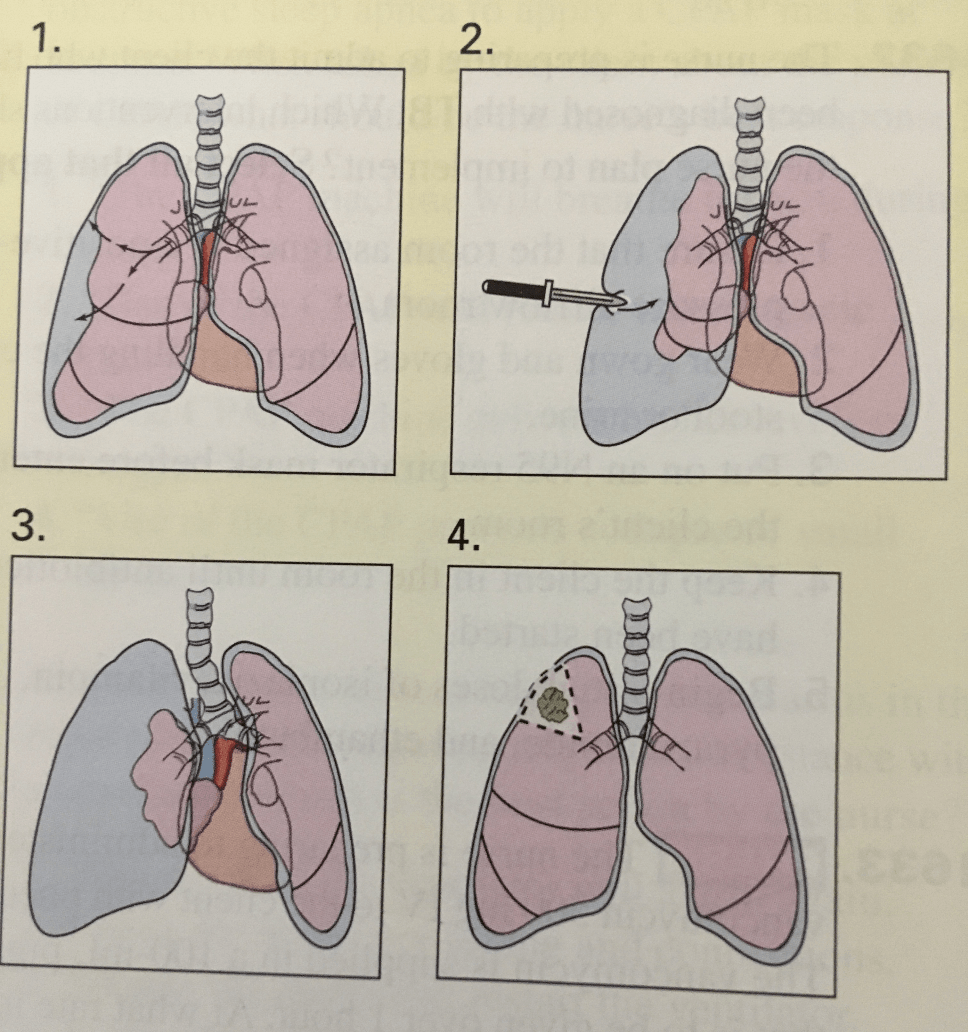
1. correct
2. traumatic pneumo
3. tension pneumo (air leak in the lung)
4. segmental resection of the lung
500
A LPN ending her shift reports to the RN that a newly hired LNA has not calculated the I/O for several patients. Which of the following actions should the RN take? A. Complete an incident report B. Delegate this task to the LPN C. Ask the LNA if he needs assistance D. Notify the nurse manager
C. Ask the LNA if he needs assistance Should find out why first and LNA did not complete and if they need education
500
Ms. D is admitted to the ICU with a diagnosis of probable sepsis and septic shock. Which data that you have collected in the health history and physical assessment are significant in developing and confirming the diagnoses of sepsis and septic shock. Select all that apply. 1. Increased Temp 2. Atrial Fibrillation 3. Cloudy, blood streaked urine 4. Decreased BP 5. Elevated heart rate 6. Abdominal and back pain 7. History of DM
1, 3, 4, 5, 6, 7 The decreased BP and increased HR are indicators. The elevation in temp suggests that sepsis (and massive vasodilation) may be the cause. The blood streaked and cloudy urine and back and abd pain point to a uti and or pyelonephritis as the cause of sepsis. Diabetic patients are at increased risk for UTI and sepsis. AF is not an indicator of sepsis and is unlikely to be the cause of Ms. D's hypotension.
500
The charge nurse is making assignments for the next shift. Which patient should be assigned to the fairly new nurse (6 months experience) floated from the surgical unit to the medical unit? A. 58 yo on airborne precautions for TB B. 65 yo just returned from bronchoscopy and biopsy C. 72 yo who needs teaching about the use of IS D. 69 yo with COPD who is vent dependent
C. C. applies to many med/surg patients A.TB mask fitting specialized training for both B and D
500
After receiving 1000 mL of normal saline, the central venous pressure for a patient who has septic shock is 10 mm Hg, but the blood pressure is still 82/40 mm Hg. The nurse will anticipate the administration of a. nitroglycerine (Tridil). b. drotrecogin alpha (Xigris). c. norepinephrine (Levophed). d. sodium nitroprusside (Nipride).
ANS: C When fluid resuscitation is unsuccessful, vasopressor drugs are administered to increase the systemic vascular resistance (SVR) and improve tissue perfusion. Nitroglycerin would decrease the preload and further drop cardiac output and BP. Drotrecogin alpha may decrease inappropriate inflammation and help prevent systemic inflammatory response syndrome, but it will not directly improve blood pressure. Nitroprusside is an arterial vasodilator and would further decrease SVR.