Inverses 101
One-to-One Functions
Finding Inverses for One-to-One Functions
Verifying Inverses of Functions
100
If the point (3, -5) exists on the graph of f(x), this point must exist on the graph of its inverse, f^-1(x).
(-5,3)
100
What is a one-to-one function?
A function is one-to-one if each element in the range corresponds to exactly one element in the domain.
100
What are the steps for solving inverses algebraically?
1) rewrite f(x) as y; switch x and y.
2) solve for the new, inverse equation for y.
3) rewrite using function notation
100
How do we verify that f(x) and g(x) are inverses of eachother?
f(g(x))=x
g(f(x))=x
200
This is the first algebraic step usually taken when solving for the inverse of a function like f(x) = 2x + 3.
Swap the x and y variables.
200
Which line test helps determine if a graph is a one-to-one function or not? How does it work?
The Horizontal Line Test; if any horizontal line can be drawn through the graph of a function and only intersect it at one point, then it is one-to-one.
200
Find the inverse of the following function:
f(x) = -2x+5
f^-1(x) = -1/2x+5/2
200
What is one piece of evidence that shows these functions are not inverses?
f(x)=1/3(x)-3
g(x)=6x+18
f(g(x))=2x+3
or
g(f(x))=2x
300
How can we graph the inverse of the function below?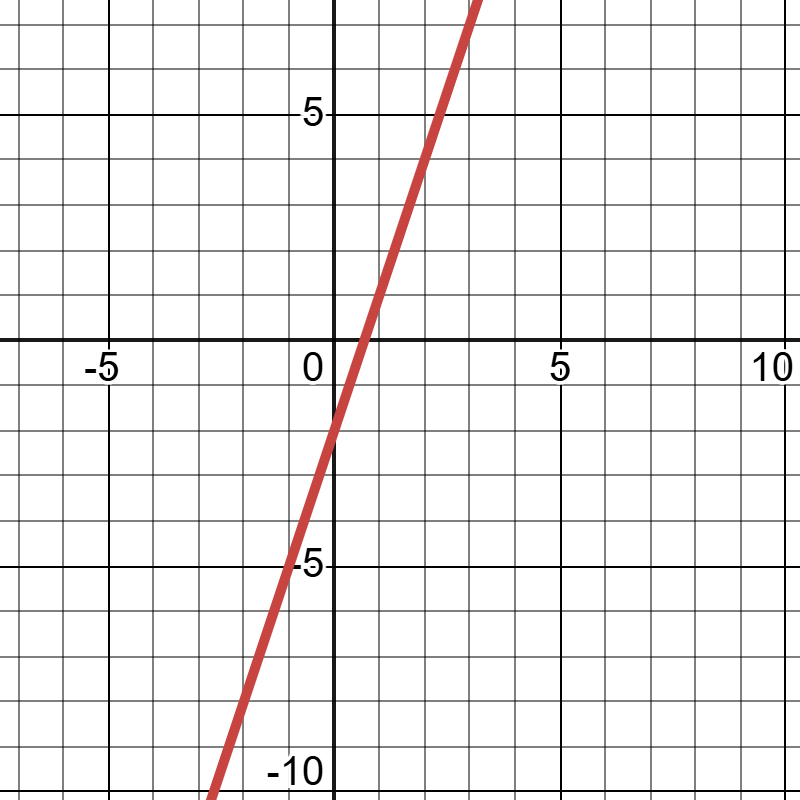
Find 5 coordinates on the graph shown and write them down. Switch the domain and range of these coordinates. Plot the new set of coordinates and connect them.
300
Is function f defined by f = {(1 , 2),(3 , 4),(5 , 6),(8 , 6),(10 , -1)}, a one to one function?
Two different values in the domain, namely 5 and 6, have the same output; hence function f is not a one to one function.
300
What do you have to do to a quadratic in order to make its inverse a one-to-one function?
Restrict it's domain.
300
True of False: The inverse of g(x)=3/2x-7 is g^-1(x)=(14-2x)/3 . (provide evidence)
What is False:
g(g^-1(x))=-x or
g^-1(g(x))=(-3x+28)/3
400
True or False (and explain): The dashed orange and solid black graphs are inverses.
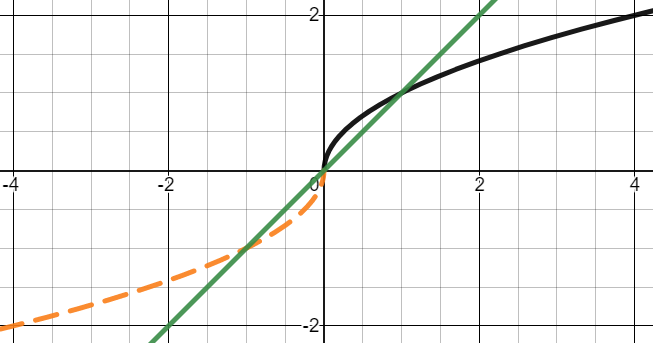
False; the functions are not symmetrical across the green line (y=x).
400
If the function f(x) is a 1-1 function and f(3) = 8 then what is...
f^-1(8)=
3
400
Find the inverse of the following function:
f(x) = -3/(x+2)
f^-1(x) = -(3)/x-2
400
Why aren't h(x) and g(x) inverses?
h(x)=(x-1)^2
g(x)=sqrt(x)+1
The domain of h is x∈(-∞, ∞) and the range of g is y∈[1,∞).
500
Because it fails the horizontal line test, the function f(x)=(x-5)^2 only has an inverse if you apply the following limitation to its domain...
x∈[5, ∞)
500
f(x) is a 1-1 function. The domain of f(x) is:
x∈[0,oo)
the range of f(x) is
y∈(-oo,2) cup (5,7)cup (7,oo)
"find the domain and range of" f^-1(x)
Domain:
x∈(-oo,2) cup (5,7)cup (7,oo)
Range:
y∈[0,oo)
500
Find the inverse of
f(x)=sqrt(x)-2
f^-1(x)=x^2+4x+4, x∈[0,∞)
500
True or False: The following two functions are inverses (with evidence)
f(x)=8-x
f^-1(x)=8-x
The domain of f is x∈(-∞, ∞) and the range of f-1 is y∈(-∞,∞).
The domain of f-1 is x∈(-∞,∞) and the range of f is y∈(-∞, ∞).
f(f-1(x))=x
f-1(f(x))=x
600
This simple rational function is its own inverse, meaning if you switch its coordinates or reflect it across y=x, then the graph remains identical.
f(x)=1/x
600
Is function f given by f(x) = -x^3 + 3x^2 - 2, a one to one function? Why?
Since a horizontal line cuts the graph of f at 3 different points, that means that they are at least 3 different inputs with the same output Y and therefore f is not a one to one function.
600
Find the inverse of
f(x)=x^2-5
f(x) (as is) does not have an inverse, since it is not one-to-one.
600
Verify that the following functions are inverses of each other:
f(x)=1/x+2
g(x)=1/(x-2)
D of f: x∈(-∞,0)∪(0,∞)
R of g: y∈(-∞,0)∪(0,∞)
D of g: x∈(-∞,2)∪(2,∞)
R of f: y∈(-∞,2)∪(2,∞)
f(g(x))=x (work shown)
g(f(x))=x (work shown)