Three main properties
Partially ordered sets
Lattices
Hasse diagrams
200
What is the difference between reflexivity and transitivity?
Reflexivity compares items in a set to themselves, while transitivity shows how rules carry over between items.
200
What is the shortened name of a partially ordered set?
Poset.
200
Are all lattices posets?
Yes.
200
What are hasse diagrams a representation of?
Lattices/posets.
400
Is the relationship "strictly greater than" symmetric?
No, since it cannot be flipped.
400
What are the three properties the rules comparing numbers in a poset must use?
Reflexivity, transitivity, and symmetry (including variants).
400
Are all posets lattices?
No.
400
Are all hasse diagrams the same shape?
No.
600
If A>B and B>C, compare A and C.
A>C
600
Can all elements in a poset be compared with the same rule?
No.
600
What is a least upper bound?
The smallest number that is greater than or equal to every number in the poset.
600
What properties do hasse diagrams follow?
Reflexivity, transitivity, symmetry (and variations).
800
Given the domain {1,2,3}, sort the items into reflexive relations.
R={(1,1),(2,2),(3,3)}.
800
Name one rule you can sort a poset with.
Divides evenly into, is less/greater than or equal to, is a subset of...
800
What is a greatest lower bound?
The largest number that is less than or equal to every number in the poset.
800
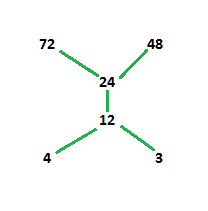 What rule was used to make this hasse diagram?
"Divides evenly into".
1000
In a group, people must find partners who are wearing the same color shirt as they are. Everyone finds a partner and there is no group where two people have different colored shirts. Which property is this a real-life example of?
The reflexive property.
1000
A mathematician compares numbers in a set by whether or not they share common factors. Is this mathematician's rule applicable to a partially ordered set or not? Why?
They are not, because the rule they are using is not transitive.
1000
Do the greatest lower bound and smallest upper bound have to apply to every number in the poset?
Yes.
1000
what was the set used to create this hasse diagram?
{1, 2, 3}.