The Plumbing
Urine for a Real Treat
Pee-pouri
100
The smallest functional unit within your kidney (each of your kidneys contains close to one million of these).
What is a nephron?
100
In a normal, healthy human, urine functions primarily to remove this element from the body.
What is nitrogen?
100
From this list – H2O, red blood cells, NaCl, glucose, and large proteins – these will leave the capillaries in the glomerulus and enter the filtrate in Bowman’s capsule.
What are H2O, NaCl, and glucose?
200
The site of filtration in our kidneys.
What is the glomerulus and/or what is Bowman’s capsule?
200
In the picture below, the letter by the region of the nephron where the osmolarity is the highest.
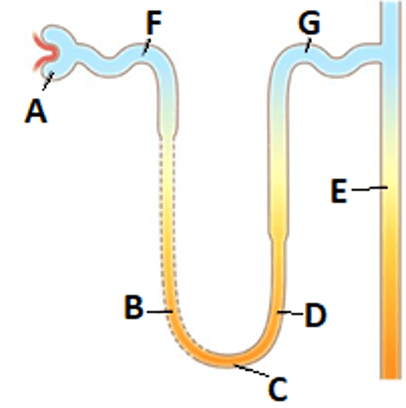
What is C?
200
Where urine is stored, before it leaves the body.
What is the bladder?
300
The place in the kidney where the osmolarity of the interstitial fluid is the highest.
What is the inner medulla?
300
In the picture below, the letter by the region of the nephron where the concentration of water is the lowest.
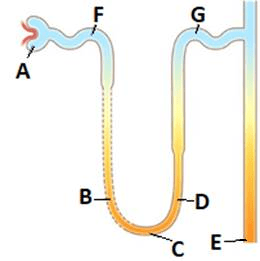
What is a trick question? The water concentration will definitely be lowest at C. It might also be the same at E, depending on how many aquaporins are in the collecting duct. The urine that goes to the bladder might be very dilute or concentrated, depending on what the hypothalamus senses in the blood. But that concentration can never be lower than what you find at the bottom of the loop of Henle, because that’s where the osmolarity is the highest, and water leaves the collecting duct passively.
300
This forces filtrate out of the glomerulus.
What is blood pressure?
400
The transmembrane protein that facilitates water crossing a lipid bilayer.
What is an aquaporin?
400
The high osmolarity of the renal medulla is maintained by all of the following except:
A. diffusion of salt from the lower region of the ascending limb of the loop of Henle.
B. active transport of salt from the upper region of the ascending limb of the loop of Henle.
C. diffusion of salt from the descending limb of the loop of Henle
D. diffusion of urea from the collecting duct.
What is “C. diffusion of salt from the descending limb of the loop of Henle”?
400
Among its many other tasks, this organ detects when the concentration of solutes in your blood is not at homeostasis.
What is the hypothalamus?
500
The place in the kidney where NaCl can diffuse out of the filtrate by passive diffusion. You need to be specific (i.e., the structure AND region in the kidney).
What is the lower portion of the ascending limb of the loop of Henle in the inner medulla?
500
If a person has dysfunctional ADH (anti-diuretic hormone) receptors, meaning their body does not respond to ADH when it is released, they will have this volume (high or low) of this concentration (concentrated or dilute) urine.
What is high volume of dilute urine?
500
The hormone that stimulates production of aquaporins and the organ that releases this hormone.
What is anti-diuretic hormone (ADH) and the posterior pituitary?