Species and Interactions
Body Systems
Nutrient Cycles
Diffusion
Ocean Acidification
100
An organism that makes its own food
What is a producer?
100
This digestive structure increases nutrient absorption by increasing surface area.
What is villi?
100
Organisms that break down organism matter and return nitrogen to the soil
What are decomposers?
100
What process allows for the exchange of gases from a high concentration to a low concentration?
What is diffusion?
100
pH of purified water
What is 7.0?
200
An organism that consumes other living things for energy and nutrients
What is a heterotroph?
200
Nutrients absorbed in the small intestine are transported to cells by this system.
What is the circulatory system?
200
The effect of excess carbon dioxide in the atmosphere
What is global warming?
200
What kind of molecules can diffuse through the cell membrane?
What is small and non-polar?
200
Substances that have a pH greater than 7 is referred to as this
What is basic/alkaline?
300
The organism that consumes secondary consumers
What is a tertiary consumer?
300
What process breaks down large food particles within the body as represented by Figure 1?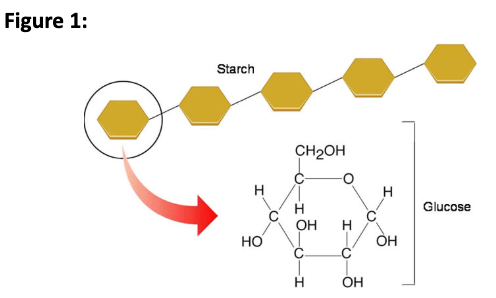
What is digestion?
300
Carbon moves from the atmosphere to the biosphere when phytoplankton perform this process using sunlight.
What is photosynthesis?
300
What will glucose (a carbohydrate) need in order to pass through the cells of the digestive tract?
Protein Channel
300
The effect of excess carbon dioxide in ocean water
What is acidification?
400
A species on which other species in an ecosystem largely depend.
What is a keystone species?
400
After eating a meal, glucose enters the bloodstream. Name the two body systems that must work together to move this glucose from the blood into muscle cells.
What are the circulatory system and endocrine system?
400
To build DNA, plants need carbon, hydrogen, and oxygen from glucose, plus these two elements absorbed from the soil.
What are nitrogen and phosphorus (N and P)?
400
When diffusion stops because the concentration is equal on both sides of a membrane, the system has reached this state.
What is equilibrium (or dynamic equilibrium)?
400
The effect of pH on sea urchins (or other calcium-shelled organisms)
What is shell damage/shell loss?
500
What the latin-based words are for producers and consumers respectively?
What are autotrophs and heterotrophs?
500
How specific structures of the circulatory system, digestive system, and respiratory system work together to absorb and transport materials the cell needs
What is: The digestive system breaks down food into nutrients, the circulatory system transports nutrients and oxygen through the blood, and the respiratory system provides oxygen - all working together to deliver what cells need?
500
Explain the relationship between the chloroplast and mitochondrion based on the diagram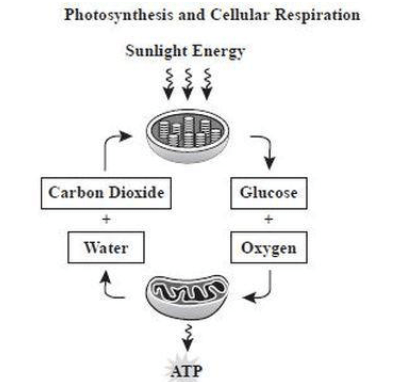 .
.
CHLOROPLASTS PRODUCE GLUCOSE AND OXYGEN THROUGH PHOTOSYNTHESIS WHICH IS USED BY MITOCHONDRIA FOR CELLULAR RESPIRATION. MITOCHONDRIA PRODUCE WATER AND CARBON DIOXIDE WHICH IS USED BY CHLOROPLASTS FOR PHOTOSYNTHESIS.
500
If moving from high to low concentration is called passive transport, what would moving from low to high concentration be called?
What is active transport?
500
What does carbonic (H2CO3) acid dissociate to form in the ocean?
What are H⁺ (hydrogen ions) and HCO₃⁻ (bicarbonate)?