Acyanotic defects I
More Acyanotic defects
MUF/ DHCA
Surgical repairs
More surgical repairs
Cyanotic defects
More anatomy and physiology
Misc
100
This defect is a "flap valve patency" at the fossa ovale maintained after birth
PFO (patent foramen ovale)
100
This defect describes when the heart position is abnormal; it is located on the right side of the chest, with the apex pointing right instead of left
Dextrocardia
100
What are two things that are removed with MUF?
Plasma free water
Inflammatory mediators
(potentially as well, potassium, free hemoglobin)
100
This procedure, not typically requiring bypass, restricts flow into the pulmonary circulation when a patient is too small for a full repair of their defect.
PA Band(ing)
100
Which shunt provides the most direct communication from the aorta to the pulmonary trunk?
Central shunt
100
When a TAPVR has siginificant narrowing or blockage along the abnormal drainage pathway, what is it known as?
"Obstructed" (versus unobstructed)
100
What pieces of anatomy, specifically, do the coronary arteries usually arise from?
Left and right sinuses of valsalva
100
What does ALCAPA stand for?
Anomalous coronary arising from the pulmonary artery
200
When the organs, including the heart, are abnormal and mixed, this condition is called ____________.
Heterotaxy
200
This condition is when all organs, including the heart, are mirror imaged.
Situs inversus
200
Edema is suggested when the fluid balance for a case is ____________. It is likely that a patient is "dry" if their fluid balance is ____________.
Edema; positive
Dry; negative
200
What is the difference between a classic BTS and a modified BTS?
Classic BTS is a direct connection of the subclavian to the PA, whereas mBTS uses a synthetic tube graft to preserve blood flow to the arm
200
What pathophysiology does a unifocalization address?
MAPCAs
200
This defect is a result of defective endocardial cushion development, resulting in mixing between all four valves
AV Canal (AVC)
Atrioventricular Canal defect
Atrioventricular septal defect (AVSD)
200
What does PA/IVS stand for?
Pulmonary atresia with intact ventricular septum
200
This genetic condition is most commonly associated with AVC/ AVSD, and all children with this condition receive an echo at birth.
Trisomy 21
300
This condition is a congenital communication between the ascending aorta and the pulmonary trunk
Aortopulmonary (AP) window
300
This defect forms when the left anterior cardinal vein fails to regress, resulting in a usually asymptomatic vessel.
LSVC (Left superior vena cava)
300
What is the benefit to a lower HCT before DHCA?
What is the benefit to higher HCT before DHCA?
Less sludging
vs.
Superior oxygen content capability
300
When an ASD/ VSD/ PFO is small enough to be closed with just suturing, the repair is referred to as a ______________________. When it is larger, typically it requires a _____________________.
Primary closure
Patch closure
300
What is the typical order of HLHS procedure pallation?
First: Norwood/ shunt
Second: BDG and shunt t/d
Third: Fontan
300
What defect is this?
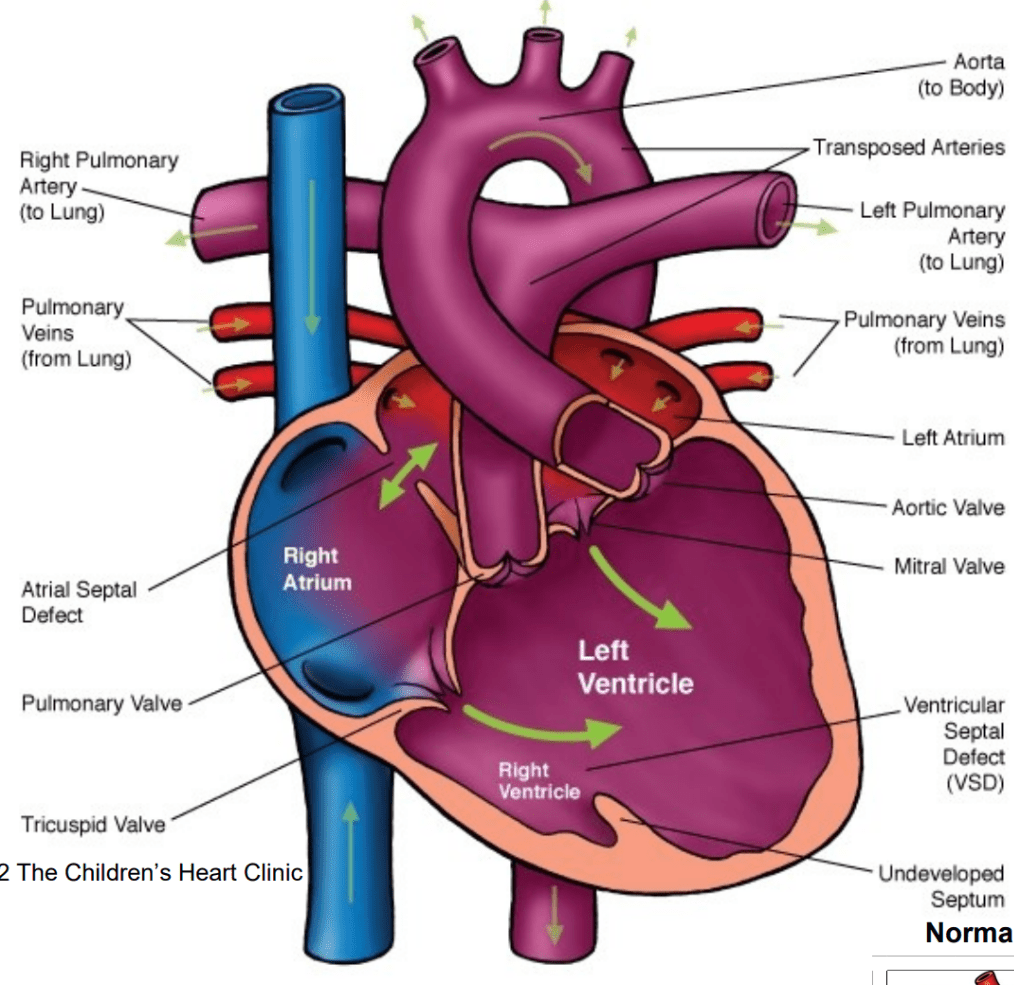
DILV (Double inlet left ventricle)
300
This congenital defect involves the pulmonary veins draining into the IVC, usually impeding into the right lung
Scimitar Syndrome-- PAPVR
300
This defect is present in 80% of patients with Noonan Syndrome
Pulmonary stenosis
400
This often asymptomatic condition describes when the aorta develops posteriorly, instead of anteriorly, to the trachea and esophagus
Right aortic arch (RAA)
400
What is the condition of a fibrous ring that would restrict blood flow out of the left ventricle?
Subaortic membrane
400
When we utilize pH stat for cooling, we are increasing the blood flow to the brain by increasing ______________ AKA being in a _______________ state.
CO2; hypercarbic
400
What is the temporary shunt that is aorta to aorta, bypassing an interruption?
Gott shunt
400
A Rastelli procedure is the less common option to correct the condition of _______________ by using two grafts.
d-TGA
400
What does TOF stand for, and what are the four components?
Tetralogy of Fallot
1. Ventricular septal defect
2. Overriding aorta
3. Pulmonary stenosis/ RVOT obstruction
5. RV hypertrophy
400
This disease, typically following untreated strep throat, is one of the causes for valvular stenosis. It is the leading cause of acquired heart disease in children worldwide.
Rheumatic heart disease (Following rheumatic fever)
400
Which condition, associated with the CHD7 gene, affects the heart, eyes, nasal passages, hearing, and genitals?
CHARGE
500
What congenital defect is shown below?
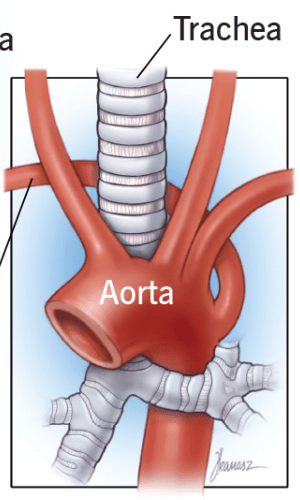
Aberrant right subclavian artery
500
What are the four types of VSDs, depending on location?
1. Perimembranous
2. Muscular
3. Inlet
4. Outlet/ Supracristal
500
When we dilute albumin in the circulating blood volume, which way does fluid shift? (There is a very specific word that is most correct for this answer)
Extravascularly
500
What are the four main components of a Norwood procedure?
Atrial septectomy
DKS (takedown/ reconnection of the PA)
Arch augmentation
Shunt
500
This procedure does not typically require cardioplegia/ cross clamping, and it redirects blood return from the upper body to the pulmonary circulation
Bidirectional glenn
500
This defect occurs as a result of a failed aorticopulmonary septal spiral and results in two parallel blood flow circuits.
Transposition of the great arteries (TGA)
500
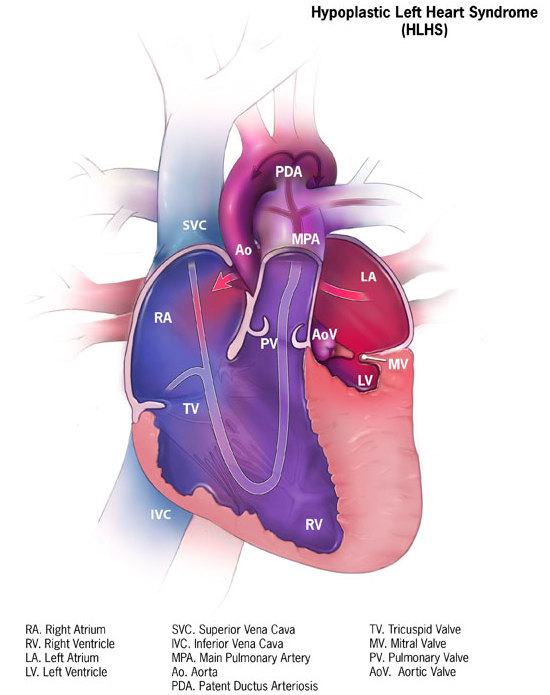
What are four features of HLHS?
Hypoplastic left ventricle
Hypoplastic aorta (arch and/or ascending)
Aortic valve abnormality (usually atresia, sometimes stenosis)
Mitral valve abnormality (usually atresia, sometimes stenosis)
PDA
Intra-atrial communication (ASD or PFO)
500
Which collection of defects includes diaphragm defects and pericardial defects that result in Ectopic Cordis?
Pentalogy of Cantrell
600
What is the most common ASD, and the most common VSD?
ASD: Ostium secundum
VSD: Perimembranous
600
This defect includes a malformed and apically displaced tricuspid valve, enlarging the RA and atrializing the RV
Ebstein's Anomaly
600
CMR is reduced to approximately what percent of baseline when at 18C?
~20%
600
Which shunt would be chosen to minimize diastolic runoff?
Sano shunt
600
This defect, usually repaired without bypass through a left thoracotomy, compromises blood flow to the kidneys and lower body.
Coarctation of the aorta
600
What is this defect?
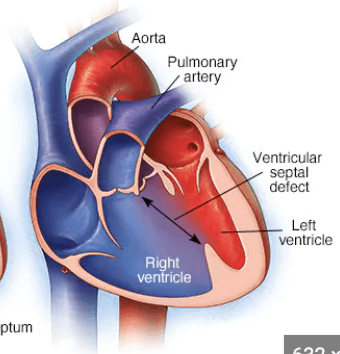
DORV (Double outlet right ventricle)
600
What is the pediatric illness that causes systemic vasculitis and, without treatment, can result in coronary aneurysms?
Kawasaki Syndrome
600
Which genetic syndrome involves vascular abnormalities, and also persistent hypocalcemia?
DiGeorge Syndrome
700
What are the four types of ASDs, which are dependent on where the defect is located?
1. Ostium secundum
2. Ostium primum
3. Sinus venosus
4. Coronary sinus
700
What type of interrupted aortic arch wound compromise blood flow to the left side of the brain (hopefully they have an intact circle of Willis!) as well as the left limb and distal aorta?
Type C
700
Once the team decides that we will be doing MUF, what are your next steps in preparation?
-Change the cardioplegia H/C to warm
-Set the CPG circuit to blood only (clamp Del Nido, unclamp bridge)
-Reimplant the hemoconcentrator onto the CPG stopcocks, clamping between
-Flush out the remaining Del Nido out of the circuit
(also: make sure that the field has the MUF adapter to connect the CPG line to the venous cannula)
700
When a durable repair of a stenotic aortic valve is not possible, what is the gold standard treatment, and what does it entail?
Ross procedure; patient's aortic valve is replaced with their own healthy pulmonary graft, and typically a homograft placed in the pulmonary position.
700
The Konno procedure _________________ for the.....?
Enlarges the Aortic annulus, Subaortic region, and LVOT
700
Other than "mixed", what are the three types of TAPVR?
Supracardiac
Cardiac
Infracardiac
700
What are the four defects associated with Shone's Complex/ Syndrome?
1. Supravalvar mitral ring
2. Parachute mitral valve
3. Subaortic stenosis
4. Coarctation of the aorta
700
A long-term excess of left-to-right shunting can result in which condition, caused by a backup from pulmonary hypertension?
Eisenmenger's Syndrome
800
What does MAPCA stand for, and what does it entail?
Major Aortopulmonary Collateral Arteries
Abnormal blood vessels providing blood flow to the lungs/ pulmonary circulation off of the aorta
800
A membrane division of the left atrium is called _______________
A membrane division of the right atrium is called _______________
Left atrium: Cor triatriatum sinister
Right atrium: Cor triatriatum dexter
800
We begin MUF; what are three limiting factors that dictate the extent/quality of our MUF?
How much volume we have left in the circuit at the end of CPB/ when we run out
Patient hemodynamics (less tolerant, slower and gentler MUF)
Patient bleeding (too much bleeding will end the MUF early)
Speed of the CPG pump (faster = more MUF faster)
Transmembrane pressure of the hemoconcentrator
800
When does an LSVC merit surgical repair/ intervention?
When it drains into the left atrium (creating a cyanotic defect) rather than the right atrium
800
A mustard procedures uses _____________ to fix ______________
A Senning procedure uses ______________ to fix ______________
Mustard; pericardium or synthetic material
Senning; patient's own atrial tissue
Both are historic ways of repairing TGA
800
This defect results in no communication between the right atrium and right ventricle, meaning that blood mixes, then shunts across an ASD and then a VSD to make it to the pulmonary circulation
Tricuspid Atresia
800
This defect involves a failure of the right semilunar valve to form, and requires a ventricular communication to allow blood to eventually perfuse the pulmonary circulation through a PDA
Pulmonary atresia with VSD
800
What is the shunt fraction for the following patient, and is this a significant shunt?
PV saturation: 100%
PA saturation: 80%
Arterial saturation: 97%
Venous saturation: 76%
1.05: 1, not significant
Qp = (Arterial saturation - Venous saturation)
Qs. (PV sat - PA sat)900
Is a double aortic arch cyanotic, and how can it cause problems?
Not cyanotic; it encircles and compresses the trachea and esophagus
900
What do Lam subtypes describe?
The location of defect for the blood flow in the case of an obstructed left atrium
900
At what point during a DHCA case (e.g. ach augmentation) would you expect to see the lowest flank NIRS? When would you expect to see the highest head NIRS?
Lowest flank: At the latest moment of DHCA before reperfusion begins
Highest hear: Immediately before DHCA starts, when most cold and most luxury perfusion
900
What does an "unroofed coronary sinus" mean?
When the coronary sinus is missing the wall ("roof), and that oxygen poor blood then drains into the left atrium (when it would otherwise go to the right atrium)

900
An HLHS patient (prior Norwood/ mBTS) comes in for the next stage of their pallation. TEE shows an LSVC. Not including the "redo sternotomy", what two components will this surgery entail? (be specific!)
Bilateral bidirectional Glenn
mBTS takedown
900
What are the two types of TGAs, and what is the difference between the two?
d-TGA: great vessels are only switched; RV pumps to aorta; urgent
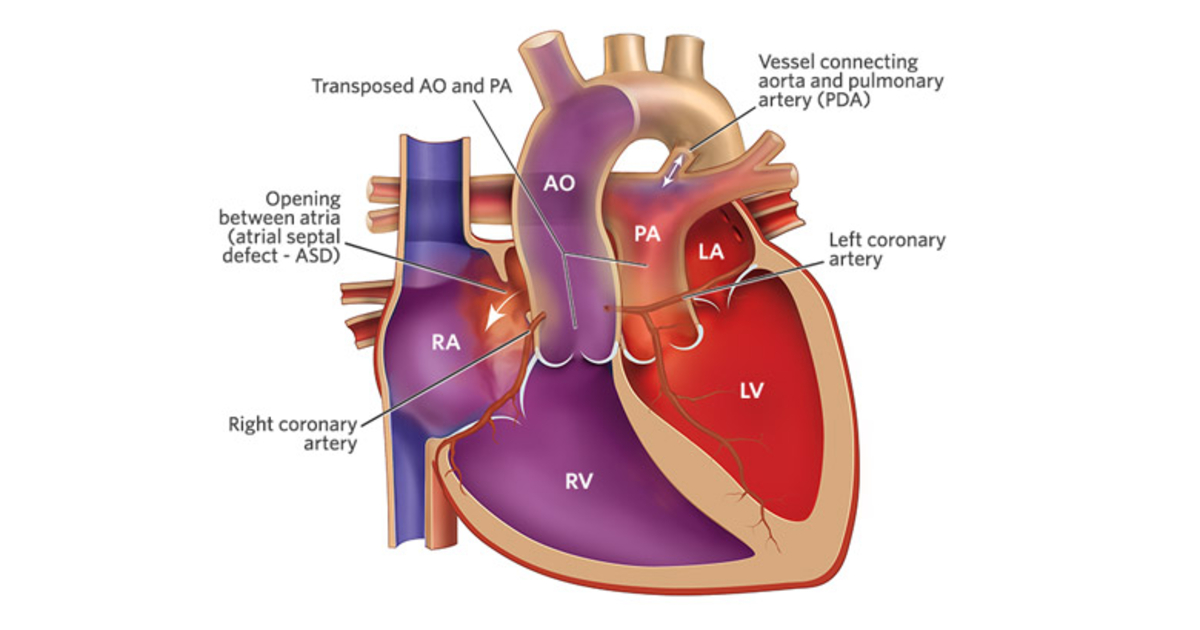
l-TGA or ccTGA: both vessels and ventricles are switched; stronger ventricle pumps to lungs and weaker ventricle pumps to body

900
What is meant by "Fontan failure"? What does it result in?
Progressive and long-term failure in a patient with Fontan physiology, persistent high venous pressure causes congestion, eventual heart failure and multi-organ dysfunction
900
What are two differences between the TAH and the Berlin heart?
The total artificial heart involves a cardiectomy; the heart stays in place with Berlin
The total artificial heart can only support BOTH ventricles; Berlin can be one or the other or both
The total artificial heart has zero potential for BTR; Berlin has potential
The total artificial heart is complete cardiac output replacement; Berlin is an assist