Chest Wall Deformities
Congenital Diaphragmatic Hernia (CDH)
Esophageal Atresia/ Tracheoesoph Fistula (EA/TEF)
EA/TEF: Operative
The Name Game
Final Jeopardy
100
This procedure uses a substernal bar to correct pectus excavatum
What is the Nuss procedure?
100
In left-sided CDH, presence of this organ in the thorax predicts worse outcomes
What is the liver?
100
These anomalies make up the VACTERL association.
What are vertebral, cardiac, tracheoesophageal, renal, and limb defects?
100
This is the initial operation for long-gap esophageal atresia.
What is gastrostomy tube placement?
100
This CDH is typically located posterolateral and on the left.
What is Bochdalek hernia?
100
During mobilizing the esophagus from the trachea in an H type TEF, this is the most commonly injured structure.
What is the recurrent laryngeal nerve?
200
This is the first-line treatment for pectus carinatum
What is external bracing?
200
These two processes drive early pathophysiology in CDH.
What are pulmonary hypoplasia and pulmonary hypertension?
200
A “double bubble” sign on X-ray suggests this congenital anomaly.
What is duodenal atresia?
200
This is the typical surgical approach for repair of Type C EA/TEF.
What is right thoracotomy or thoracoscopy?
200
This CDH occurs anteriorly near the sternum.
What is Morgagni hernia?
300
The 4 major complications of the Nuss procedure (Name 3)
What is Cardiac/pericardial injury, bar migration/displacement, bar infection/reaction, pneumothorax/hemothorax?
300
This ventilation strategy uses very small tidal volumes at high frequency to minimize lung injury.
What is high-frequency oscillatory ventilation (HFOV)?
300
This is the most common type of EA/TEF (describe the anatomy).
What is Type C: proximal esophageal atresia with distal TEF?
300
This vein is commonly ligated during repair of Type C EA/TEF.
What is the azygos vein?
300
This syndrome is characterized by hypoplasia of the pectoralis major muscle, ipsilateral hand/upper limb anomalies
What is Poland syndrome?
400
A 2-week-old presents with a midline sternal defect and a pulsatile mass covered by thin skin. This is the management.
What is early surgical repair?
400
These are the four CDH defect stages from smallest to largest.
What are A, B, C, and D?
400
A neonate with esophageal atresia and no bowel gas on X-ray most likely has this type.
What is Type A (pure esophageal atresia without TEF)?
400
If primary repair of esophageal atresia is not possible, this reconstruction strategy is used.
What is a tissue conduit (e.g. stomach, colon, small intestine)?
400
This open surgical procedure for pectus carinatum involves resection of abnormal costal cartilage with sternal osteotomy to reposition the sternum.
What is the Ravitch procedure?
500
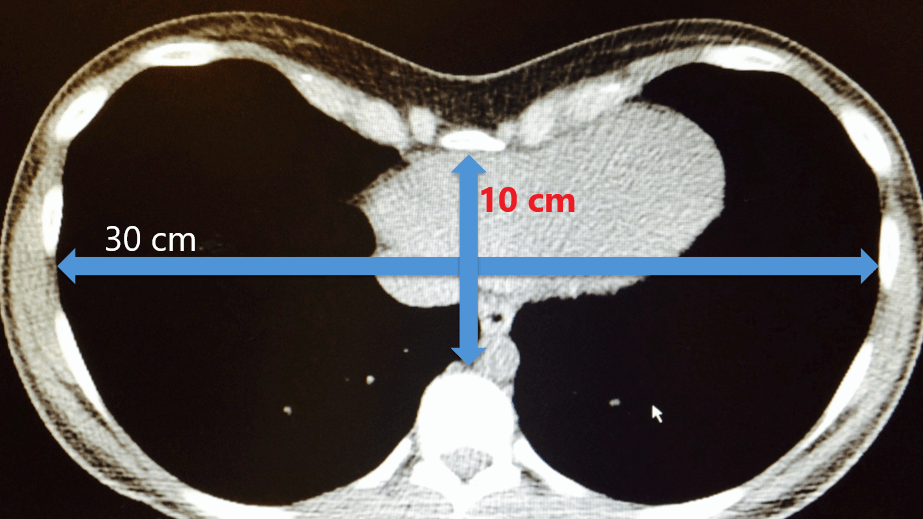 Calculate the Haller Index
What is 3?
500
These CDH defect types are typically amenable to primary repair.
What are A (<25% absent) and B (20-50% absent)?
500
Long-gap esophageal atresia is defined as a gap greater than 2 of these.
What are vertebral bodies?
500
Neonates with EA/TEF can undergo early repair except for these 3 contraindications (name 2)
What are low birth weight, long-gap EA, or instability (e.g., cardiac anomaly)?
500
This esophageal lengthening procedure uses a flap of dilated proximal esophagus to bridge a long gap EA.
What is a Bianchi flap?