Environmental Cleaning
Sterilization Process
Sterile Technique
Patient Safety
Wound Closure & Healing
100
What products are used to clean the operating room?
An Environmental Protection Agency (EPA) registered, facility approved cleaning agent.
100
What is Biofilm?
The accumulation of bioburden which is composed of bacteria and other biological elements.
Result of tight adhesion of bioburden to the instrument's surface.
Prevents successful sterilization.
100
Name the single most effective measure to prevent the transmission of pathogenic microorganisms.
Hand hygiene
100
List the 3 zones in the perioperative environment and what attire is appropriate in each zone.
Unrestricted zone: street clothes
Semi-restricted zone: surgical attire, hair cover, facility approved shoes
Restricted zone: surgical attire, head cover, facility approved shoes, and mask
100
What type of suturing technique is this?

Running Suture, Continuous Suture
200
How do you clean the perioperative environment?
-Top to bottom
-Less soiled areas to dirtiest areas
200
What is the maximum weight limit for an instrument set?
25 lbs
200
How often should the scrub personnel change their sterile gloves?
Every 90 - 150 minutes
Additional considerations for changing gloves:
When a visible or suspected perforation occurs
After touching a helmet hood or visor
After contact with methyl methacrylate
200
What standardized surgical safety checklist should be followed in the surgical setting to prevent wrong patient, wrong site, wrong procedure events?
Universal protocol/Timeout
200
What type of suturing technique is this?
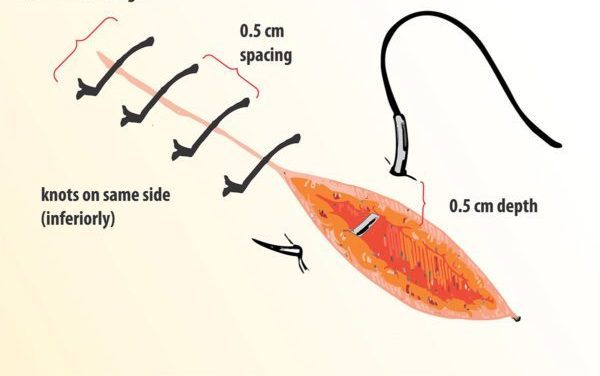
Interrupted suture
300
When should trash, equipment, and contaminated linen be removed from the operating room?
After the patient leaves the OR suite.
300
Water temperature is a critical component in the cleaning of equipment. Should water temperature be hot or cool when cleaning instruments? Why?
Cool.
Cool water prevents blood coagulation on instruments and helps to remove gross soil from instrument crevices, joints, and lumens.
Hot water can denature blood proteins which make blood removal more difficult
300
Sterile instrumentations' shelf life is ___________- related.
List factors that impact shelf life for sterile items.
Event
Factors:
- packaging material quality
- storage conditions
- how an item is transported
- number of times the item was handled
- moisture
300
Who is responsible for marking the patient's surgical site?
Surgeon or Licensed Independent Practitioner performing the procedure.
300
List and describe the 3 types of wound healing mechanisms (intentions)
Primary intention: clean, approximated incision is closed with suture or other appropriate product.
Secondary intention: wound heals by granulation, leading to wound contracture
Tertiary intetion/Delayed wound healing: delayed wound closure due to considerable tissue loss and/or gross infection
400
What level of transmissions-based precautions should be used when handling trash, linens, or other items contaminated with blood, body fluids, and other infectious materials?
Standard precautions
400
What does IUSS stand for?
What are critical components of running items through an IUSS cycle?
Immediate Use Steam Sterilization.
- Must follow the same cleaning and decontamination processes in SPD
- a FDA approved rigid, enclosed sterilization container must be used
- Items processed by IUSS must be used immediately and not stored for future procedures
- A biological indicator is run with any implant load
400
Where is a sterile gown considered sterile?
From the chest to the level of the sterile field and 2 inches above the elbow to the proximal edge of the cuff.
400
What fall prevention practices are utilized in the operating room?
- Never leave a patient unattended
- Place the safety strap 2 inches above the patient's knees
- Lock the stretcher prior to moving the patient
400
What is the purpose of drain placement?
Name a simple drain.
Name a closed suction drain.
Drains provide an exit for blood, serum, bile, air, secretions, and pus. Drains also create a portal of entry for pathogenic microorganisms.
Simple drain: penrose, red rubber
Closed suction: Hemovac, Jackson-Pratt, chest tube
500
When does the following cleaning occur?
- Damp dusting
- Turn over cleaning
- Terminal cleaning
- Scheduled cleaning
- Enhanced cleaning
- Damp dusting: before first procedure of the day, damp dust all horizontal surfaces
- Turn over cleaning: occurs after a patient exits an operating room and before the next set-up begins
- Terminal cleaning: at the end of each day that the procedure room is used
- Scheduled cleaning: on periodic, routine basis (equipment, appliances, air-handling systems, closets)
- Enhanced cleaning: after patients who are suspected or diagnosed with a transmissible disease leaves the OR
500
Should a Biological Indicator (BI) produce a positive or a negative test after being processed with an instrument load?
Negative.
BIs are used to monitor the sterilizer's efficiency and effectiveness. This test demonstrates whether the sterilization conditions were adequate to kill the non-pathogenic spore housed within the BI. A negative BI indicates that the sterilization conditions were met.
A positive BI result is immediately reported, the sterilizer is not used, items processed in the same sterilizer are recalled, and reprocessed based on the last negative BI test. Further testing is done before the sterilizer is cleared for use.
500
What traffic rule must the scrub person observe when changing positions with another scrubbed person?
Move either face-to-face or back-to-back
500
The 1999 report To Err is Human: Building a Safer Health System, started a cultural shift within health care. The cultural shift resulted in addressing mistakes as systems issues. What was the prior cultural model focus when a mistake occurred in healthcare?
Individual blame
500
What is the purpose of negative-pressure wound therapy (NPWT) or Vacuum-Assisted Closure (VAC)?
List 3 components of NPWT and VAC
Applies constant, controlled, negative pressure to a wound into which a drainage sponge has been placed.
3 Components:
1. Mechanical tension on tissues causes fluid removal (reduces edema, decreases bacterial load)
2. Macrodeformation (wound contracture)
3. Microdeformation (Microscopic interaction between wound tissue and dressing)