Personal Experiences and Political Events
Religion/
Ideology
Ideology
Gender Roles
Marji's
Iran
Iran
Panel Analysis
Heroism
100
This 1979 revolution overthrew the Shah and dramatically changed life in Iran during Marji's childhood.
Islamic Revolution
100
At the beginning of the story, Marji believes she will grow up to become this religious leader who help people.
Prophet
100
After the revolution, Iranian schools are separated based on this characteristic.
Gender
100
How does Marji challenge stereotypes about Iranian people?
Through her childhood story, she shows that people in Iran are ordinary individuals with families, humor, and everyday lives. It isn't just what is shown in the news.
100
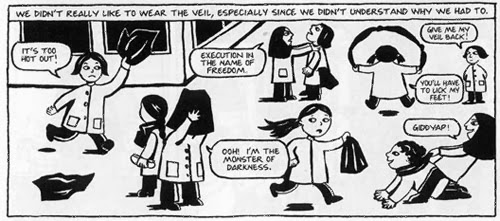
What does this image reveal about the girls?
She is showing that girls are still independent individuals and not powerless victims.
100
As a young child, Marji believes heroes are people who have suffered in this way for their political beliefs.
Being Imprisoned (Political Prisoners)
200
After the revolution, Marji and her classmates suddenly had to wear this item to school.
Veils/Hijab
200
Marji's parents explain this political system to her, describing a society where social classes are equal.
Communism
200
Women must wear this garment in public as part of the new Islamic laws.
Veil
200
By showing parties, music, and family conversations, Satrapi highlights that many Iranians value this basic human desire.
Freedom of Personal Expression
200
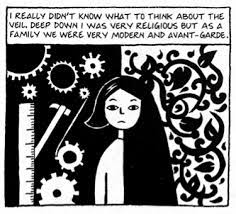
How does this panel characterize Marji?
This panel reveals how Marji is torn between her religious identity and her more modern outlook on the lifestyle (mentions of identity)
200
Marji idolizes this relative who spent years in prison for his political beliefs.
Uncle Anoosh
300
This war between Iran and a neighboring country begins during Marji's childhood and leads to bombings and shortages.
Iran-Iraq War
300
Marji imagines a friendly relationship with this religious figure, often talking to him before she loses faith.
God
300
Marji's mother becomes frightened after her photograph appears in the newspaper protesting against this new law.
Law Requiring Women to Wear the Veil
300
The story emphasizes that the actions of this group in power should not define the entire population of Iran
Government or Political Regime
300
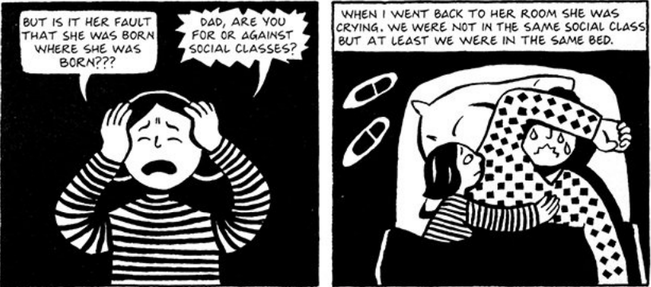
Why are Marji and Mehri upset beyond the fact that Mehri and the neighbor boy broke up?
The impact of social classes on Marji's and Mehri's lives and how betrayed they felt by both the government and Marji's parents
300
Initially Marji believes her father was not as heroic as Uncle Anoosh and Laly's father for these reasons.
Not Imprisoned or Killed for Political Beliefs
400
Marji learns the harsh reality of the war when a missile hits the home of this Jewish family.
Baba-Levy family
400
After this beloved relative is executed as a political prisoner, Marji becomes angry with God and loses her faith.
Uncle Anoosh
400
These officials stop people on the street to enforce rules about clothing and behavior.
Guardians of the Revolution (religious police)
400
Through Marji's experiences during war and revolution, the book shows the emotional cost these events have on this group of people.
Ordinary Civilians or Families
400
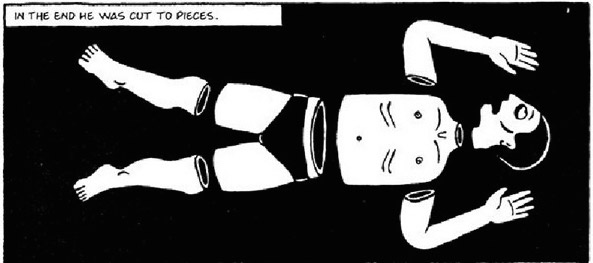 What does the way the body is drawn reveal? Must make specific references to the image
Childlike perception of violence because of how the body looks hollow, like a mannequin, no blood, etc
400
These two political prisoners were released after the revolution.
Siamak Jari and Moshen Shakiba
500
Before being sent to war, poor boys are given these objects that supposedly open the gates of heaven if they die.
Plastic Keys to Paradise
500
The government encourages boys to die in war using this religious idea that dying for the country guarantees entry to heaven.
Martyrdom
500
Marji's parents send her abroad partly because they fear these authorities may punish her rebellious behavior.
Islamic Authorities/Revolutionary Guards
500
By telling her own childhood story, Satrapi uses personal narrative to give readers a deeper understanding of Iran.
Human/Personal Perspective on History
500
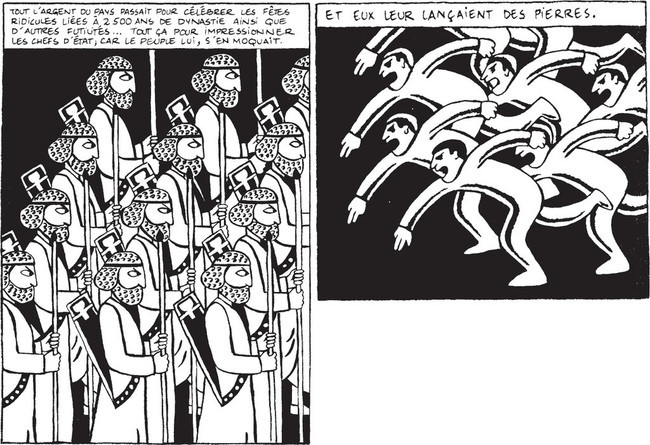 Describe these panels. What's happening in them? What's the context?
The history of Iran as constantly being in a state of endless invasions and how it affects them currently
500
Marji's parents eventually decide to send her away to Austria for this reason. (give one example)
Becoming More Rebellious and Outspoken