Abbrev.
Healthcare Lingo
Taken PO
Poke & Deliver
Look, Listen, Sniff
Breathe In, Breathe Out
100
cap
What is a capsule?
100
-plasty
What is the repair of?
100
2 different oral solids other than tablets
Gummies, capltes, capsules.
100
This stands for TPN
What is total parenteral nutrition?
100
2 different types of eye dosage forms
solutions, suspensions, eye inserts, ointments
100
2 disadvantages of inhalers
A common problem is overuse of the bronchodilator agent and
underuse of the steroid agent.
• Patient education is required in understanding the function and
mechanism of action of each of their medications.
• Sometimes difficult to determine whether the canister is empty
• Requires hand-lung coordination.
• Difficult for some elderly patients or patients with arthritis to depress MDI
200
IV
What is intravenous?
200
Cuti
What is the skin?
200
2 advantages of oral liquids
...
200
2 different sites where TPN can be administered
Central (upper right of chest) or PICC (in the arm)
200
2 different types of nasal dosage forms
solution, suspension, gel/jelly
200
2 advantages of inhalers
amount of drug provided can be controlled with metered valves.
• Administration is very simple and “clean” — no solutions to be
measured or nebulizers to be washed. Opaque, sealed containers provide
protection for the drug from light, oxygen and moisture and also maintain the
sterility of the product.
• Particle size can be controlled and made relatively uniform for increased
effectiveness of the drug.
Pre measured dose
300
q3h
What is every three hours?
300
Radiography
What is the record of x ray/radiation
300
5 different types of tablets
chewable, ec, SR, LA, compressed, multi compressed, etc....
300
A terminal method used after the drug has been sealed in its final container. This method uses steam/water and heat.
What is the Steam sterilization method?
300
When instilling ear drops in a 2-year-old child this is the way we move the ear
Gently pull the ear lobe down and back to straighten the ear canal.
300
3 different dosage forms of inhalers
MDI, BAI. DPI, Nebulizers, Respimat
400
os
What is left eye?
400
Antipyretic
What is against fever?
400
3 advantages of oral liquids
An easy, pleasant route. The patient can administer their own dose.
• Liquid is generally easy to administer to a child.
• Administration is neither painful (injections) nor embarrassing (rectal).
Easier to swallow, especially for children and elderly
• Permit more flexible dosage
• Drugs are usually absorbed faster since it is already in solution or in finely
divided particles; there is no disintegration step involved.
• It is easier to compound liquids than solids (capsules or powders)
400
This dosage form must never be given IV
What is a suspension?
400
2 types of dosage forms for ears
solutions and suspensions
400
What is the difference between a metered dose inhaler and a breath activated inhaler? Can a spacer be used with either of them? If so, which one or both?
MDI uses propellant
BAI uses patients own force of inhalation no propellant
Spacer only used with MDI
500
SR
What is slow release?
500
Gastroenteritis
What is inflammation of the stomach and small intestine?
500
3 disadvantages of oral solids
The therapeutic action of the drug may be inconsistent and
unpredictable.
• Onset of action is slow compared to injectable.
• Some drugs are destroyed by acids/enzymes in the GI tract.
• Cannot be used when the patient is unconscious or nauseous
May be large and difficult to swallow. Limited or no dosage flexibility,
may not be able to be split.
500
3 different types of sterilization techniques
What is autoclave, dry heat, gas heat, radiation, and/or filtration
500
4 uses of nasal preparations
- Allergy sprays
- Decongestants
- Moisturizer
- Systemic therapy
500
3 critical factors required to maximize inhalation therapy.
- Drug must be delivered to site of action.
- Particle size.
- Proper technique.
600
mEq
What is milliequivalent?
600
Postprandial
What is after meal?
600
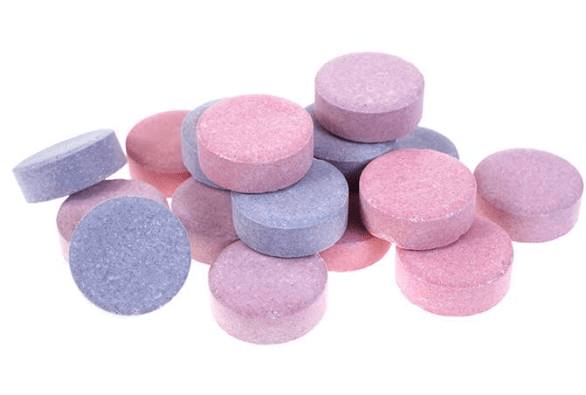
This is this type of tablet
What is a chewable tablet
600
4 different types of parenteral injection routes and their definitions
- Intradermal - into the top layer of the skin at a slight angle
- Subcutaneous - into the subcutaneous tissue of the skin using a 3/8 inch to 1 inch needle
- Intravenous - into a vein
- Intramuscular - into muscle tissue using one to one and a half inch needle
600
Nasal congestion and the action of decongestants explained. (How do they work)
Normal nasal lining contains mucous. Due to irritation or infection the blood vessels in the nasal lining swell causing an abundance of mucous to be produced. The presence of extra mucous causes more mucous to be produced thus creating congestion.
Decongestants act on the sympathomimetic system of the Autonomic nervous system, creating the “fight or flight syndrome”. This creates vasoconstriction, therefore reducing the irritation, inflammation and mucous, thus relieving the congestion.
600
This is the order that inhalers should be used
Beta-agonist bronchodilator (salbutamol, terbutaline) — opens up
airways for other medication
2. Anticholinergic bronchodilators (ipratropium)
3. Steroid (beclomethasone, budesonide) — instruct patient to gargle or
drink water after use to prevent fungal infections (thrush) of the mouth.
4. Any other inhalers such as anti-allergy