Phases of the Moon
Eclipses
Seasons
Tides
Lucky Dip
100
How many days are there in a lunar cycle or lunar month?
29.5 days approximately.
100
What does eclipse mean in science?
Eclipse means the total or partial blocking/obscuring of one celestial body by another.
100
What does rotation mean in Space Science?
Rotation is when an object spins on its own axis or centre.
100
The 'lump' of water created by the gravitational pull of the moon and sun on the Earth's water is called -
Tidal bulge
100
If it is Spring in the Northern Hemisphere, what season is it in the Southern Hemisphere?
It is Autumn
200
Can you list the moon phases starting with the new moon?
New Moon, Waxing Crescent, First Quarter, Waxing Gibbous, Full Moon, Waning Gibbous, 3rd or Last Quarter, Waning Crescent.
200
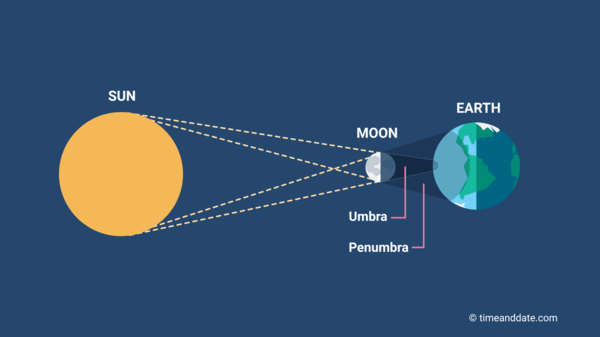
Identify the shadows created during an eclipse.
The penumbra is the lighter outer shadow, and the umbra is the central darker shadow.
200
The Earth ________ around the Sun every ________ days.
a) revolves b) 365 1/4
200
How many high tides and low tides occur each day?
2 of each
200
What color is the number 9?
pink
300
The term _________refers to the phases of the moon between New and Full Moon and is gradually more of the lit surface becomes visible. __________ is the opposite, as the Moon moves from behind the Earth back towards the sun, and less of the lit side is visible as it goes through the phases.
waxing, waning
300
Describe the three celestial bodies involved in a Lunar eclipse and how it occurs.
The sun, the Earth and the Moon need to align during a Lunar eclipse in that order, so that the Earth can block the sun's rays from reaching the Moon creating the eclipse.
300
Identify the different seasons that are commonly recognised on Earth.
There are 4 recognised seasons on Earth, being Summer, Autumn (or Fall in the US), Winter and Spring. In the Southern Hemisphere these occur opposite to the Northern Hemisphere, for example Summer in the South is when Winter happens in the North.
300
Describe how moon phases create Spring Tides.
When the moon phase aligned the Moon with the Sun and Earth in a straight line, either during New or Full Moon, the gravitational pull on the Earth's water is increased resulting in higher high tides and lower low tides.
300
Identify the approximate angle of tilt of the Earth and Moon on their individual axis.
Earth = 23.5 degrees Moon = 5 degrees
400
Explain why only one side of the Moon is visible from Earth.
Only one side of the Moon is visible from Earth because the Moon rotates on its axis at the same rate that the Moon orbits the Earth.
400
Draw a diagram of a Solar eclipse.
400
Explain the two factors that cause the different seasons on Earth.
Earth's tilt on its axis and the revolution of Earth around the sun cause the seasons. As the Earth travels in a loop around the Sun each year it is tilted on its axis. Summer happens in the hemisphere tilted towards the Sun, and winter happens in the hemisphere tilted away from the Sun. As the Earth travels around the Sun, the hemisphere that is tilted towards or away from the Sun changes.
400
_______Tides are caused by the Sun and Moon being at right angles (perpendicular) to the Earth, during first and last quarter moon phases. This means the Moon and Sun's gravitational pulls are working against each other, resulting in lower than normal high tides and higher than normal low tides.
Neap
400
The revolution and rotation of the moon are in sync. What impact does this have on our view of the moon?
We can only see one side from Earth.
500
Both a New moon and a Full moon occur when aligned with the sun and Earth. However the ________ moon occurs when the Moon is between the sun and Earth, and only the side in shadow is visible. Whereas the _______ moon occurs when the Moon is directly behind the Earth and is the side visible if fully lit by the sun's rays.
New, Full
500
Explain why a total solar eclipse is not experienced every month or everywhere.
For a total solar eclipse to occur there has to be perfect alignment of the sun, Moon and Earth. Due to imperfect paths and tilts this is rare. Also, the Moon appears to move in front of the Sun during a solar eclipse, the shadow cast by the Moon is much smaller than Earth. A total solar eclipse creates an almost pinpointed umbral shadow moving across the Earth's surface, called the 'Path of Totality'. Solar eclipses are therefore only visible from within that narrow path across the Earth, and this does not always fall on land or inhabited areas.
500
Explain why the seasons are more extreme the further you more away from the equator.
At the equator there are no significant difference in the seasons because each day the Sun strikes at about the same angle. Every day of the year the equator receives about 12 hours of sunlight. The poles remain cool because they are never tilted in a direct path of sunlight. Much light is scattered by the atmosphere before reaching the Earth surface at the poles. During midwinter, when a pole is tilted away from the Sun, there is no daylight at all. The areas between the equator and each pole will vary in seasonal change depending on location.
500
Predict the approximate time with am/pm and height (in metres) of the next high tide using the chart and graph below - 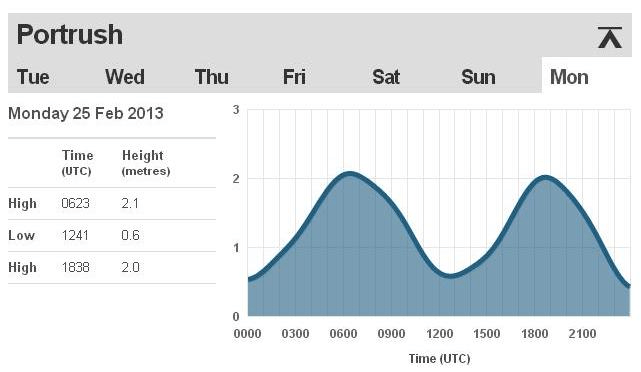
The next high tide would be expected in approximately 12 hours, so at 0600 on Tuesday at 21 meters
500
Predict what will happen to tides if the Moon continues to move away from the Earth.
Earth’s oceans would have much smaller tides - about one-third the size of what they are now, as only caused by Sun's gravitational pull.