Phonological
Rules
Rules
What is the phoneme?
The suffix "-able" selects for this type of word, and turns it into an adjective in the case of "enjoyable".
What is a verb?
It's the interpretation of this structure. 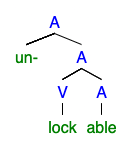
What is 'not lockable'?
Given the environments below, this one is where we we determine that [t] is an allophone of /s/.
s: a_p, p__o, e__#
t: #___e, #___a, #___o
What is word initial position?
I [saw John at the store] and Mary [did so] too is this type of constituency test.
What is substitution
When we're writing a rule, it is because multiple allophones belong to the same phoneme, or this distribution.
What is complementary?
These types of affixes attach to a root first.
Under this structure, it's the person on the balcony.
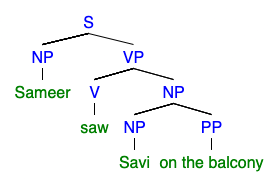
Who is Savi?
[maɹat] 'glove' [maɹad-i] 'gloves'
[tinut] 'shoe' [tinud-i] 'shoes'
In this language, it's the environment where /d/->[t].
What is word finally?
It's the question you'd ask if you were using the stand alone test to determine if [on the balcony] in the sentence 'Karen saw Sheila [on the balcony]' was a constituent.
What is, 'Where did Karen see Sheila"?
It's the type of rule that results in words like "something" being produced with a [p].
/sʌmθɪŋ/ --> [sʌmpθɪŋ]
What is insertion?
It is the place where a word derives it's meaning from.
What is the root?
'On Zoom' modifies this constituent resulting in the interpretation that the teaching took place there.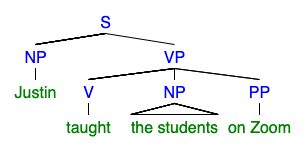
What is the VP?
It's the environment where /t/ --> [ɾ] in English in words like [waɾəɹ] 'water' and [bɪɾəɹ] 'bitter'.
What is intervocalically?
It's the kind of constituency test exemplified below:
'Mark ate beans at the park.'
'At the park, Mark ate beans ________'
What is movement?
[kasa] 'deer' [sima] 'tree'
[kinaʃ] 'table' [ɹɑʃ] 'fear'
Based on this data it is the rule that changes the phoneme /s/ to [ʃ]. (X --> Y/C_D)
What is /s/ --> [ʃ]/__#?
It's why the tree below is ungrammatical in English. 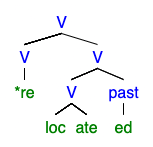
What is the inflectional affix is attached before the derivational affix.
Under this structure, it's the person on the balcony.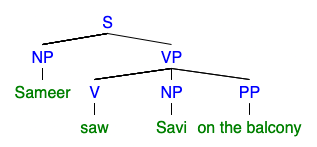
Who is Sameer?
[fellus] 'chicken' [ilfellus] 'the chicken'
[aria] 'air' [laria] 'the air'
What is the the word initial segment of the root?
"OJ drove the white bronco [on the 5 Freeway] and [through the streets]" is an example of this type of constituent test.
What is coordination?
[mudi] 'couch' [mʊni] 'grass'
[muki] 'tire' [mʊŋi] 'fence'
Based on this data it is the rule that changes the phoneme /u/ to [ʊ]. (X --> Y/C_D)
What is /u/ --> [ʊ]/___[+nasal]?
It is this type of affix that creates the following words in Berber and Kabyle respectively.
Berber: [afus] 'hand' [t-afus-t] 'hand.fem'
Kabyle: [issli] 'groom' [θ-issli-θ] 'bride'
What is a circumfix?
It's the interpretation of this structure.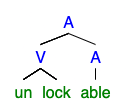
What is 'able to be unlocked'?
It's the environment (C_D), of the rule that results in stop insertion in words like:
/sʌmθɪŋ/ --> [sʌmpθɪŋ]
/pɹɪns/ --> [pɹɪnts]
What is between a nasal stop and a voiceless fricative?
Choose your own constituency test to tell me whether [The dog] in the sentence "The dog buried the bone." is a constituent.