Atomic Theory
Periodic Table
Bonding Basics
Atomic Structure
Acids and Bases
100
Who's model is this? It has protons and electrons in a nucleus and electrons in an orbit. 
Bohr's Model.
100
Who is credited with creating the periodic table?
Dimitri Mendeleev.
100
Name the 3 types of bonds and what kind of elements form each type of bond.
Metallic bonds are between 2 metals. Ionic bonds are between metals and non-metals. Covalent bonds are between 2 non-metals.
100
How do you find the number of protons in an atom using the periodic table?
It is the atomic number.
100
Do acids or bases have a pH less than 7?
Acids
200
True or False - Neutrons were easy to discover and were in very early atomic models?
False.
200
Elements that are in the same __________ or ____________ have similar properties because they have the same number of valence electrons.
Group or Family (2 word from the same thing.)
200
If an atoms LOSES an electron, does it become a positive or negative ion? Why?
If an atom loses on electron it loses a negative charge so it would become overall positively charged or a positive ion.
200
How do you find the number of neutrons in an atom? How many neutrons are in Carbon 14? How many are in Carbon 16? What are each of these called?
You find the atomic number by subtracting the atomic number of an atom (the number of protons) from the atomic mass (the number of protons and neutrons).
Carbon-14 has 8 neutrons (14-(Atomic Number)6 = 8.
Carbon-16 has 10 neutrons (16-(Atomic Number)6=10
These are called isotopes.
200
How do bases feel?
Slippery
300
True or false - Neutron are the smallest atomic particle?
False.
300
How can you use the periodic table to determine if an element is a metal, non-metal or metalloids?
Elements to the left of the "staircase" are metals. Elements to the right are on-metals. Elements that touch the staircase are metalloids.
300
What happens if an atom like hydrogen bonds (1 valence electron) tries to bond with oxygen (6 valence electrons.)? Would oxygen be full? What would it need to do to be full?
Oxygen is not full if it bonds with hydrogen because it would only get 1 electron from hydrogen to have 7. It needs a second hydrogen atom to be full. H2O.
300
How many protons, electrons and neutrons does Li have? How do you know?
How many protons, electrons and neutrons does the isotope Li-5 have? How do you know?
Lithium has 3 protons and 3 electrons. We know this because it is the atomic number. Lithium has 4 neutrons. We find this by subtracting the atomic number (3) by the atomic mass (7). 7-3=4
Lithium-5 is an isotope. It would still have 3 protons and 3 electrons. It has 2 neutron. We get this by subtracting the atomic number of Lithium (3) from the mass of this isotope (in this case, 5) 5-3=2
300
Acids taste ______ and bases taste _________.
Sour/Bitter
400
True or false - neutrons and protons have opposite charges?
False
400
What are noble gases? Where are they on the periodic table? How are the different from all the other elements.
Noble gases are gases in group 18 of the periodic table. They all have 8 valence electrons (a full shell) and thus they are the only elements that don't react with other elements.
400
A metal is group 1 is most likely to form a single bond with a non-metal in group__________? Why?
17. Because group 1 elements have 1 valence electron to give anyway and group 17 have 7 and therefore need to gain 1.
400
What element is this? How do you know?
It is Boron. We know because it has 5 electrons and Boron is Atomic Number 5.
400
What happens when you mix an acid (vinegar) with a base (baking soda?)
They neutralize forming water and a salt.
Baking soda and vinegar form the gas CO2 (+ salt + water) causing bubbles to form.
500
Why were neutrons harder to discover than protons in the nucleus?
They have no charge and don't react with protons or electrons for this reason.
500
What does the word periodic tell you in the "periodic table"?
The properties of the elements repeat in pattern which each group and each period having similar properties to other elements in a similar location on the table.
500
What is a polar covalent bond? Give an example.
A polar covalent bond is an unequal sharing of valence electrons in a covalent bond. It happens if one atom is bigger an pulls the shared electrons more strongly than the other. An example is H20. The shared electrons in H2O spend more time around the oxygen atom than the hydrogens.
500
Draw on electron dot diagram to show Sodium (Na) bonding with Chlorine (Cl).
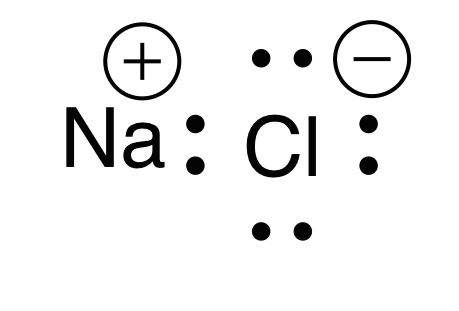
500
Name a neutral substance, an acid, and a base.
Water is neutral. Citrus juices, vinegar, etc are acids. Soap, baking soda, etc are bases.