Pulsed Ultrasound
Sound
Sound Beam & Display Modes
Bioeffects
Image Characteristics & Artifacts
Pulsed Echo Instrumentation
100
Axial resolution is determined by _?
Spatial Pulse Length
This is the ability to display two structures that are close together along the line of sound.
Typically ranges from 0.1 to 1.0 mm
100
The number of cycles that an acoustic variable goes through in 1 second of time describes _?
A. Frequency B. Period C. Wavelength D. Amplitude
A. Frequency
100
As the number of focal zones increase, the FR will _?
A. decrease, B. increase, C. remain unchanged
A. decrease
Focusing concentrates the sound energy into a narrow beam & improves lateral resolution. Phased array transducers utilize electronic focusing.
100
What are the two bioeffects of diagnostic ultrasound?
Heat (thermal) and cavitation (mechanical).
Thermal Index (TI):
TIS - soft tissue thermal index
TIB - bone thermal index
TIC - cranial bone thermal index
100
The shadowing artifacts demonstrated on the image below are due to which of the following.
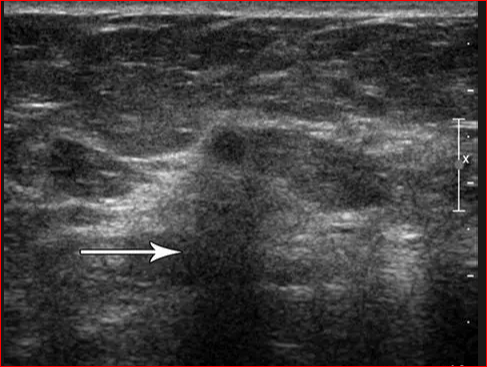
a. attenuation, b. refraction, c. absorption, d. Rayleigh scattering
a. attenuation.
Shadowing occurs behind a structure that attenuates more energy than the surrounding tissue
100
What part of the ultrasound machine generates the voltages that drive the transducer?
The Pulser.
Creates electrical signals that excite the PZT. This functions during transmission of sound. Pulser determines the strength of sound waves, phasing, and the PRP. The PRP determines the depth: Short PRP = shallow image and long PRP = deep image.
200
The pulse repetition frequency will _ with increased imaging depth.
Decrease
PRF is the number of pulses in 1 second. Typically 1 - 10 kHz. When depth is shallow, PRF is high. When depth is deep, PRF is low. PRP is the time it takes from the beginning of one pulse to the beginning of the next.
200
If frequency is increased, the wavelength will _?
Decrease.
Higher frequencies produce sound waves that are spaced close together (SPL). Determined by both the source and the medium
200
The ratio of output to input power is defined as _.
gain
200
No independent confirmed significant bioeffects have been reported to occur in mammalian tissues to focused SPTA intensities of less than _.
A. 1W/cm2, B. 5W/cm2, C. 3 W/cm2, D 7 W/cm2
A. 1 W/cm2
In the low megahertz frequency range there have been (as of this date) no independently confirmed significant biological effects in mammalian tissues exposed in vivo to unfocused US with intensities below 100mW/cm2 SPTA, or to focused SPTA intensities below 1W/cm2. Doppler applications may have an intensity that exceeds 100 mW/cm2 and should be used with caution in fetal exams.
200
Name the artifact indicated by the arrows on the Doppler waveform provided.
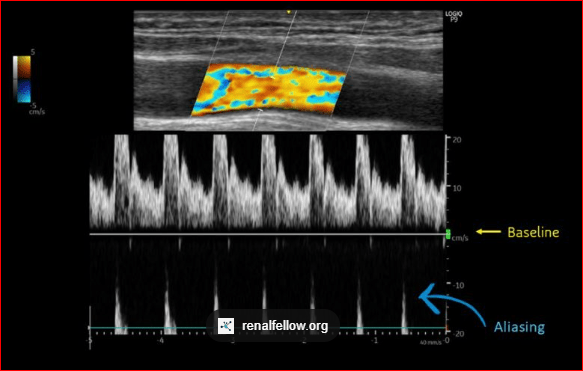
Aliasing.
Color aliasing occurs when Doppler shift exceeds the Nyquist limit. This can be corrected with increasing the PRF or decreasing the Doppler shift.
200
What are the 5 functions the receiver performs on an ultrasound machine?
Amplification, compensation, compression, demodulation, and rejection.
The receiver transforms electrical signals from the transducer into signal for display.
300
If the PRF is increased, what will happen to the duty factor?
The duty factor will increase.
Duty factor is the amount of time the sound is being transmitted. Any factor which increases the time a machine is transmitting sound will cause the duty factor to increase.
**Sonographer can adjust by changing the depth. Inversely proportional to depth (increase in depth= decrease in duty factor)
300
From the mechanical wave diagram below, label "A" corresponds to _?
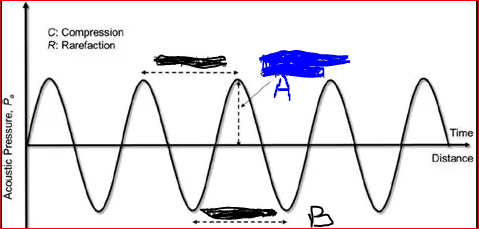
Amplitude
This is the difference between the maximum value and the mean of any acoustic variable. Amplitude decreases as sound propagates through the body.
300
The effects of soft tissue on US are called:
a. acoustic proliferation properties, b. dynamic effects, c. acoustic propagation properties, d. biologic effects
c. Acoustic propagation properties
300
What is the most relevant intensity to thermal effects?
A. SATA ~ Spatial Average Temporal Average
B. SPTA ~ Spatial Peak Temporal Average
C. SPTP ~ Spatial Peak Temporal Peak
D. SATA ~ Spatial Average Temporal Average
B. SPTA ~ Spatial Peak Temporal Average
300
This image demonstrates the subtle differences in echogenicity. This is an example of _ resolution.
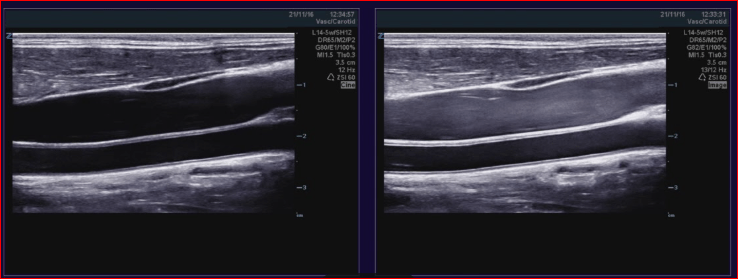
Contrast resolution
Grayscale maps depicting 256 shades of gray are used.
Axial resolution is the ability to display two structures that are close together along the line of sound propagation and lateral resolution is the ability to identify two structures close together when they are sis by side (perpendicular to main axis).
300
This converts electrical into acoustic energy during transmission. It converts returning acoustic into electrical energy during reception.
The Transducer
400
_ is the distance covered by one cycle.
a. pulse length, b. wavelength, c. cycle distance, d. cycle duration
b. wavelength
400
Crystal thickness determines the _?
Frequency. The number of cycles that an acoustic variable goes through in 1 second.
Thinner PZT = Higher Frequency
Thicker PZT = Lower Frequency
400
What term provides the number of grey levels available to the ultrasound image?
Dynamic Range. Usually measured in decibels. As the signal is processed, the DR decreases
400
The science of identifying and measuring those characteristics of an US field which are especially relevant to its potential for producing biological effects.
Dosimetry
400
Apodization of a transducer reduces or eliminates _?
a. Mirror Image Artifact, b. Aliasing, c. Enhancement, d. Side Lobe Artifact
Definition of Apodization: Derived from Greek term meaning "removing the foot". Involves altering the shape of an electrical signal to reduce discontinuities at the edges.
d. Side Lobe Artifacts.
Single element transducers are susceptible to Side Lobe Artifacts. Grating Lobes are Side Lobe Artifacts that occur with multi-element array transducers.
400
The component that controls the electrical signals sent to the transducer for sound pulse generation.
The pulser
500
A transducer with more than one active element is called:
a. multipurpose, b. annular, c. mechanical, d. array
d. array
500
Power / Area describes what term?
Intensity = Power (W) / Area(cm2).
Typical values range from 0.01 - 300 W/cm2.
Intensity is determined by the sound source and is adjustable by the sonographer.
500
True or False
Lateral resolution is also called _?
Axial
Azimuthal
Longitudinal
Range
Azimuthal
500
_ intensity is related to tissue heating.
SPTA
Any exam that causes an elevation in temperature of less than 2 degrees C ma be used without reservation.
Any exam that causes a temperature elevation to greater than 41 degrees C is considered potentially harmful to a fetus.
500
The ratio of the largest to the smallest signal strength that each component processes. It is the display that indicates the number gray shades.
Dynamic Range
Usually measured in decibels. As the signal is processed, the DR decreases.
500
Do not use a transducer with a crack in the housing because the potential for _ to the patient.
electrical shock
600
A single element transducer is focused
a. by the manufacturer, b. cannot be focused, c. by increasing power, d. by the sonographer
a. by the manufacturer
600
Constructive interference is when sound waves add together and increase in _.
amplitude
Occurs when waves are "in phase" with each other.
600
What is propagation speed determined by?
a. wavelength, b. intensity and density, c. amplitude, d. density and elasticity, e. density and amplitude
d. density and elasticity
600
The _ is a number proposed in the AIUM guidelines that relates to cavitation.
Mechanical Index (MI)
MI is higher (more likely to produce cavitation) with: Higher pressure beams and Lower Frequency.
600
_ is a redirection of US in many directions as a result of a rough boundary between two media.
a. refraction b. Rayleigh scattering c. scattering d. reflection
Scattering
600
The pulser creates the firing pattern for phased array systems. This is called the "_"?
Beam Former