Work
Energy
Surprise
Conservation of Energy
Power
100
Give three defining factors of Work
1. Work is a scalar
2. Units: Joules
3. Adds or removes energy to/from a system
4. Force causes motion for work to be done
5. Work is equal to change in kinetic energy

100
Define energy and three types of energy.
Energy- ability to do work
Kinetic Energy- energy of an object in motion
Potential Gravitational- Energy stored in an Earth-Object system due to position
Potential Spring- Stored energy caused by the compression or stretch of a spring
100
How many ounces are in 2 tons
64,000 ounces
100
Define the concept of conservation of energy
Total energy will remain constant. The energy can change form or it may be transferred to another system, however the total energy will never change.
100
Define power
The rate that work done

200
What is the equation for work? List what each variable represents.
Work = Fdcosθ
F=Force
d=Displacement
θ=Angle between F & d
200
List the equations for all the types of energy.
Kinetic- K= 1/2(mv^2)
Potential Gravitational- Ug= mgh or -(Gm1m2)/r
Potential Spring- Us= 1/2Kx^2
200
True or False
Centripetal force is a real force.
True
Centrifugal force is not a real force.
200
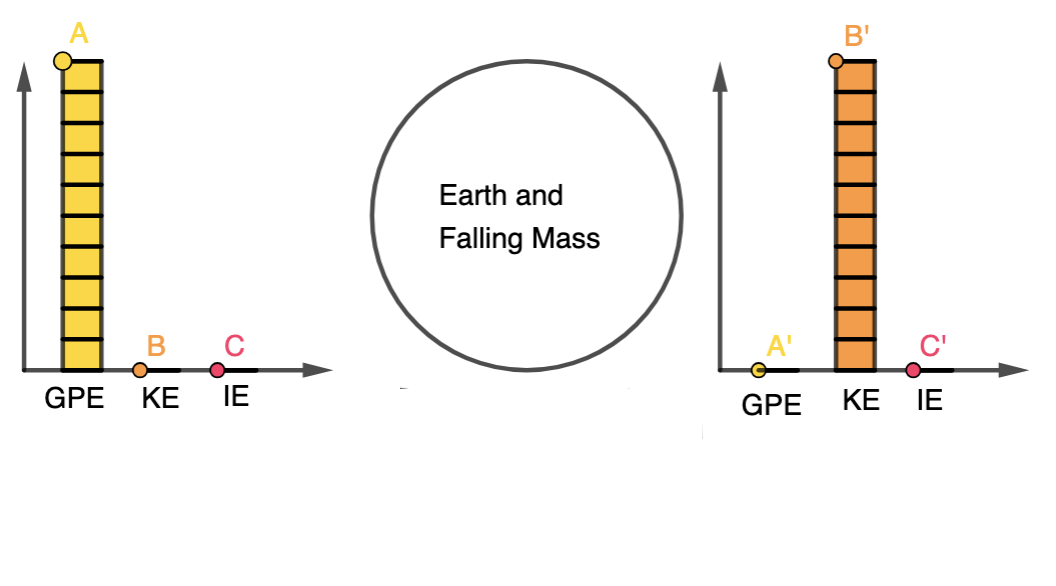
Set up a LOL diagram where a mass is dropped from rest from an unknown height.
200
What is the equation for Power? List the variables.
P=w/t or P=Fv
P- Power
w- Work
t- time
F- Force
v- velocity
300
A man is walking with a brief case in his hand. The brief case weighs 29.4N. The man walks 45m. How much work was done to the brief case.
W=fdcosθ
W=(29.4)(45)(cos(90)
W=0 J
300
A 1.2kg toy car is pushed at a speed of 6.2m/s. After two seconds, the car slows to a speed of 3.3m/s. What is the change in kinetic energy during this time period?
Δ K=(1/2)m(finalv^2)-(1/2)m(initialv^2)
Δ K=(.5)(3.3)-(.5)(6.2)
Δ K=-1.45 J
300
How many hearts does a shark have?
One
300
A 4.5kg ball is dropped from rest at a height of 6m. What is the ball's speed right before impact with the ground?
Ei=Ef
Ug=Kf
mgh=(1/2)mv^2
Sqrt(2gh)=v
V=10.84m/s
300
An object has 49 J of work done on it for 15 seconds. What is the power?
P=W/t
P=49/15
P=3.27 watts
400
A man slowly lowers a 12.2kg box from a height of 2m to ground level. How much work was done on the box.
W=Fdcosθ
W=mg*d*cosθ
W=(12.2*9.8)*(2)*(cos180)
W=-239.12 J
400
A box of mass 23.6kg is dropped from a height of 132m. What type of energy does the box have before being dropped? Calculate that energy.
Potential Gravitational Energy
Ug=mgh
Ug=(23.6)(9.8)(132)
Ug=30,528.96 J
400
What year was Isaac Newton born? (Within 30yrs)
1643
400
There is a hill with negligible friction of height 5m & length 7m. A box with a mass of 4.6 kg is slid from rest to the bottom of the hill. What is the difference between the final velocity and the velocity at half the height?
mgh=mg(1/2h)+(1/2)mv^2
gh=g(1/2h)+(1/2)v^2
gh-g(1/2h)=(1/2)V^2
2gh-gh=v^2
squareroot(gh)=v(half of h)
mgh=(1/2)mv^2
gh=(1/2)v^2
Squareroot(2gh)=v(bottom of hill)
Squareroot(2gh)-Squareroot(gh)=2.9m/s
400
A box has 180 J of work done on it and it moves 6m at a rate of 7m/s. Find power.
W=FdcosTheta
180=F(6)(cos(0))
F=30N
P=Fv
P=(30)(7)
P=210 watts
500
A box of mass 230,000kg is pulled by a crane at an angle of 49 degrees. The box is pulled 79m. How much work was done on the box?
W=Fdcosθ
W=(1098)(79)(cos49)
W=56,907.87 J
500
A 2.1kg toy car is pushed with an initial velocity of 7m/s. The car has 48 J of work done on it. With the given information, find final kinetic energy.
K=(1/2)(m)(v^2)
W=mad
ad=W/d
Vfinal^2=Vinitial^2+2ad
Vf^2=Vi^2+2(w/d)
Vf^2=(49)+(45.71)
Vf^2=94.71
Vf=9.73m/s
Kf=(1/2)(2.1)(9.73^2)
Kf=99.4 J
500
Where is king Tut's tomb located?
Valley of the Kings, Luxor, Luxor Governate, Egypt
500
There hill with height 5m and length 7m. A box of mass 6.4kg starts at rest, and begins to slide down the frictionless hill. There is 10m of ground area after the hill levels out, 8.5m are made up of a rough material. What would the coefficient of kinetic friction have to be for the box to stop completely at the end of these 8.5m?
Ei +Wnc = Kf
Ug + Wf = Kf
Ug + Wf = 0
Ug = -Wf
mgh = -FdcosTheta
mgh = -μmgdcos180
h = μd
μ = h/d
μ = .71
500
A 2kg box is lowered from a height of 3m. This takes 5 seconds. What is the power.
W=FdcosTheta
W=(mg)dcosTheta
W=(2*9.8)(3)cos(180)
W=-58.8 J
P=W/t
P=58.8/5
P=11.76 watts