Lab Skills & Concepts
Key Vocab
Equations
Miscellaneous
100
What two things must a scientific question include?
The independent and dependent variable
100
What is velocity?
The rate of change of position over time.
100
Which equation do we use to relate net force and acceleration?
Newton's 2nd Law:
a=F_"net"/m
100
Is the object in this graph moving? Justify your answer.
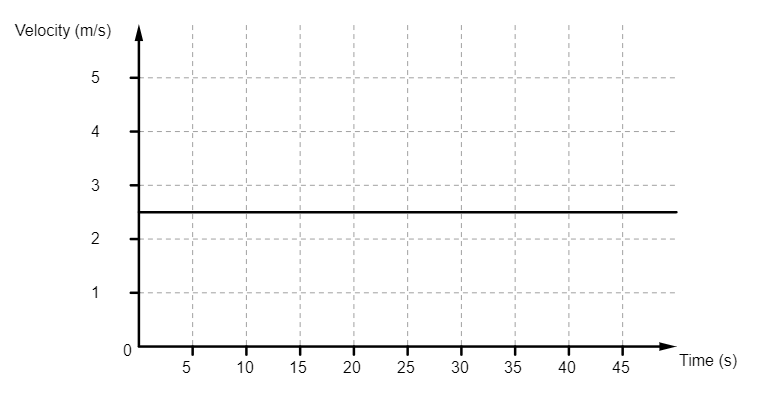
Yes - it has a constant velocity of about 2.5 m/s. (The graph being flat means it's not accelerating, though it is moving)
200
What is a controlled variable in a lab investigation?
A variable we keep constant since it's not the focus of our investigation
200
What is the normal force?
The normal force is the force of a surface to prevent an object from passing through the surface.
200
What equation do we use to calculate the force of gravity on a mass?
F_g=mg (g=10)
200
How do we know if an object is accelerating from a position-time graph?
An object is accelerating when its position-time graph is curved.
300
How do we convert position data from cm into m?
Divide by 100 or multiply by
1/100
300
What does it mean for an object to be in equilibrium?
It means an object is in a constant state of motion with the following:
1. A net force of 0 N
2. An acceleration of 0 m/s2
3. A constant velocity
300
What are the equations for net force?
F_"net"=F_"right"-F_"left"" or "F_"net"=F_"up"-F_"down"
300
List two things which are true for a properly drawn free-body diagram.
Drawing a proper free-body diagram includes:
- Arrows pointing away from the dot/box
- Labels for the force on each arrow
- Representing greater forces with longer arrows
400
What is the independent variable in a lab investigation?
The variable we directly change to determine its effect on another variable.
400
What does it mean for two variables to be inversely proportional?
Two variables are inversely proportional if the change by inverse factors - if one increase the other decrease by the same factor.
For example: if mass doubles, acceleration changes by half
400
Which equation would you use for the following problem?
A car starts at rest and accelerates at a rate of 3 m/s2. What is the position of the cart after 5 seconds?
x=x_0+v_0t+1/2at^2
400
A rope is used to pull up a 2 kg box with an acceleration of +5 m/s2. What are possible values for the upwards force of the rope on the box?
Since it's accelerating upwards, the force of the rope must be greater than the force of gravity Fg=(2)(10)=20 N. So the upwards force must be greater than 20 N.
500
What are the control, dependent and independent variables in the scientific question: How does ball size affect the terminal velocity of a ball when dropped?
Control: height of the ball, IV: ball size, DV: velocity
500
Define acceleration. Can an object be moving but not accelerating?
Acceleration is the speeding or slowing down of an object due to net force. Yes, an object can move at constant velocity and not be accelerating.
500
Explain how and what formulas you would use to find the normal force upwards if given the mass and acceleration of an object in an elevator.
1. Find net force using a=F(net)/m
2. Find Fg using Fg=m*(10)
3. Find F(normal/up) using F(net)=F(up)-F(down)
500
Does an object moving to the right need to have a net force to the right? Why or why not?
No because the object could be moving to the right at a constant velocity and thus have no acceleration and no net force at all.