Newton Laws
Force Problems
Other forces
Momentum Problems
Free Fall
100
What is the difference between balanced and unbalanced forces? Describe what happens to an object in each case.
Balanced forces are equal in size and opposite in direction, resulting in no change in motion. The object stays at rest or continues moving at the same constant speed.
Unbalanced forces are not equal, which means there is a net force, causing the object to speed up, slow down, or change direction.
100
What is the net force required to accelerate a 4 kg object at 3 m/s².
F = m·a = 4 × 3 = 12 N
100
What common force best explains why a feather and a tennis ball do not both fall with an acceleration of 9.8 m/s2 like they should?
Air resistance
100
A 3 kg ball rolls with a velocity of 2 m/s. What is its momentum.
p = m·v = 3 × 2 = 6 kg·m/s
100
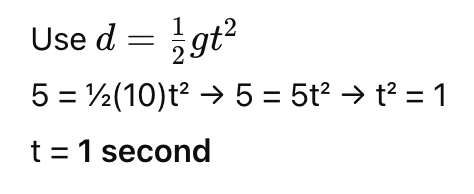
how long an object takes to fall 5 meters from rest (use g = 10 m/s²)
200
According to this law, an object will keep doing what it’s already doing unless a net force acts on it.
Newton’s 1st Law (Law of Inertia).
200
A 10 N force pushes an object to the right, while a 4 N force pushes to the left. What is the net force and its direction?
Net force = 10 − 4 = 6 N to the right
200
Rank the following items from most momentum to least momentum.
Fast airplane Slow bicyclist Parked car Fast bicyclist
Fast airplane, fast bicyclist, slow bicyclist, parked car
200
What is the mass of an object that has 15 kg·m/s of momentum while moving at 5 m/s.
m = p / v = 15 / 5 = 3 kg
200
A rock is dropped from rest and falls for 3 seconds. What is its final velocity.
v = g·t = 10 × 3 = 30 m/s downward
300
Why does a heavier object have more inertia than a lighter one?
Inertia is an object’s resistance to changes in motion. A heavier object has more mass, so it has more inertia and is harder to start or stop.
300
A 20 kg object experiences a net force of 50 N. What is the object’s acceleration?
a = F/m = 50 / 20 = 2.5 m/s²
300
An electric bike accelerates from 8.900 m/s to 12.50 m/s in 5.000 s. If the mass of the bike and its rider is 166.0 kg, find the force on the car and the final momentum.
F = 119.5 N
pfinal = 2,075 kg*m/s
300
A cart with a mass of 20 kg has a momentum of 60 kg·m/s. What is the cart’s velocity.
v = p / m = 60 / 20 = 3 m/s
300
An object is dropped from a height of 20 m. This is the time it takes to hit the ground (use g = 10 m/s²).
20 = ½(10)t² → 20 = 5t² → t² = 4 → t = 2 seconds
400
This relationship explains why two objects pushed with the same force accelerate differently depending on their masses.
Newton’s 2nd Law (a = F/m) — smaller mass accelerates more; larger mass accelerates less.
400
A 6 kg box is pulled with 30 N forward and encounters 10 N of friction backward. What is the acceleration of the box?
Net force = 30 − 10 = 20 N
a = F/m = 20 / 6 = 3.33 m/s²
400
Friction depends on 3 factors. What are those factors?
1.The rougher the surface, the greater the friction.
→Rougher surfaces have greater microwelds (microscopic bumps on surfaces that cause friction) which increases the resistance between the objects.
2.The greater the force pushing the two objects together, the greater the friction.
→Increases the opposition of the microwelds between the objects.
3.The greater the surface area of the two objects touching, the greater the friction.
→Increases the contact between the objects.
400
A baseball moving at 40 m/s has a momentum of 20 kg·m/s. What is the baseball’s mass.
m = p / v = 20 / 40 = 0.5 kg
400
A ball is thrown upward at 15 m/s. After 1 second of rising, this is its velocity.
v = v₀ − g·t = 15 − 10(1) = 5 m/s upward
500
You run into a friend while skating and you both fall in opposite directions. What Newton Law is this?
3rd Law
500
A student pushes a 12 kg cart, causing it to speed up from rest to 6 m/s in 3 seconds. This is the net force exerted on the cart.
First find acceleration: a = Δv / t = 6 / 3 = 2 m/s²
Then force: F = m·a = 12 × 2 = 24 N
500
What is the mass of a car that hits a deer with a force of 3,000 N if it started traveling at a speed of 50 m/s but slowed down to 25 m/s in 5 s before hitting the deer?
600 kg
500
Two objects collide: a 10 kg object moving at 4 m/s transfers all its momentum to a 5 kg object at rest. What is the final velocity of the 5 kg object.
Initial momentum of 10 kg object: p = 10 × 4 = 40 kg·m/s
All momentum transfers to 5 kg object:
v = p / m = 40 / 5 = 8 m/s
500
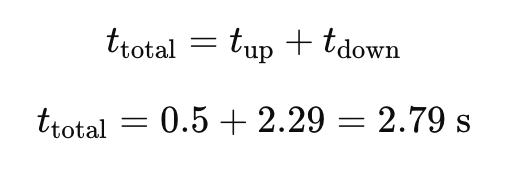
A ball is thrown upward at 5 m/s from a 25 m height. find the flight time