Electrostatics
Current
Energy
Circuits
Units
100
Like Charges __________
and
Opposite Charges ___________
Like Charges Repel
and
Opposite Charges Attract
100
A wire experiences a current of 20A. How many Coulombs flow through the wire in 10s?
200 C
100
Unit for energy:
J or Joules
100
When the current has only one path to take through a circuit, it is called ______________
Series
100
What are the units of charge?
Coulombs
200
Describe the charge of each particle:
Electron
Neutron
Proton
Electron: Negative
Neutron: Neutral
Proton: Positive
200
A 10V battery powers a tiny turbine with an internal resistance of 10Ω. What current flows through the turbine?
1A
200
In a perfect world, conductors do not transfer all of the source energy. But the law of conservation of energy says that energy cannot be created or destroyed. Where does this energy go?
It becomes thermal energy, heating up the wire/material it flows through.
200
When the current has to branch off in different directions, the circuit is called ___________
Parallel
200
What are the units for potential difference?
Volts
300
What is the charge of an elementary particle?
1.6*10^-19 C
300
What is current?
The flow of charge
300
How many amperes are delivered to a 100W bulb by a battery of 25V?
4A
300
3 resistors are wired in series. The (current / voltage drop) is the same in each.
3 resistors are wired in parallel. The (current / voltage drop) is the same in each
Series ; Current
Parallel; Voltage Drop
300
What combination of units make up current?
Current = Amperes
1 Ampere = 1C / 1sec
400
State Coulomb's Law
The Electric Force between two charged objects is proportional to the product of two charges and inversely proportional to the square of the difference between them
OR
F_E=(kq_1q_2)/(r^2)
400
An ammeter needs to be wired in (series / parallel) with a (low / high) internal resistance to be effective
Series ; Low
400
How many volts are required to supply a 150W bulb if it has an internal resistance of 10Ω?
38 V
400
4 resistors of 10Ω each are wired in parallel. What is the equivalent resistance?
2.5Ω
400
What combination of units make up the units for resistance?
Resistance =
Resistance = Omega
1 Omega= (1V)/A = ((1J)/C)/((1C)/s) = (1Js)/C^2
500
Two objects of charge q, separated by a distance d, experience a force F. If 1/3 of the charge on one object is transferred to the other and the distance between them is doubled, by what factor has F changed?
2/9 or 22%
500
An voltmeter needs to be wired in (series / parallel) with a (low / high) internal resistance to be effective
Parallel ; High
500
How are resistance and resisitivity related? (use an equation to describe it)
Bonus to double your score: What does resisitivity depend on?
R=rhoL/A
Resistivity depends on the material
500
A circuit with 4 equal resistors as shown below is attached to a battery. Which resistor has the most power? (from left to right, top to bottom: R1, R2, R3, R4)
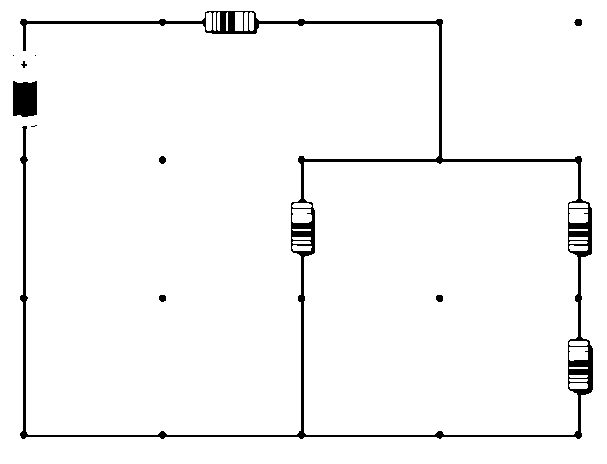
R1
500
How many electrons are in a charge of 5C ?
3.125*10^19