You're Getting On My Nerves!
No Brainer
Jog My Muscle Memory
P&Oh No!
Let's Get Physical (Therapy)!
100
Injury to this nerve is the most common cause of lateral scapular winging, and this is the muscle it innervates.
- Double points for naming other muscle (1) innervated by the same nerve
- Double points for naming the less common nerve and muscle that can be injured in a case of lateral winging
What is the trapezius and the spinal accessory nerve (CN XI)?
CN XI (roots C3,4) also innervates SCM muscle
Less commonly, lateral winging can be caused by damage to Dorsal Scapular Nerve (C4,5) to Rhomboids
100
A patient with impaired fluency, intact comprehension, and impaired repetition has this type of aphasia.
What is a nonfluent/expressive aphasia (Broca's aphasia)?
100
The Cozen's test assesses for tendonitis at this bony landmark.
What is the lateral epicondyle?
100
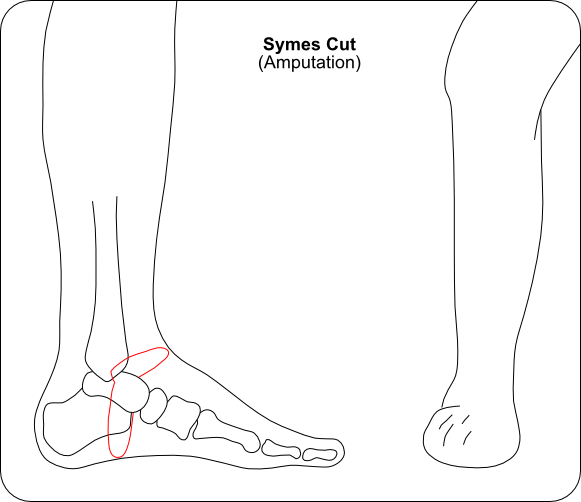
This lower extremity amputation is an ankle disarticulation with attachment of the heel pad to distal end of tibia.
What is Syme's amputation?
100
This therapeutic method is also known as the neurodevelopmental technique, whose goal is to normalize tone, inhibit abnormal primitive reflexes, and facilitate automatic reactions with subsequent normal development.
What is the Bobath technique?
As compared to the Brunnstrom technique, which maximizes/utilizes spasticity for ambulation/ADLs.
200
Entrapment of the suprascapular nerve in this area would lead to isolated infraspinatus weakness.
What is the spinoglenoid notch?
The nerve passes through the suprascapular notch before innervating Suprasinatus, and the spinoglenoid notch to innervate Infraspinatus

200
This level on the Ranchos Los Amigos scale refers to patients exhibiting confused and appropriate behavior.
What is level VI?

200
You would measure between these two bony landmarks to assess leg length discrepancy.
What are the ASIS and medial malleolus?
200
An amputee who has unlimited household ambulation but limited community ambulation would be this K level.
What is K2?
K0 - minimal household ambulation/transfers only
K1 - limited household ambulation
K2 - unlimited household ambulation, limited community ambulation
K3 - unlimited household ambulation, unlimited community ambulation + variable cadence
K4 - athletes + children
200
Heterotopic ossification (HO) in the setting of spinal cord injury most commonly occurs in this joint.
What is the hip?
Most common joint in burn patients is the elbow.
300
This is the rate of axonal regrowth after injury (daily or monthly).
What is 1 mm/day or 1 inch/month?
- This is for axonal loss; vs. a demyelinating condition resolves much more quickly, in weeks vs. months to years
300
At this stage of Brunnstrom's stroke recovery process, spasticity is typically at its highest.
What is stage 3?
300
A displaced femoral neck fracture with a partially intact joint capsule would be this stage on the Garden classification.
What is stage III?
I: Incomplete, nondisplaced
II: Complete, nondisplaced
III: Displaced, capsule intact
IV: Displaced, capsule ruptured
300
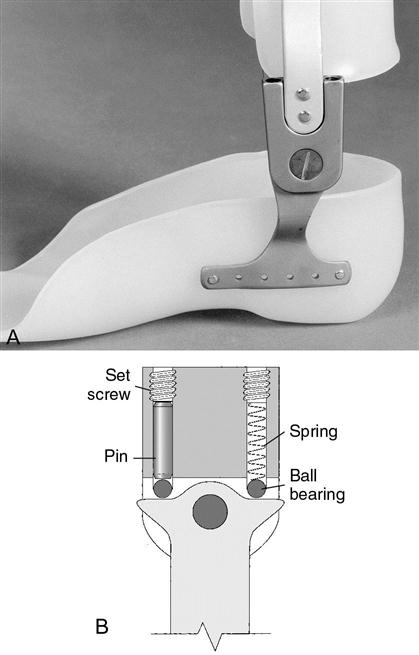
This AFO ankle joint modification would assist in active plantarflexion (hint: spring or pin? Placed anteriorly or posteriorly?).
What is a spring in the anterior channel?
- springs assist with moving the foot in that direction (anterior - plantarflex, posterior - dorsiflex)
- pins prevent foot movement in that direction
300
In a wheelchair with adjustable wheel axles, this adjustment would improve stability, particularly helpful in a bilateral lower extremity amputee patient.
What is posteriorly moving the axle?
- anterior axle positioning increases maneuverability, however there is a smaller base of support (See Cuccurullo figure 12-5)
400
The H-reflex on NCS is often used to monitor for this condition in the lower extremity (i.e., absence of this reflex can suggest presence of this condition).
What is an S1 radiculopathy?
400
In patients with posttraumatic amnesia (PTA), severe disability is unlikely when the duration of PTA is within this time cutoff.
What is less than 2 months?
PTA
Severe disability unlikely when <2 months
Good recovery unlikely when >3 months
Coma
Severe disability unlikely when <2 weeks
Good recovery unlikely when >4 weeks
400
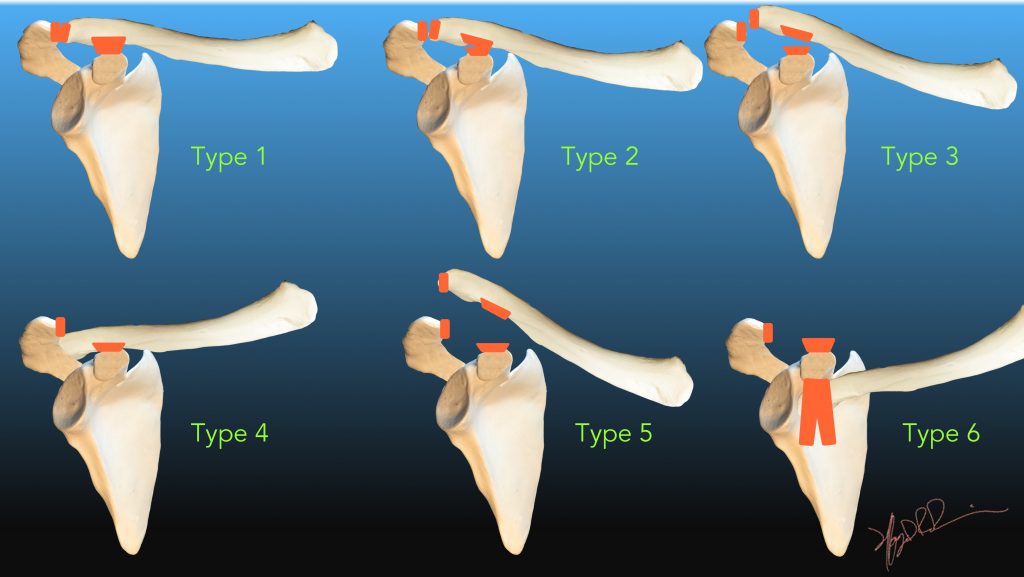
A patient with an AC joint injury who is found to have complete ruptures of the AC and CC ligaments, with his clavicle displaced superiorly above the acromion, and an increased CC distance of 25-100% compared to the contralateral side. What type is this injury as determined by the Rockwood classification of AC joint injury?
400
A traumatic unilateral, transfemoral (AKA) would increase energy expenditure by this percentage above normal.
What is 60-70%?
Increases by location:
- Symes: 15%
- Traumatic uni BKA: 25%
- Vascular uni BKA: 40%
- vascular uni AKA: 100%
- Traumatic bilat AKA > 200%
- hip disarticulation: 100-200%
400
This is the transfer of heat that occurs by circulation (liquid or gas) over the surface of a body. Some examples include fluidotherapy and contrast baths.
What is convection?
500
Damage to this nerve would result in pure weakness of the flexor pollicis longus, flexor digitorum profundus, and pronator quadratus (without sensory deficit). Patients may exhibit a positive "OK" sign.
What is the anterior interosseus nerve (AIN)?
500
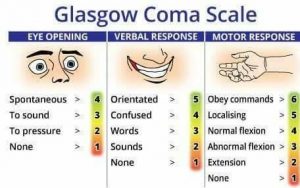
You're examining a patient in the ED who has sustained an MVA. He opens his eyes when spoken to. His words are nonsensical and have no conversational value. He pulls his fingers away from you when the nailbeds are pressed. This exam is consistent with a Glascow Coma Scale (GCS) of this number.
What is 10 (motor 4, verbal 3, eye 3)?
500
A 9-year old presents with wrist pain after a fall onto an outstretched arm, XRs demonstrate a fracture of the distal radius through the physis and epiphysis, giving her this type of Salter-Harris Fracture.
What is Salter-Harris Type III?

500
This type of cervicothoracic orthosis (CTO) is the most restrictive removable cervical brace, making it ideal for young patients with unstable cervical fractures.
What is the Minerva brace?
500
This type of therapeutic massage involves gliding of the hand from distal to proximal, with its mechanical effects aiming to relieve pain, increase lymphatic drainage, and reduce vascular congestion.
What is effleurage?