End Behavior
Multiplicity
Synthetic Division
Create a function!
Rational Roots
Final Jeopardy
100
These two things uniquely determine the end behavior of a polynomial.
What are the leading coefficient and the degree?
100
The multiplicity of the root x=4 in the function
f(x) = (x+4)^2(x-4)^3.
What is 3?
100
The remainder of
(x^3+3x^2+5x-1) \div (x-2).
What is 29?
100
A polynomial with only one real root.
Answers vary: example
f(x)=(x-2)^4
100
All possible rational roots of
f(x)=2x^6+11.
What are
\pm(1,11, \frac{1}{2}, \frac{11}{2})?
200
The end behavior of
f(x)=-3x^4+3x^2-x+1.
What is down/down?
200
The multiplicity of the root x=0 in
f(x) =x^2(x-1)^6.
What is 2?
200
(x^3+4x^2-3x-18) \div (x-2) =
What is
x^2 + 6x+9?
200
A polynomial that bounces off the x-axis twice and crosses once.
Answers vary: example
f(x) = (x-1)^2(x+2)^2(x+3)
200
All possible rational roots of
f(x) = 5x^4+6x-3.
What are
\pm(1, 3, \frac{1}{5}, \frac{3}{5})?
300
The end behavior of
f(x)=x^3-5x^2+x-1.
What is down/up?
300
The number of even-multiplicity and odd-multiplicity roots.
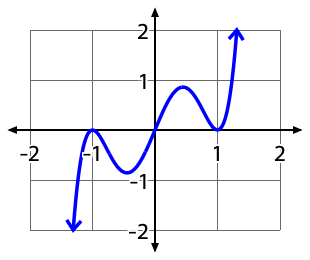
What are 2 (even) and 1 (odd)?
300
(x^4 - 6 x^3 + 13 x^2 - 12 x + 4) \div (x-1) =
What is
x^3 - 5 x^2 + 8 x - 4?
300
A polynomial of degree 8 that never crosses the x-axis.
Answers vary: example
f(x) = (x-3)^2(x-2)^4(x-1)^2
300
All possible rational roots of
f(x) = 9x^5+x^4+3x^3-2x^2-x+10.
What are
\pm(1,2,5,10,1/3, 2/3, 5/3,10/3, 1/9, 2/9, 5/9, 10/9)?
400
The end behavior of
f(x)=3(x-1)(x+2)^2(x+4)^4.
What is down/up?
400
The number of even-multiplicity and odd-multiplicity roots.
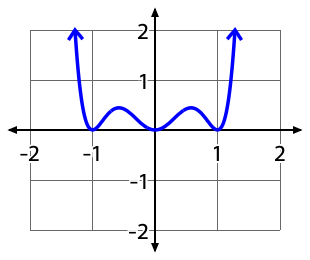
What are 3 (even) and 0 (odd)?
400
(x^3 -27) \div (x-3) =
What is
x^2 +3x+9?
400
A polynomial of degree 6 that crosses the x-axis twice.
Answers vary: example
f(x)=(x-1)^3(x+5)^3
400
f(x)=-3x^4+x^2+2x-1
Mason claims f(-2) = 0. Is Mason right? Explain without plugging in x=-2.
Mason is wrong, -2 is not a possible rational root.
500
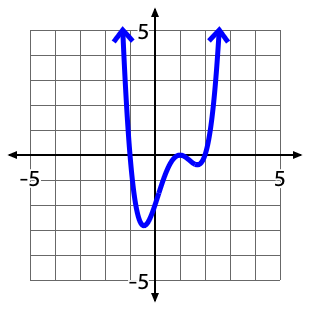
The function has a _______ leading coefficient and ____ degree.
Positive, even
500
Is it possible that a degree-91 polynomial never crosses the x-axis? Why or why not? Explain...
Not possible... degree is odd, so the end behavior is different in either direction (down/up or up/down)
500
(2x^5 -3x^3 - x^2 +1) \div (x+1) = ?
What is
2 x^4 - 2 x^3 - x^2 \text{ R}1?
500
A polynomial of degree 60 that only has x=0 as a (real) zero and a leading coefficient of 2.
What is
f(x) = 2x^{60}?
500
x=-11 is not a root of
f(x) = 2x^6+11.
How is this possible?
The Rational Roots Theorem only gives possible roots; it does not guarantee roots.
500
Is it possible to create a degree-8 polynomial that crosses the x-axis exactly 5 times? Why or why not?
Not possible: 3 zeros remaining, so either: one zero (repeated 3 times) OR two zeros, one repeated twice. Either way, at least one cross.