Pages 1-3
Pages 4-6
Pages 7-9
Pages 10-12
Vocabulary
100
Question
Why is Europe’s population shrinking, according to the text on this page?
Answer
Europe’s population is shrinking because birth rates have fallen below replacement level while people are living longer.
100
Question
What 3 major changes in caused Europe’s population to grow rapidly after the 1750s?
Answer
Better sanitation, improved medical care, and increased food production reduced death rates and allowed the population to grow.
100
Question
What is a “baby boom,” and how is Europe’s earlier baby boom contributing to today’s aging population?
Answer
A baby boom is a period of high birth rates, and as those people grow older, they increase the elderly population today.
100
Question
How did Germany’s 2007 immigration law aim to address its workforce shortage?
Answer
It encouraged skilled workers from other countries to move to Germany to fill job shortages.
100
Question
Define Demography
Answer
The study of human populations, including how populations change over time through births, deaths, and migration.
200
Question
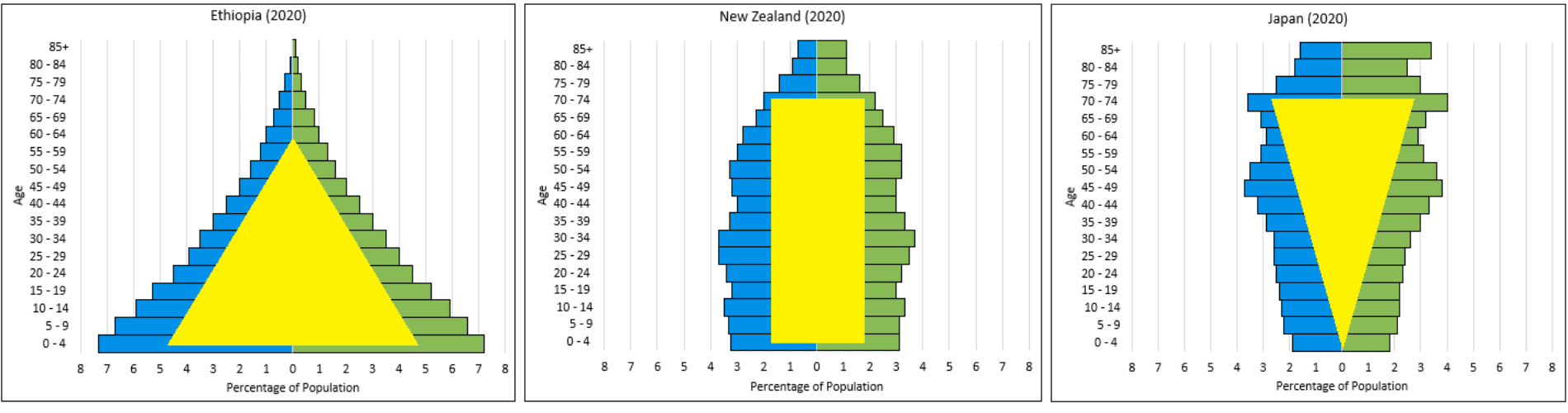
Look at the three population pyramids labeled Rapid growth, Slow growth, and Negative growth below. Describe how each one looks different from the others (shape and width at the bottom, middle, and top).
Answer
Rapid growth has a wide base and narrow top, slow growth has a more even shape, and negative growth has a narrow base with a wider middle and top.
200
Question
According to the demographic transition model, what happens to birth rates and death rates in Stage 2?
Answer
Death rates drop quickly while birth rates stay high, leading to rapid population growth.
200
Question
Why does an aging population raise concerns about pensions and health care systems?
Answer
Because more elderly people need pensions and health care while fewer workers are paying into the system.
200
Question
What policies are European governments using to encourage more women to participate in the workforce?
Answer
Childcare support, parental leave, flexible work hours, and family-friendly workplace policies.
200
Question
Define Life expectancy
Answer
The average number of years a person is expected to live in a specific country.
300
Question
Why is Europe’s population shrinking, according to the text?
Answer
Europe’s population is shrinking because birth rates have dropped below replacement level and people are living longer.
300
Question
Based on the model, in which stage is Europe today, and why? Use evidence from the reading to support your answer.
Answer
Europe is in Stage 4 because both birth rates and death rates are low and population growth is slow or negative.
300
Question
What happened in Leipzig, Germany, when the city’s workforce began to shrink?
Answer
Businesses closed, unemployment rose, and parts of the city were abandoned.
300
Question
What is one advantage and one possible concern about bringing in workers from outside Europe?
Answer
An advantage is filling labor shortages, and a concern is social tension or integration challenges.
300
Question
Define Total fertility rate (TFR)
Answer
The average number of children a woman is expected to have during her lifetime.
400
Question
What is meant by dependency ratio, and why can a high dependency ratio be a problem for a country?
Answer
The dependency ratio compares young and elderly people to the working-age population, and a high ratio is a problem because fewer workers must support more dependents.
400
Question
What are two reasons given for the decline in total fertility rates in Italy and across Europe?
Answer
Women are having children later in life, and family planning methods are widely available.
400
Question
Why are businesses worried about the long-term effects of Europe’s declining workforce?
Answer
There may not be enough workers to replace retirees, which can slow economic growth.
400
Question
Why are most European countries experiencing negative population growth?
Answer
Because total fertility rates are below replacement level and populations are aging.
400
Question
Define Replacement rate
Answer
The number of children per woman needed to keep a population the same size from one generation to the next. =2.1
500
Question
Using the population-change equation, identify two factors that cause a population to grow and two factors that cause it to shrink.
Answer
Births and immigration cause population growth, while deaths and emigration cause population decline.
500
Question
Look carefully at the Italy, 2010 population pyramid. What does its shape (especially the base) tell you about Italy’s future population?

Answer
The narrow base shows that few children are being born, meaning Italy’s population will continue to shrink.
500
Question
How does a shrinking workforce affect the dependency ratio, and why is this a problem for governments?
Answer
It raises the dependency ratio, meaning fewer workers must support more dependents, increasing government costs.
500
Question
Why do developed countries tend to have lower birth rates than developing countries?
Answer
Children are more expensive to raise, women have more education and career opportunities, and family planning is widely available.
500
Question
Define Dependency ratio
Answer
The comparison of the number of young and elderly people to the working-age population.