Positioning and Projections
body habits types
Landmarks
Anatomy
Factors of image quality
Miscellanious
Miscellaneous #2
100
The patient is lying on his left side in his hospital bed. The image receptor is against the patient's posterior side of his body. The central ray is horizontal and the beam is directed to enter the anterior and exit the posterior side of his body. What specific POSITION is the patient in?
Left lateral decubitus
100
Which type of body habitus is described as being "average"
What is sthenic?
100
Which of the following can be palpated to locate L4-L5?
What is the iliac crest?
100
What is the primary center for bone growth termed?
What is Diaphysis?
100
An AP axial (lordotic) chest projection with accurate positioning demonstrates...
What is the first rib superimposed over the medial end of the clavicle?
What is entire lung field?
What is equal distance from vertebral column to the sternoclavicular joints? (No rotation)
100
involuntary motion (hint: 5)
(bonus: what primarily controls it?)
What is chills, peristalsis, tremors, spasms, and pain?
What is using short exposure time (can also rotor up to try and time image)?
100
The image gently campaign raises awareness of increased pediatric dose, ways to reduce dose is by...
What is using no grid, collimating to the area of interest, higher kVp technique, avoid repeats, short exposure time, use of immobilization devices, and use shielding when not in the pertinent anatomy?
200
The patient is lying on their back on a stretcher. The patient's left side is against the image receptor. A horizontal central ray enters the patient's right side and exits the patient's left side of the body. What specific PROJECTION is being used?
What is a Lateral?
200
broad frame, 5% of population
What is hypersthenic?
200
Which of the following can be palpated to locate T9-10?
What is xiphoid process?
200
The structural term for a freely movable joint is
What is synovial joint?
200
the minimum number of posterior ribs that need to be visualized above the diaphragm on an AP supine or portable projection of the chest
What is 8-9 ribs?
200
Jasmine Ayokunle arrives in the department with a suspected pleural effusion in the left lung. Jasmine cannot stand or sit upright. The best position to help demonstrate the suspected pathology is
What is Left lateral decubitus chest?
(bonus: what marker are you using?)
200
crucial to demonstrate possible air and fluid levels in the chest
What is patient in erect or decubitus position?
300
The projection and position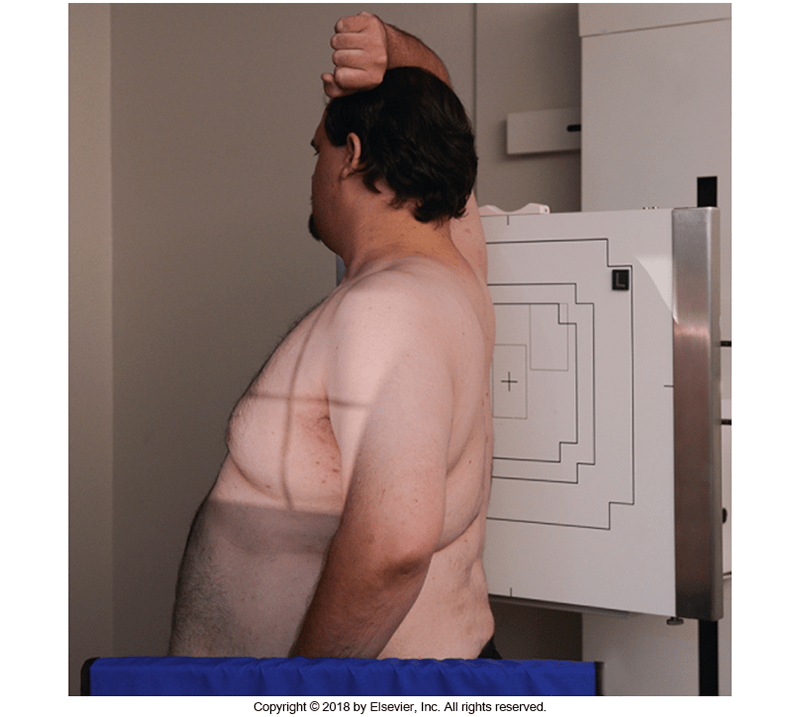
What is RPO and AP?
300
average 50% of population
What is sthenic?
300
Which of the following can be palpated to locate C7-T1?
What is vertebral prominens?
300
Kevin Verochka arrives in the department with a suspected pneumothorax in the left lung. He cannot stand or sit upright. The position that will best help to demonstrate this suspected pathology is.
What is Right lateral decubitus chest?
300
the following position(s) will best demonstrate the left ribs.
What is RAO and LPO?
300
Alternative to AP Abdomen Erect
What is Left lateral decubitus?
300
The vertebral level the sternal angle located at
What is T4-T5?
400
A patient is lying on her back facing the x-ray tube. The left side of her body is turned 20 degrees away from the image receptor. What is this radiographic position?
What is RPO?
400
35% of population, thinner than average
What is Hyposthenic?
400
Which of the following can be palpated to locate L2-L3?
What is inferior costal margin?
400
abnormal convex curvature of the thoracic spine
What is kyphosis?
Bonus: what type of study would we do on someone like this, technique and why.
400
Image criteria for a pediatric abdomen: AP Supine
(bonus: give me techniques, CR angle, centering, field size, breathing instructions, )
What is No rotation (look at alas and obturator foramen) include diaphragms to pubic symphysis, and not motion.
What is 70@2, 10x12 LW (starting point) CR 0 degrees perpendicular, infant/small child" 1" above umbilicus, older child: @ iliac crest, Suspend on expiration ( or watch)
400
When performing portable AP chest exams, the following should be annotated on the patient's image post-processing so that consistency among exams may be achieved.
What is Source-to-image receptor distance (SID)?
What is technique (kVp and mAs)?
What is the degree of patient elevation?
400
a patient enters the ED with a possible pneumothorax in the left lung. Due to the trauma, the patient cannot sit or stand independently. The following positions would best demonstrate this condition.
What is a right lateral decubitus?
(bonus: what marker do you use?)
500
A young female patient from the emergency department (ED) is brought to radiology for rib examination. She is able to sit up or stand for the procedure. She indicates that the region of pain is the left anterior region. The rib projections/positions should ideally be performed is
What is RAO and PA?
500
10% of population, very thin and slender
What is asthenic?
500
Which of the following can be palpated to locate T7?
What is inferior angle of the scapula?
500
The internal prominence or ridge in which the trachea bifurcates into the right and left bronchi
What is carina?
500
Ways to find rotation in an X-ray image (hint: think of each exam)
(bonus: tell me how to tell rotation in each one)
What is spinous process, sternoclavicular joints, iliac wings, rib length, and obturator foramen?
500
Voluntary motion (hint: 4)
(bonus: what primarily controls it?)
What is nervousness, discomfort, fear, and age?
What is clear instructions, providing patient comfort, immobilization devices?
500
the advantage of rotating a patient into an oblique position instead of the AP and PA projections used for the sternum.
What is to prevent superimposition of the sternum with the vertebral column
600
The type of projection created with the CR directed along or parallel to the long axis of the body.
What is axial?
600
sternum for a Large, barrel-chested thorax need
what is less obliquity, about 15 degrees?
600
Which of the following can be palpated to locate T2-T3?
What is the jugular notch?
600
A general rule states that radiographic grids must be used in chest radiography for
What is exposure factors using 100 kV or greater and 10 cm in thickness?
600
You perform an acute abdomen series on an asthenic patient. As part of your site protocol, you take a PA chest, and an AP upright and AP supine abdomen. When reviewing, on your supine radiograph you notice bilateral colic flexures are included but the pubic symphysis is clipped. The next steps to be taken...
What is "take a bladder shot" 10x12 CW to include the bladder area/ pubic symphysis? (center 2" below the ASIS)
600
A portable AP chest x-ray on a patient elevated 30° demonstrates that the manubrium is located around T6 and five ribs are visible above the clavicles. It is determined that the image must be repeated. The error is
What is Too much caudad angle was used?
600
Image criteria: (pediatric) AP Erect abdomen
(bonus: give me technique, field size, centering, and breathing instructions)
What is diaphragms must be included, No rotation, No motion, soft tissue border outlines and gas filled structures?
What is 70@2, 10x12 (starting point), infants/small child: 1" above the umbilicus, older children: 1-2" above the iliac crest, top of light at the level of axilla, suspend on expiration (or watch for breathing, age dependent)?
700
A patient is erect with his left side of the chest placed against the image receptor. The central ray enters the right side of the upper chest and exits the left. The specific position that has been performed...
What is a left lateral?
700
the recommended degree of obliquity for an oblique position of the sternum for a patient with an asthenic body habitus
What is about 20 degrees?
700
These should never be palpated
What is pubic symphysis?
What is ischial tuberosity?
700
The pair of ribs attaches to the sternum at the level of the sternal angle
What is 2nd rib?
700
A correctly positioned lateral chest radiograph demonstrates some separation of the posterior ribs owing to the divergent x-ray beam. But a separation of greater than ____ cm indicates objectionable rotation from a true lateral
What is 1 cm?
700
Full inspiration will usually demonstrate this many posterior ribs above the diaphragm on a pediatric patient when performing an AP or PA chest
What is 9-10 ribs?
700
For an abdomen; The EI # will be within range to best visualize the anatomy
What are kidneys, psoas muscle, lower liver border, and lumbar region?
800
You perform a PA chest exam on a patient in the department. On the radiograph you notice the left sternoclavicular joint is more open than the right. The position error is
What is the patient is in a slight ROA?
800
A radiograph of a supine KUB on a hypersthenic patient taken for constipation issues reveals that the symphysis pubis is cut off along the bottom of the radiograph. The top of the left kidney and a portion of the ascending colon are also clipped. The modifications that the technologist needs to make for the repeat exposure.
What is Use two 14x17" IRs crosswise, one centered lower and the other one higher?
800
A morbidly obese patient has come to the department for an x-ray. You cannot locate any of the standard palpable landmarks. You decide you will locate her pubic symphysis and use that to make sure the bottom of your cassette is in the correct place. If the patient was 5 feet, 8 inches tall, you would measure this far from the jugular notch.
What is 22 inches?
800
the following abdominal region would contain the right colic (hepatic) flexure (hint: 9 quadrant system)
What is right lateral lumbar?
800
A patient enters the ED with a possible ascites. The patient is ambulatory. The following projections of the abdomen will best demonstrate this condition.
What is AP erect?
800
Where the CR should be directed for an AP right lateral decubitus projection of the chest.
What is the Level of T7, perpendicular to the midcoronal plane
800
An AP chest projection (lateral decubitus position) obtained with the patient in a slight RPO position demonstrates.
What is the right SC joint without vertebral column superimposition and 9 or 10 posterior ribs above the diaphragm?