Vocabulary
Plate Boundaries
Soil Dynamics
Wind Patterns
WILD
300
What is a horizon? (related to soil)
The noticeable parallel line in soil layers (different pH, parent material, etc.)
300
Which of the following layers of the earth is entirely liquid?
A. Inner Core
B. Outer Core
C. Mantle
D. Lithosphere
B. Outer Core
300
What are some influences that affect soil horizons?
Seasons, temperature, climate, minerals, organisms
300
When looking at the layers of the atmosphere, temperature fluctuates. Why does temperature increase as you reach the stratosphere?
Temperature increases because the stratosphere is where the Ozone Layer is located: this is responsible for retaining the heat
300
What are some influences that affect soil horizons?
Seasons, temperature, climate, minerals, organisms
400
What is parental material?
What is original rocks that were broken down to form the basis of the soil
400
Name one type of plate movement and a geologic process that happens
Convergent Movement: earthquakes, trenches, volcanoes, islands
Divergent Movement: earthquakes, trenches, seafloor spreading
Transform Movement: earthquakes, fault lines
400
How would soil organisms affect soil structure and development?
Decomposers (inorganic) and Detritivores (organic) are respond for recycling nutrients back into the environment
400
What is a convection current, and how does this impact air pressure?
Warm air heats up and rises, while cool air sinks. The sinking air moves along the surface, gets warmed again, and the cycle repeats. Warm air creates low air pressure zones, while warm air creates high air pressure zones
400
Describe the general method that scientists use to study the interior of the Earth
Mainly analyzing seismic waves generated by earthquakes or man-made explosions. Seismometers record how these waves travel through different layers, changing speed or disappearing
500
What is the albedo effect?
Process by which different surfaces on Earth reflect or absorb sunlight
500
Why are earthquakes more common along plate boundaries than elsewhere in the world?
Earthquakes are more common along plate boundaries because these areas are where the Earth's tectonic plates constantly grind, collide, or pull apart.
500
Which soil horizon is composed mainly of mineral material with very little organic matter?
1) O Horizon
2) A Horizon
3) B Horizon
4) D Horizon
3) B Horizon
500
What are the three cell types for the tricellular model describing atmospheric convection currents?
Hadley, Ferrel, and Polar
500
Which soil type holds the MOST water?
Clay
600
What is a subduction zone?
It is the crevice that forms during convergent movement, forming deep trenches in the ocean
600
What causes volcanoes to form along the continental plate boundary of a subduction zone?
The oceanic plate melts under pressure and extreme heat, allowing magma to form. Because magma is less dense than the continental plate, it rises and can form volcanoes.
600
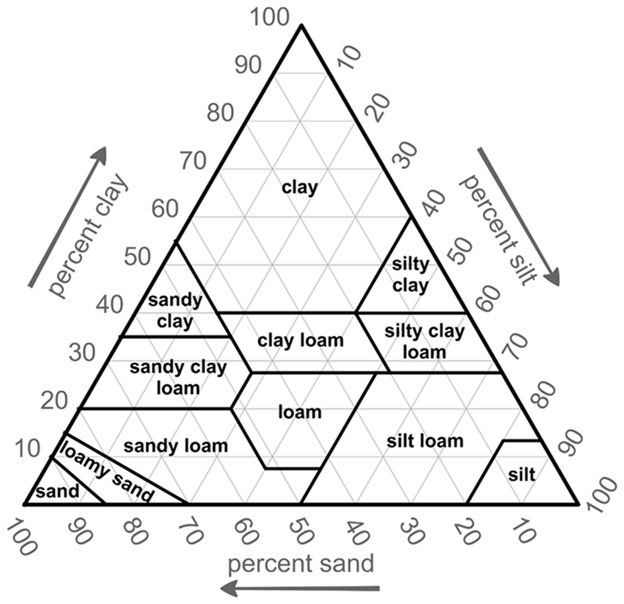
What is the correct percentages to get "Loam" soil?
40% sand, 40% silt, 20% clay
600
What causes the change in seasons on Earth? Include the sun's angle in your response
The change in seasons on Earth is caused by the tilt of Earth’s axis as it travels around the Sun. As Earth moves along its orbit, the tilt causes the angle at which sunlight hits Earth’s surface to change throughout the year. Summer has more sunlight, whereas winter has less sunlight (Northern Hemisphere)
600
Describe what a rain shadow is:
When moist air moves toward a mountain, it rises and cools, causing the water vapor to condense and fall as rain on the windward side. By the time the air crosses the mountain and moves down the leeward side, it has lost most of its moisture, so the area receives very little precipitation, creating a dry rain shadow.
700
What is a Hadley Cell?
A Hadley Cell is a large-scale pattern of air circulation in Earth’s atmosphere between the equator and about 30° latitude in both hemispheres.
700
What is the difference between the lithosphere and asthenosphere
The lithosphere is made up of the crust and the uppermost part of the upper mantle (tectonic plates). The asthenosphere lies below the lithosphere, made up of rock that is viscous and plastic (semi-fluid) changes through plastic deformation
700
The percentages of the soil’s sand, silt, and clay is referred to as:
A. Texture
B. Minerals
C. Horizons
D. Relative Particle Size
A. Texture
700
Explain why coastal locations typically have less fluctuation in temperature than inland areas
The oceans absorb and hold onto the sun’s heat. Areas near the coast are warmed by the ocean’s heat. The land does not hold onto the sun’s heat, so it will fluctuate a lot more between day and night, summer and winter.
700
Explain the specific results during an El Niño and a La Niña event? (Water/Air Currents)
During El Niño, unusually warm ocean water in the eastern Pacific weakens trade winds and can bring wetter conditions to the southern United States and drought to places like Australia and Indonesia.
During La Niña, cooler-than-normal Pacific waters strengthen trade winds and typically cause drier conditions in the southern United States and wetter conditions in the western Pacific regions.