Elements
Principles
Movements
Artist/Paintings/Misc.
Color Theory
100
The lightness and darkness of a color is referred to as what element?
Value
100
The repetition of an element or shape throughout a work of art is known as what principle?
Pattern/Repetition
100
This movement was inspired by Rome and Greek mythology and history.
Neoclassical
100
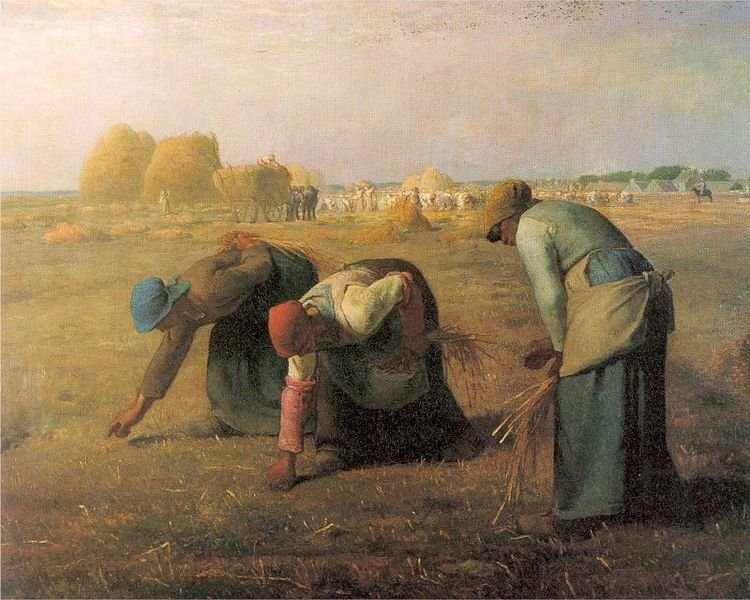
Name the art AND the artist.
The Gleaners—Jean François Millet
100
What are the three primary colors?
Red, Blue, and Yellow
200
A path created by a moving point is referred to as what element?
Line.
200
The use of opposite elements is what principle?
Contrast
200
This movement was known to celebrate the working class.
Realism.
200

Name the artist AND the painting
Stonebreakers—Gustave Courbet
200
Colors that are on the opposite sides of the color wheel are called what?
Complementary Colors
300
What is the area between and around objects in a work of art called?
Space (negative space)
300
When the two sides of an artwork are not equally distributed this is called what type of balance?
Asymmetrical
300
The Industrial Revolution helped inspire what movement?
Romanticism
300
This artist paintings were criticized for their "crude subject matter."
Gustave Corbet
300
Mixing complimentary colors together can do what to the value of a color?
Make it darker.
400
This image would be best described by what element?
Form.
400
The arrangement of opposite elements is best describes what principle?
Contrast
400

Name a characteristic that makes this piece Neoclassical.
Clean lines and sharp colors
Classical proportions in humans
Symmetry
Heroic figures from Rome and Greek history or mythology
Emphasis on faces to tell the story
400
A technique where artist use even vertical and horizontal lines to divide an image for accurate resizing or replication is called what method?
The grid method.
400

This is an example of what color scheme?
Monochromatic
500
How would you describe texture?
The way things feel or appear to feel.
500
This element is synonymous with the term focal point.
Emphasis
500
Name an artist from the Realism movement.
Jean François Millet
Gustave Courbet
500
Name all seven elements.
Texture
Form
Color
Space
Shape
Value
Line
500
What are analogous colors?
Colors that are next to each other on the color wheel.