English
Math
Reading
Science
100
How many questions are on the English test and how long do you have to answer them?
A: 45 questions, 30 minutes
B: 50 questions, 35 minutes
C: 75 questions, 45 minutes
D: 75 questions, 75 minutes
The correct answer is:
A: 45 questions, 30 minutes
This section assesses the ability to make decisions to revise and edit short texts and essays in different genres.
100
How many questions are on the Math test and how long do you have to answer them?
A: 45 questions, 45 minutes
B: 36 questions, 45 minutes
C: 60 questions, 45 minutes
D: 60 questions, 60 minutes
The correct answer is:
B: 36 questions, 45 minutes
That means you have about one minute per problem
This section assesses the mathematical skills you have typically acquired in courses up to the beginning of grade 12. Though, most of the content tested is Geometry or Algebra.
100
How many questions are on the Reading test and how long do you have to answer them?
A: 30 questions, 25 minutes
B: 25 questions, 30minutes
C: 40 questions, 45 minutes
D: 60 questions, 45 minutes
The correct answer is:
B: 25 questions, 30 minutes
This section assesses the ability to read closely, reason logically about texts using evidence, and integrate information from multiple resources.
100
How many questions are on the Science test and how long do you have to answer them?
A: 30 questions, 30 minutes
B: 35 questions, 35 minutes
C: 40 questions, 35 minutes
D: 40 questions, 40 minutes
The correct answer is:
A: 30 questions, 30 minutes
This section assesses the interpretation, analysis, evaluation, reasoning, and problem-solving skills required in biology, chemistry, Earth/space sciences and physics.
200
There are typically _____ passages with ____ questions each.
A: 2, 25
B: 4, 15
C: 5, 9
D: 5, 15
The correct answer is:
D: 5, 9
Each passage should take you about 10 minutes.
The sections do NOT get more difficult as you go along. Each passage contains easy, medium, and difficult questions.
Use the entire time, read carefully, and go in order, this isn’t a test to skip around in.
200
About _____ % of the Math section tests topics learned in Middle School (percent, proportions, area, volume, average, median, etc)
A: 25%
B: 30%
C: 35%
D: 40%
The correct answer is:
D: 40%
The ACT calls these questions "Integrating Essential Skills" and they make up a little less than half of the test.
The other 60% is High School Math
7-9 questions are Algebra focused
about 10 questions are Geometry focused
5-8 questions are on Probability & Statistics
200
There are _____ passages with about ____ questions each.
A: 3, 12
B: 4, 9
C: 6, 6
D: 9, 4
The correct answer is:
B: 4, 9
Each passage should take you about 9 minutes.
50-60% of questions are about Key Ideas & Details
This category requires you to read texts closely to determine central ideas and themes; summarize information and ideas accurately; and show an understanding of relationships
25-30% of questions are about Craft and Structure
These questions ask you to answer questions that:
determine word and phrase meanings
analyze an author’s word choice rhetorically
analyze text structure
10-25% of questions are about Integration of Knowledge and Ideas
This category requires you to understand author's’ claims, differentiate between facts and opinions, and use evidence to make connections between different texts that are related by topic.
200
There are typically _____ passages that have different contexts.
A: 2-3
B: 3-4
C: 4-5
D: 5-6
The correct answer is:
D: 5-6
All of it is based on real science. Use your knowledge to your advantage!
Yet, the focus is on interpreting data and information NOT knowing specific science facts (though that definitely helps!)
300
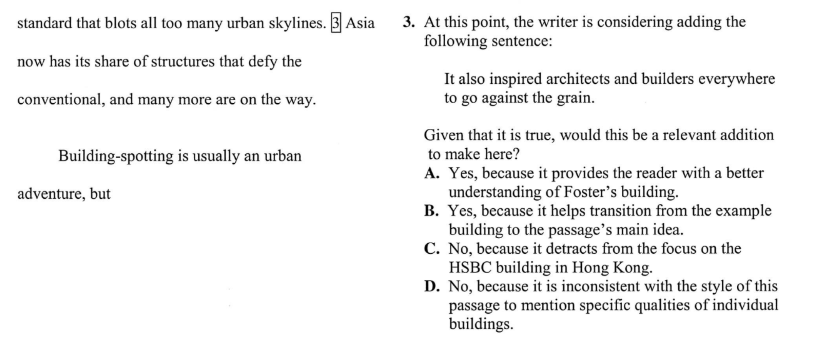
This word is commonly used when asked to "add" or "delete" a word or phrase.
A: and
B: or
C: but
D: with
The correct answer is:
A: and
Explanation:
This will help you to see whether it makes sense with or without a word.
For Example:
300
Which of the following is not true about the Math section:
A: This is the only section where questions increase in difficulty
B: You are allowed to use an approved calculator the entire test
C: If you don't have a calculator, you're out of luck and have to use mental math for everything
D: The answers are in smallest to largest order
The correct answer is:
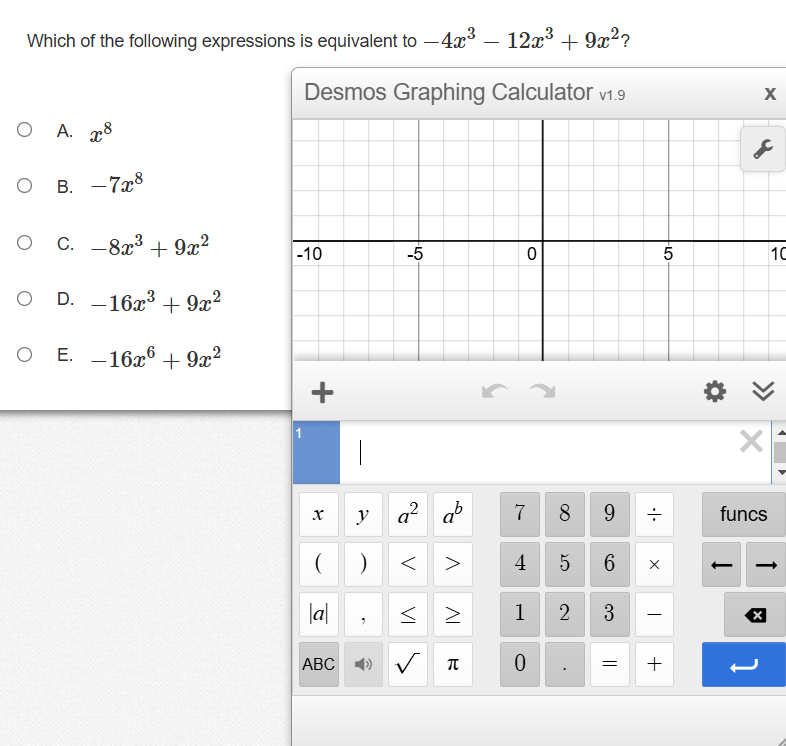
C: If you don't have a calculator, you're out of luck and have to use mental math for everything
Explanation:
The ACT will have a Desmos calculator embedded into the digital interface. Like this!
300
Which of the following is not a tip for completing the Reading section:
A: Complete the Passages in Order
B: Read the First and Last Paragraph of the passage completely and carefully
C: Make sure the ENTIRE passage is correct
D: Read the Questions FIRST
The correct answer is:
D: Read the Questions FIRST
Explanation:
Don’t pre-read the questions, it’s a huge waste of time. Do the questions as they appear in the passage so you know them in context!
300
Which of the following is not true about the Science section:
A: There is typically an introductory paragraph, then the charts/graphs/figures, followed by the questions
B: You are allowed to use an approved calculator the entire test
C: The passages DO NOT get more difficult
D: The only passage that MUST involve close reading is the opposing viewpoint passage
The correct answer is:
B: You are allowed to use an approved calculator the entire test
Explanation:
A calculator is only allowed on the Math section.
You won't be doing much computing on the science portion. The focus is on knowing how to use the information to make scientific inference.
400
To get a 20 on the ACT English portion you need to answer about this many questions correctly:
A: between 10 to 20 (20-40% correct)
B: between 20 to 30 (43-60% correct)
C: between 30 to 40 (60-68% correct)
D: between 40 to 50 (80-100% correct)
The correct answer is:
C: between 30 to 40 (60-80% correct)
Explanation:
The ACT is "curved." Getting a little over half correct will earn you a score in the 20's.
This score is relatively accepted for entrance into most 2 and 4-year colleges or other technical training programs that require placement tests.
400
To get a 20 on the ACT Math portion you need to answer about this many questions correctly:
A: between 20 to 24 (44-53% correct)
B: between 25 to 29 (55-64% correct)
C: between 30 to 34 (67-76% correct)
D: between 35 to 40 (78-89% correct)
The correct answer is:
A: between 20 to 24 (44-53% correct)
Explanation:
The ACT is "curved." Getting a little over half correct will earn you a score in the 20's.
This score is relatively accepted for entrance into most 2 and 4-year colleges or other technical training programs that require placement tests.
400
To get a 20 on the ACT Reading portion you need to answer about this many questions correctly:
A: between 10 to 14 (28-39% correct)
B: between 15 to 19 (42-53% correct)
C: between 20 to 24 (56-67% correct)
D: between 25 to 30 (70-83% correct)
The correct answer is:
C: between 20 to 24 (56-67% correct)
Explanation:
The ACT is "curved." Getting a little over half correct will earn you a score in the 20's.
This score is relatively accepted for entrance into most 2 and 4-year colleges or other technical training programs that require placement tests.
400
To get a 20 on the ACT Math portion you need to answer about this many questions correctly:
A: between 10 to 14 (28-40% correct)
B: between 15 to 19 (42-54% correct)
C: between 20 to 24 (57-69% correct)
D: between 25 to 29 (71-83% correct)
The correct answer is:
B: between 15 to 19 (42-54% correct)
Explanation:
The ACT is "curved." Getting a little over half correct will earn you a score in the 20's.
This score is relatively accepted for entrance into most 2 and 4-year colleges or other technical training programs that require placement tests.
500
The waitress places the old soup kettle in the center of the table, she knows that one bowl is just not going to be sufficient! If you aren’t cautious, you’ll be bursting by the time your entree arrives! I always select the veal because the thin slices of meat are so tender you don’t even need a knife.
Choose the best revision for the underlined part of this sentence from the attached document:
A: No Change
B: satiated
C: full
D: stuffed full
The correct answer is:
C: full
Explanation:
The simplest sounding word may often be the best choice. The word bursting is more of a negative term.
Satiated is what is referred to as a “fake-fancy” trap and not necessary. Stuffed full is more of a slang or colloquialism.
Even though this may seem like a judgment of writing styles, currently published test questions can require you to adjust any particular writing style to meet the demands of clarity and word choice standards. This process can be tricky!
500
If x = 6, y = -2, and z = -3, what is the value of x^y-yz+(x/(yz))
A: 251
B: 36/251
C: -(179/36)
D: 35/36
E: Answer cannot be determined
The correct answer is:
C:
-(179/36)
Explanation:
Substitute the values for the variables and simplify the expression:
6^(−2)−(−2)(−3)+(6/[(−2)(−3)]).
Recall that negative exponents in the numerator, when evaluated, move the expression to denominator, without the negative sign (
1/6^(-2)
, in this case). Also remember to mind your signs when substituting and evaluating operations with negative numbers:
According to the order of operations, PEMDAS, do the exponents first, then multiplication and division (left to right).
1/36-6+1
Then, in order to add/subtract, change the whole numbers to fractions with 36 as the denominator:
1/36-216/36+36/36
500
Modern medicine is not the only affected industry, however; because most modern food sources strive to provide large quantities of food quickly, all food industries have become heavily reliant upon antibiotic use. This is certainly the case for those raising livestock of any kind, ranging from cows, to pigs, to chickens. These animals are typically fed a steady diet of antibiotics, as these allow the animals to be grouped together in smaller quarters, and fed a diet encouraging quick and easy fat production. Without antibiotics, the cost of red meat, fish, and poultry would all likely skyrocket, rendering meat of any kind a precious commodity. Similarly, many fruits and plants are treated with antibiotics to stave off bacterial contamination that would render entire crops inedible. A post-antibiotic era would force the entire food industry to raise prices due to lower production and a greater likelihood of failure.
Q: According to the passage, what has led to the post-antibiotic era?
A: over-use of antibiotics and the failure to create newer, stronger antibiotic strains
B: doctors’ failure to adequately quarantine patients with antibiotic-resistant illnesses
C: the failure in modern medicine to accurately identify bacterial strains
D: the failure of medical labs to create adequate medicine and a lack of funding in the medical industry
The correct answer is:
A: over-use of antibiotics and the failure to create newer, stronger antibiotic strains
Explanation:
Those are the primary reasons identified. Correct identification of bacteria is not mentioned in the paragraph, nor is adequately quarantining patients. While the failure to create new and better antibiotics is identified as one of the causes of the development of antibiotic-resistant bacteria, a lack of funding was not a primary reason for the development of the post-antibiotic era, but is instead one of the obstacles facing the prevention of a post-antibiotic era.
500
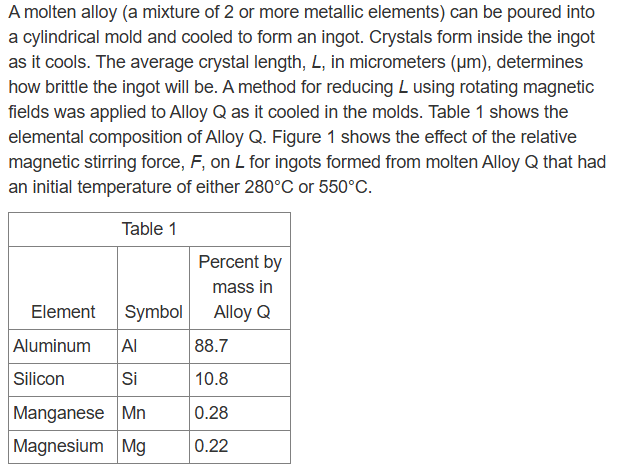
Based on Table 1, if an ingot of Alloy Q had a mass of 200g, that ingot would contain what mass of Mg?
A: 0.22g
B: 0.44g
C. 2.2g
D. 4.4g
The correct answer is:
B: 0.44g
Explanation:
See Figure 1: The percent by Mass for Magnesium should be 0.22 percent (0.0022 when written as a decimal). So 0.22% of 200g or (0.0022x200) is 0.44g.