Polynomial Equation Info
Polynomials-No Calculator
Rational Functions
More Rational
Polynomial Graph Info
Variation
Inequalities
100
What is the end behavior of y = (x + 3)2(x-7)(4x +3)3?
degree 6 with positive leading coefficient ... so up on both ends
100
List the PRZs (possible rational zeros) for the function:
f(x) = 6x^4 - 3x^3 + 5x^2 + 3x - 9
+-1, +-3,+-9, +-1/2, +-1/3, +-1/6, +-3/2, +-9/2
100
Find the hole for the function
f(x) = ((x+3)(x-2)(2x - 7))/((x - 2)(x-3))
(2, 15)
Explanation: x = 2 because the factor (x - 2) cancels out when simplifying. 15 because plug x = 2 into the simplified function
((x+3)(2x - 7))/(x-3)
100
Write a rational function with vertical asymptote at -5.
anything with (x + 5) as a factor of the denominator
100
What does the end behavior tell you about the equation of the polynomial?
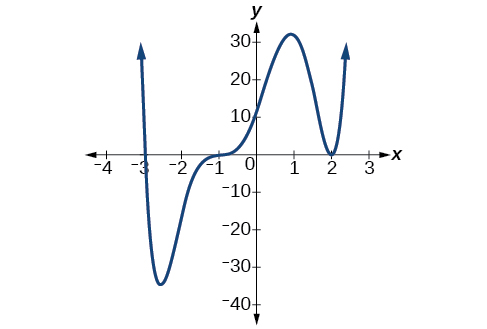
The polynomial has an even degree and positive leading coefficient.
100
On a treasure map, the actual distance is directly related to the scaled distance. If 15 miles is represented by 3 centimeters, then how many centimeters on the treasure map are equivalent to 135 miles?
d=ks
15=k(3) --> k = 5
d=5s
135=5s
s= 27 cm
100
-x2 +5x - 6 < 0
-(x-3)(x-2) = 0
x = 3,2
if x < 2 then -x2 +5x - 6 is negative
if 2<x<3 then -x2 +5x - 6 is positive
if x > 3 then -x2 +5x - 6 is negative
(-oo, 2)uu(3,oo)
200
What are the zeros of y = (x + 3)2(x-7)(4x +3)3?
-3, 7, -3/4
200
How many positive zeros might the function
f(x) = 6x^4 - 3x^3 + 5x^2 + 3x - 9
have?
f(x) term signs: + - + + - ... 3 sign changes so ... 3 or 1 positive zeros
200
Find the domain for the function
f(x) = ((x+3)(x-2)(2x - 7))/((x - 2)(x-3))
look at denominator BEFORE simplifying
{x|x!=2, 3} or (-oo,2)uu(2,3)uu(2,oo)
200
Why does the function have a slant asymptote?
f(x) = ((x+3)(x-2)(2x - 7))/((x - 2)(x-3))
The function has a slant asymptote because the degree of the numerator is one higher than the degree of the denominator.
200
What are the obvious zeros of the function?
-3, -1, and 2
200
If y varies inversely as x and x=5 when y=20, then what is the constant of variation, k?
y=k/x
20=k/5
k = 100
200
(x+4)/((x+4)(x-7)) <0
hole at x = -4, x = 7 is vertical asymptote.
intervals: (-oo,-4) is negative
(-4,7) is negative
(7,oo) is positive
but -4 is not included so...
{x|x<7 and x != -4}
OR
(-oo,-4)uu(-4,7)
300
What is the behavior of each zero in y = (x + 3)2(x-7)(4x +3)3?
-3 = touch because degree 2 (even)
7 = cross because degree 1 (odd)
-3/4 = cross because degree 3 (odd)
300
If
-3+sqrt5i
is a root of a polynomial g(x), then what else has to be a root as well?
-3-sqrt5i
300
Find the vertical asymptotes for the function
f(x) = ((x+3)(x-2)(2x - 7))/((x - 2)(x-3))
x = 3
*look at denominator after simplifying. (x = 2 is part of a hole, not an asymptote)
300
Write a rational function with a horizontal asymptote at y = -3
*degree of numerator and denominator should be the same
*lead. coeff of numerator / lead. coeff of denom = -3
300
What does the behavior of the zeros tell you about the equation of function
-3 = cross so (x + 3) has odd power
-1 = cross so (x + 1) has odd power ... it also crosses kind of like a cubic so maybe (x + 1)3
2 = touch so (x - 2) has even power, maybe (x - 2)2
Function should be degree 6 at least
300
The cost per person to rent a mountain cabin is inversely proportional (varies inversely) to the number of people who share the rent. If the cost is $36 per person when 5 people share, what is the cost per person when 8 people share?
C=k/P
36=k/5-->k=180
C=180/P
P=8 then C =$22.50
300
solve the inequality
((x + 1)(x - 2))/(x - 1)>=0
zeros of top and bottom: x = -1, 1, 2
intervals:
x<-1 negative
-1<x<1 positive
1<x<2 negative
x>2 positive
"or equal to" so -1 and 2 are included. 1 is not included because vertical asymptote
[-1,1) uu [2,oo)
400
How many turning points could y = (x + 3)2(x-7)(4x +3)3 have?
degree 6 so ... at most 5 turning points ... 5 or less turning points
400
How many negative zeros might the function
f(x) = 6x^4 - 3x^3 + 5x^2 + 3x - 9
have?
f(-x) term signs: + + + - - so one sign change, so exactly 1 negative zero
400
Give the x and y intercepts for the function
f(x) = ((x+3)(x-2)(2x - 7))/((x - 2)(x-3))
x intercepts: x = -3 and 7/2 (set simplified numerator = 0)
y intercepts: y = 7 (plug in 0)
400
f(x) = ((x+3)(x-2)(2x - 7))/((x - 2)(x-3))
What is the equation of the slant asymptote?
The slant asymptote is y = 2x+5. Do long division
400
How many turning points does the graph have? Using ONLY that information, what do you about the equation of the function?
The graph has 3 turning points so the function equation is at least degree 4, maybe higher.
** (-1,0) is NOT a turning point **
400
Suppose y varies jointly as x & z.
If y = -180 when z = 15
and x = -3,
then find y when x = 7 and z = -5.
y=kxz
-180=k(15)(-3) -->k=4
y=4xz
y=-140
400
The function f(x) = 0.125x2 - 0.8x + 99 models a motorcycle’s stopping distance, in feet, traveling at x miles per hour on dry pavement. Determine the speeds that require a stopping distance of at least 267 feet.
0.125x2 - 0.8x + 99>=267
0.125x2 - 0.8x - 168 >=0
I graphed it on the calculator and got 40 as a zero.
40 mph or higher
500
Sketch a graph of the function y = (x + 3)2(x-7)(4x +3)3 based only on information you know from the factored form of the equation.
end behavior: both ends up
zeros: -3 (touch), 7 (cross), -3/4 (squiggly cross)
500
Test the PRZ x = 3 using synthetic division for the polynomial. What does your result tell you about x = 3?
f(x) = 6x^4 - 3x^3 + 5x^2 + 3x - 9
top row: 6 -3 5 3 -9
middle row: -- 18 45 150 459
bottom row: 6 15 50 153 450
This means that x = 3 is not a root of the function f(x)
500
Simplify the function to find the hole (x,y)
y = (2x^3+13x^2-22x-105)/(6x^2+x-35)
Simplified function
y = ((x-3)(x+7))/(3x-7)= (x^2+4x-21)/(3x-7)
hole (-5/2, 1.71) or (-5/2, 99/58)
500
As x --> -1+ , f(x) --> what?
As x --> oo, f(x) --> what?
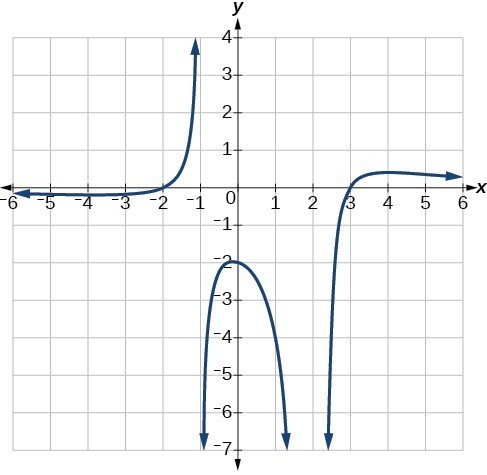
As x --> -1 from the right side, f(x) --> negative infinity
As x --> infinity, f(x) --> 0
500
Write the polynomial in factored form based on the information given in the graph.
(x+3)(x+1)3(x-2)2
500
Describe the variation equation in words:
a = (10cb)/sqrtd
a varies jointly as c and b and inversely as the square root of d
500
(x^5 - 9x^2 + 15x - 2)/((x + 17)(x - 3))>=0
use calculator to find real zeros of the top. check intervals using a table or graph. 3 and -17 not included because vertical asymptotes
(-17,0.15]uu(3,oo)
**technically 0.146144... but rounded to two decimal places