Unit 1: Functions and their Graphs!
Unit 2: Graphs of Functions/Transformations
Unit 3: Function Algebra
Unit 4: Polynomial and Rational Functions
100
Write the following in interval notation! Answer each part!
a)
x \le 5
b) all numbers greater than or equal to -10 and less than 1
c) 
a)
(- infty,5]
b)
[-10,1)
c)
(- infty,3) U [6, infty)
100
Does the following graph represent a one-to-one function? Justify your reasoning.

no! passes vertical line test so it is a function but does not pass the horizontal line test so it is not a one-to-one function!
This is the quadratic parent function!
100
Evaluate the following:
f(8)
f(x)=|root(3)(x)-7|
f(8) = |2-7| = |-5| = 5
100
Use the rational zeros theorem to list all possible rational zeros of the following polynomial:
f(x) = 3x^3 -8x^2-33x-10
all possible rational zeros: +- 1, 2, 5, 10, 1/3, 2/3, 5/3, 10/3
200
Make a table for the following function. Then, draw a graph using your table.
f(x)=\sqrt(5x+6)
some points on the graph:
(-1,1), (2,4), (6,6), (15,9), (23, 11)
graph looks like:

200
a) Identify the parent function from the following.
b) identify all transformations required to get from the parent function to the transformed function f(x).
f(x) = -2|x+2|+4
a) parent: f(x) = |x|; abs val fn
b) vertical shift up 4 units
reflect across x-axis
horizontal shift left 2 units
vertical stretch by factor of 2
200
Consider the following 2 functions!
f(x) = 1/x
and
g(x) =2/(x+2)
Find the following:
a) (g-f)(-1)
b)
(f/g)(-2)
a) 3
g(-1) - f(-1) = 2 - (-1) = 3
b) undefined! cannot divide by 0 ever!
200
Use the Remainder Theorem (Synthetic Substitution) to evaluate f(x) at c.
f(x) = 2x^4+4x^3+2x-1; c=-2
answer = f(-2) = -5
300
Identify all x and y-value discontinuities from the following graph. Then, find the domain and range. Express it in interval notation.

x value discontin. = -3, 0
y-value discontin.= -1.3, -1
Domain: (-infinity, -3) U (-3, 0) U (0, infinity)
Range: (-infinity, -1.3) U (-1.3, -1) U (-1,infinity)
300
Evaluate the following using algebraic methods:

lim as x approaches -3 of the function is: -5
*hole! factors cancel!
300
Do the following notations mean the same thing? Explain briefly.
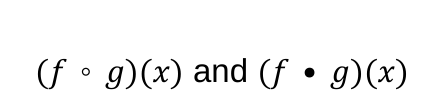
no! 1st is function composition! That means evaluate f(x) with g(x) as the input of the function! f(g(x))
the second means multiply! f(x) times g(x) !
300
The following represents a rational function:
f(x) = (x^2+7x-8)/(x-1)
Find and label the following:
a) x and y intercepts
b) Vertical asymptote
c) horizontal asymptote
d) slant asymptote
e) holes
f) domain and range
x intercept: (-8,0)
y-intercept: (0,8)
holes: hole at x=1 -> (1,9)
vertical asymptote: no vertical asymptote
horizontal asymptote: none (undefined because bigger degree on top BOTU)
slant asymptote: y=x+8
domain:
(- infty,1) U (1, infty)
range:
(- infty, 9) U (9, infty)
400
Create a function on the graph side of your whiteboard that has a:
domain of: (-5, 3]
range of: (-7, 2]
hole at (-5,-7) and curve
400
You must answer each part correctly to receive credit. Identify whether the following statements are true or false about the following graph of f(x).
a) f(1) = -5
b)
lim_(x->-3)f(x)=0
c) f(-2) = 3
d) lim_(x->1)f(x)= undefined 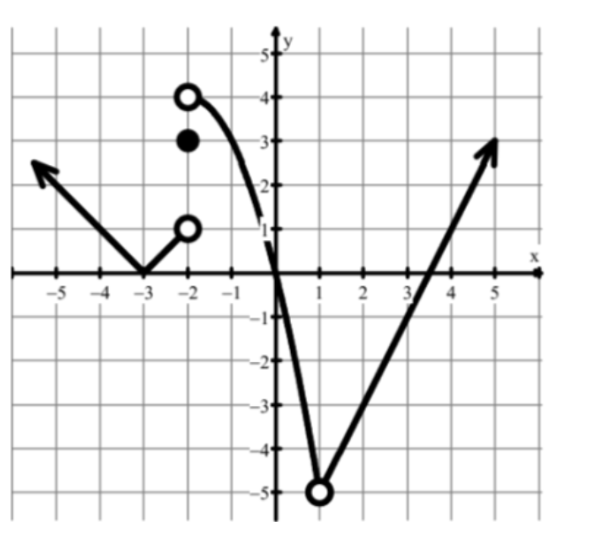
a) false - undefined bc of the hole
b)true
c) true
d) false - lim is -5
400
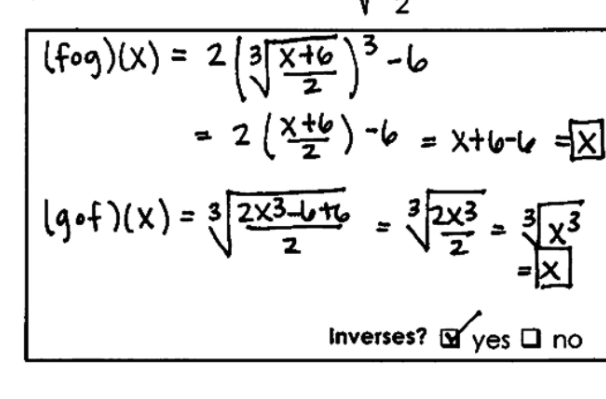
Emma claims that the inverse of
f(x)=2x^3-6
is
f^-1(x)=root(3)((x+6)/2
Is Emma correct? Justify your reasoning.
yes correct!
400
Divide the following polynomials showing work for both synthetic and long division. You must get both methods correct to receive credit for this question.
(x^4-64x^2+9x-80) divide (x-8)
x^3 + 8x^2 +9-(8)/(x-8)
500
Write a function for the given perimeter of the rectangle as a function of as a function of its width. A rectangle has a width that is 7 more than the length. The perimeter can be found by adding two times the width by two times the length.
Simplify your function!
P(w) = 2(w) + 2(w-7)
P(w) = 2w + 2w -14
P(w) = 4w -14
p(w) = 2(2w-7)
w = 7 + l so l= w-7
500
Find a value of a so that the following piecewise function is continuous everywhere.

a= 13
want limits at x=1 to be the same and equal f(1).
ax-5 = 8 ax=13 x =1 so a=13
500
Find k(x), g(x), and h(x), such that: k(g(h(x)))=5(x-1)^3
k(x)=5x
g(x)= x^3
h(x)= x-1
500
Use the factor theorem to determine if the following binomial is a factor of the given polynomial. If so, completely factor the polynomial and give the zeroes.
f(x) = 9x^4 - 18x^3 -73x^2+2x+8; (x+2)
yes! factor:
f(x) = (x+2)(9x^3-36x^2-x+4)
becomes
f(x) =(x+2)(9x^2-1)(x-4)
then becomes
f(x) = (x+2)(3x+1)(3x-1)(x-4)
finally the zeroes are: {-2,-1/3,1/3, 4}