Polynomials &
Rationals
Rationals
Describe the end behavior of
y=2x^5+3x^2-2x+1
y \rightarrow \infty as x \rightarrow \infty and y \rightarrow -\infty as x \rigtharrow -\infty
Find the domain, range and any asymptotes of
y=ln (x-2)
Domain: All real numbers greater than 2
Range:
(-\infty,\infty)
Asymptotes: x=0
Find the vertex and focus of the parabola:
Vertex (0,0)
Focus (2,0)
\sum_{i-2} ^5 i^2-2
Find the sum:
46
Find the limits using the graph:
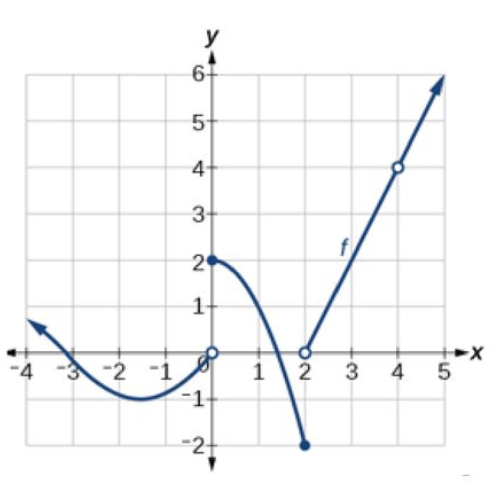
a) \lim_{x \to 2^- } f(x)
b) \lim_{x \to 4 } f(x)
a) -2
b) 4
List all possible rational roots:
y=-2x^5-4x^4-13x^3+70x^2-90x+14
\pm14 , \pm7 , \pm 7/2 , \pm2 , \pm1
Evaluate the log:
log_4 (\frac{1}{64})=
-3
Find the equation of the conic shown here: 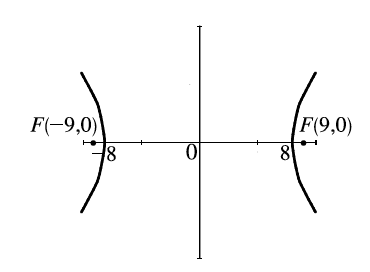
Hyperbola.
\frac{x^2}{64} - \frac{y^2}{17}=1
Write a rule for the sequence: 9, 14, 19, 24
a_n=5n+4
Use a table to find the limit as x approaches 0 of
y=\frac \sin x \x
1
Find all horizontal and vertical asymptotes of the function:
r(x)=\frac{x^2}{x^2-11x+30}
y=1, x=5 and x=6
Combine into a single logarithm:
\log_2 x + \log_2 (xy^2) +4log_2 y
\log_2 (x^2 y^6)
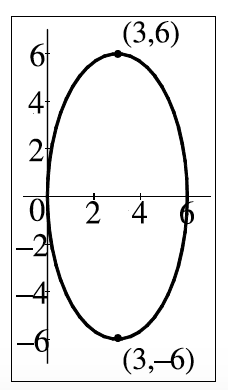
Sketch the graph of the ellipse:
\frac{(x-3)^2}{9} + \frac{y^2}{36}=1
Find the first 3 partial sums of the series: 20+10+5+...
S_1=20
S_2=30
S_3=35
Find the limits below if
f(x)=\frac {3x^2+3x-6}{x^2-4}
a) \lim_{x \to -2 } f(x)
b) \lim_{x \to \infty } f(x)
a) 9/4
b) 3
Use synthetic division to show (x-4) is a factor of
f(x)=x^5+x^4-36x^3-16x^2+320x
See board
Solve the equation:
3^{x+2} = 5^{2x}
x = 1.036
Complete the square and determine the type of curve represented by the equation:
4x^2+9y^2+24x-36y+36=0
Ellipse
\frac{(x+3)^2}{9} + \frac{(y-2)^2}{4}=1
During a baseball season, a company pledges to donate $5000 to a charity plus $100 for each home run hit by a local team. Does this represent a sequence or series? Explain.
Series
Suppose f(x) is a function, where
f(2)=3
Does this imply:
\lim_{x \to 2} =3?
No. Consider a piecewise function
Write the equation of the cubic function shown here:
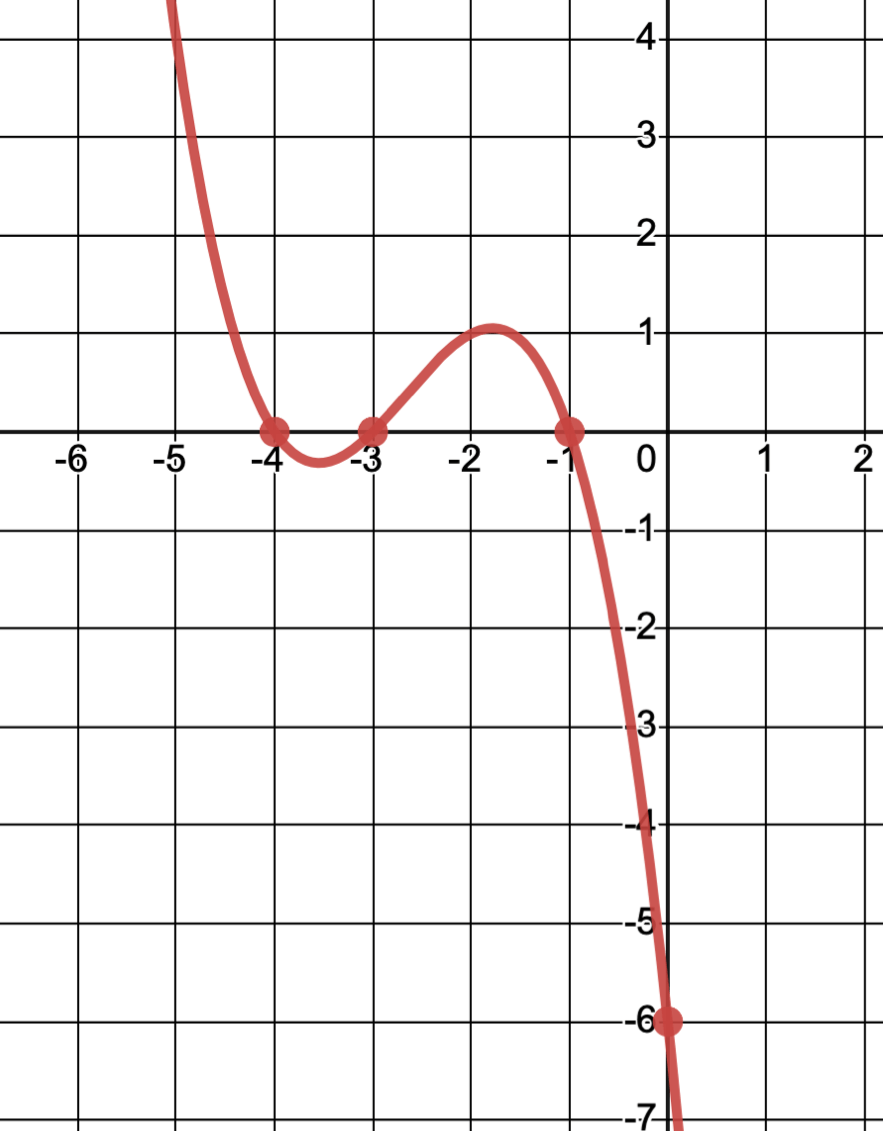
y=-\frac{1}{2}(x+1)(x+4)(x-3)
How long will it take an investment of $300 to triple if the interest rate is 9.5% per year, compounded continuously?
About 11.5 years
A cannon fires a cannonball along a parabolic path with vertex at the highest point of the path.
If the cannonball lands 1600 ft from the cannon and the highest point it reaches is 2,400 ft above the ground, find an equation for the path of the cannonball. Place the origin at the location of the cannon.
(x-800)^2= -\frac{800}{3} (y-2400)
Find the sum of the positive odd integers less than 300.
Hint - use a formula
22,500
Find the limit using any method:
\lim_{x \to 0} \frac{|x-4|}{x-4}
DNE