Radians& Degrees/Reference Angles
Coterminal Angles/SOH CAH TOA
Graphing
Trig Equations
Verifying Identities
100
Convert to radians:
165^o
(11pi)/12
100
Find a positive and negative coterminal angle for
65^o
425^o, -295^o
100
Name period and amplitude for
y=4sin(3x)-1
period=2pi/3
amplitude=4
100
costheta=1/2
theta=pi/3+2pin, (5pi)/3+2pin
100
Verify that
csc^2xcos^2x=csc^2x-1
Change to sine and cosine
Pythagorean Identity
200
Convert to degrees:
(7pi)/5
252^o
200
Find a positive and negative coterminal angle for
(3pi)/4
(11pi)/4, -(5pi)/4
200
Name transformations for y=-cos(x+pi)+3
vertical reflection, left pi, up 3
200
(cscx+2)(2cos-sqrt3)=0
x=pi/6+2pin, (11pi)/6+2pin,(7pi)/6+2pin
200
Verify that sinxsecx=tanx
change to sine and cosine,
sine/cosine=tangent
300
Convert to degrees:
(4pi)/5
144^o
300
Find x.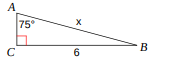
6.211
300
What are the period and asymptotes of
y=2tan(x+pi)-1
period=pi
asymptotes: -pi/2, -3pi/2
300
tanx=-1
x=(3pi)/4+2pin, (7pi)/4+2pin
300
Verify that
1/(sinxcotx)=1/cosx
change to sine and cosine, cancel out sines
400
What is the reference angle for
140^0
40^o
400
Find x. 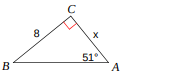
6.478
400
What is the period, amplitude, and transformations of
y=-3sin(1/2(x+pi))-5
Transformations: vertical reflection, horizontal stretch, vertical stretch, left pi, down 5
Period=4pi
Amplitude=3
400
2sintheta=sqrt2
theta=pi/4+2pin, (3pi)/4+2pin
400
Verify that
sec^2x-csc^2x=tan^2x-cot^2x
sub 1-sec^2x=tan^2x, then use Pythagorean identity substitution
500
What is the reference angle for
(7pi)/6
pi/6
500
Find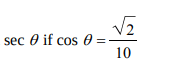
5sqrt2
500
Graph
y=2cos(x-pi/2)+1
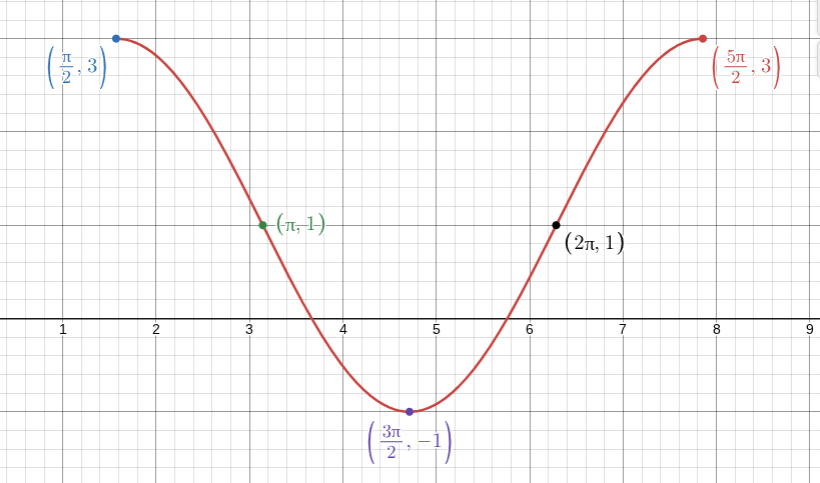
500
sinx+sqrt3=-sinx
x=(4pi)/3+2pin, (5pi)/3+2pin
500
Verify that
1/(1-sinx)+1/(1+sinx)=1+tan^2x
combine into one fraction, Pythagorean identity, reciprocal identity, Pythagorean identity