Basics
Definitions Features
Factors of PED
Application to
Firms
Firms
Application to Govt
Numerical
100
Which PED value represents perfectly inelastic demand?
A. –∞
B. –1
C. 0
D. +1
C. 0
100
Which of the following goods is most likely to have a PED of –2.5?
A. Insulin
B. Salt
C. Luxury cars
D. Basic food items
C. Luxury cars
100
A firm wants to increase revenue but operates in a market where close substitutes are becoming more available over time. Which strategy is most appropriate?
A. Increase price immediately
B. Decrease price as demand becomes more elastic
C. Keep price constant regardless of PED
D. Exit the market
B. Decrease price as demand becomes more elastic
100
A firm finds that the PED for its product is –0.3. If the firm increases price by 10%, what will most likely happen to total revenue?
A. Decrease significantly
B. Increase
C. Remain unchanged
D. Become zero
Answer: B
(Inelastic demand → price ↑ leads to TR ↑)
100
A government imposes a tax on cigarettes, knowing demand is highly inelastic. What is the most likely outcome?
A. Large fall in tax revenue
B. Small increase in tax revenue
C. Large increase in tax revenue
D. No change in tax revenue
C. Large increase in tax revenue
100
What is the correct definition of price elasticity of demand (PED)?
A. The change in price divided by change in quantity demanded
B. The responsiveness of quantity demanded to a change in income
C. The responsiveness of quantity demanded to a change in price
D. The responsiveness of price to a change in demand
C. The responsiveness of quantity demanded to a change in price
200
Which factor is most likely to make demand for a good more price inelastic?
A. Many close substitutes available
B. The good is a necessity
C. High proportion of income spent on the good
D. Long time period
B. The good is a necessity
200
. A product has many close substitutes. What is likely its PED?
A. Inelastic
B. Perfectly inelastic
C. Elastic
D. Zero
C. Elastic
200
A good has a PED of –1.8. If price rises by 10%, what is the expected change in quantity demanded?
A. Falls by 18%
B. Falls by 10%
C. Falls by 1.8%
D. Increases by 18%
A. Falls by 18%
200
A company selling luxury handbags faces a PED of –2.0. If it raises prices, total revenue will:
A. Increase because demand is elastic
B. Decrease because demand is elastic
C. Remain constant
D. Increase because quantity demanded increases
B. Decrease because demand is elastic
200
A government wants to maximise tax revenue with minimal reduction in consumption. Which good should it tax?
A. Luxury cars
B. Foreign holidays
C. Petrol
D. Designer clothing
Answer: C
(Petrol is relatively inelastic)
200
Which formula correctly represents PED?
A. % change in price ÷ % change in quantity demanded
B. % change in quantity demanded ÷ % change in price
C. Change in quantity demanded × change in price
D. Price ÷ quantity demanded
B. % change in quantity demanded ÷ % change in price
300
Why does the availability of substitutes affect PED?
A. It changes production costs
B. It affects consumer responsiveness to price changes
C. It changes government tax policy
D. It affects supply onl
B. It affects consumer responsiveness to price changes
300
A good that takes a small proportion of income is likely to have:
A. Elastic demand because consumers are sensitive
B. Inelastic demand because price changes are less noticeable
C. Unit elastic demand
D. Perfectly elastic demand
Inelastic demand because price changes are less noticeable
300
. If price rises by 10% and quantity demanded falls by 25%, PED is:
A. –0.4
B. –2.5
C. –1.5
D. –0.25
B. –2.5
300
A firm sells a product with PED = –0.4. It increases price by 20%. Which combination is most likely?
A. Quantity falls by 8%; TR rises
B. Quantity falls by 50%; TR falls
C. Quantity rises by 8%; TR rises
D. Quantity falls by 20%; TR unchanged
A. Quantity falls by 8%; TR rises
(%ΔQ = –0.4 × 20% = –8%; price ↑ more than quantity ↓ → TR ↑)
300
How does time affect PED?
A. Demand becomes more inelastic in the long run
B. Demand becomes more elastic in the long run
C. Time has no effect on PED
D. Demand becomes perfectly inelastic over time
B. Demand becomes more elastic in the long run
300
Why is PED usually expressed as a negative value?
A. Because price and demand always increase together
B. Because of the law of demand showing an inverse relationship
C. Because it measures income changes
D. Because it is always equal to zero
B. Because of the law of demand showing an inverse relationship
400
A product has PED = –1.2. If price falls by 5%, what happens to quantity demanded?
A. Increases by 6%
B. Increases by 1.2%
C. Decreases by 6%
D. Increases by 12%
A. Increases by 6%
400
A supermarket introduces a discount on rice, a staple food. Sales increase only slightly.
What is the best explanation?
A. Rice has many substitutes
B. Rice is a luxury good
C. Rice is a necessity with inelastic demand
D. Rice has perfectly elastic demand
C. Rice is a necessity with inelastic demand
400
If PED = –0.6 and price increases by 15%, what is the expected change in quantity demanded?
A. Falls by 9%
B. Falls by 6%
C. Falls by 15%
D. Falls by 25%
A. Falls by 9%
400
A monopolist observes that lowering price from $10 to $8 increases total revenue from $1000 to $1200. What can be inferred?
A. PED < 1 in this range
B. PED > 1 in this range
C. PED = 1 exactly
D. Demand is perfectly inelastic
B. PED > 1 in this range
Price ↓ by 20%
You assumed quantity ↑ by 20%
So you thought PED = 1 (unitary)
400
Which factor would make PED more elastic?
A. Necessity good
B. No substitutes
C. Large proportion of income spent
D. Short time period
C. Large proportion of income spent
400
Which strategy is most likely to reduce price sensitivity?
A. Increasing number of substitutes
B. Reducing switching costs via competition
C. Building strong brand loyalty
D. Lowering product quality
C. Building strong brand loyalty
500
Which action would MOST likely make demand more inelastic?
A. Entering a highly competitive market
B. Increasing availability of substitutes
C. Lowering switching costs
D. Increasing product differentiation
Increasing product differentiation
500
A firm is charging a price of $12 for its product and using 80% of its production capacity of 10 000 units per month. Assuming the product has unitary price elastic demand, which price should the firm charge toutilise its full capacity?
A $9.00 B $9.60 C $10.00 D $10.60
A. $9.00
The firm is currently producing 80% of 10,000 units:=8,000
It wants to produce 10,000 units, so quantity demanded must increase by:=25\%
Since demand is unitary price elastic (PED = 1):
Therefore, price must fall by 25%.
500
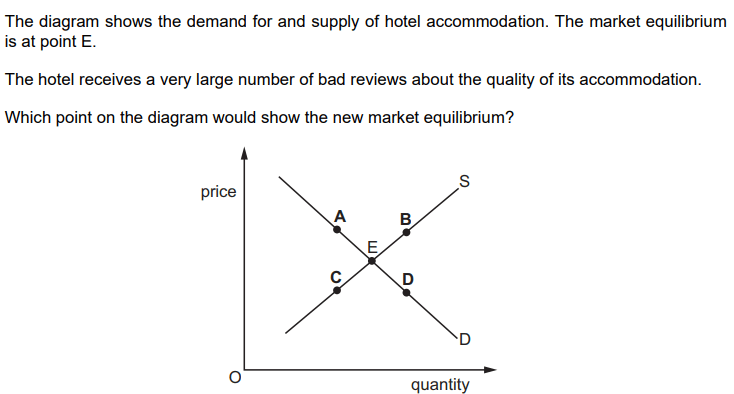
C
500
What is a major function of the price mechanism?
A providing incentives for government intervention to reduce income inequality
B removing shortages by creating incentives for market prices to fall
C removing surpluses by creating incentives for market prices to rise
D signalling changes in market conditions to producers and consumers
D signalling changes in market conditions to producers and consumers
500
A family is willing to pay a maximum of $600, $500 and $400 for air tickets for the mother, father and daughter to attend a wedding in another city. The airline announces a promotional air fare of $450 per ticket, provided at least three tickets are purchased. What will be the consumer surplus gained by the family if they use the promotional offer?
A $100 B $150 C $200 D $250
B $150
500
Which statement defines market equilibrium?
A when ceteris paribus no longer applies
B when quantity demanded equals quantity supplied
C when quantity demanded is equal to price
D when supply can no longer expand
B when quantity demanded equals quantity supplied