Simple Probability
Theoretical Probability
Experimental Probability
Independent Probability
Dependent Probability
100
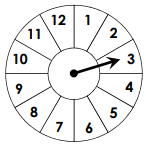 P(even number) =
6/12 = 1/2 = 0.5 = 50%
100
There are 2 blue, 6 yellow, 10 red, 3 green, 5 orange, and 4 purple marbles in a jar. One marble is chosen at random.
P(red or blue)=
12/30 = 2/5 = 0.4 = 40%
100
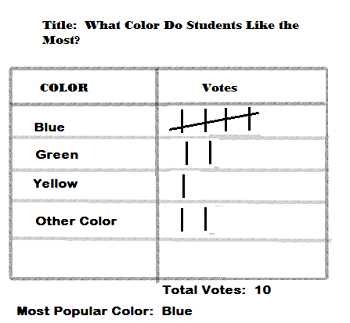
What is the experimental probability of choosing green based on the data?
2/10 = 1/5 = 0.2 = 20%
100
What is the probability of getting heads when flipping a coin and getting a 3 when rolling a die?
Round to the nearest percent.
1/12 = 0.08 = 8%
100
There are 2 math books and 3 social
studies books on a shelf. Randomly
choosing a math book off of the shelf,
giving it to your friend, and then
randomly choosing another math
book.
1/10 = 0.1 = 10%
200
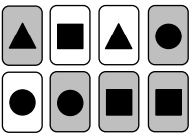
P(not a triangle)=
6/8 = 3/4 = 0.75 = 75%
200
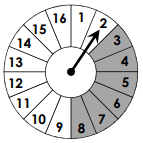
P(grey)=
6/16 = 3/8 = 0.375 = 37.5%
200
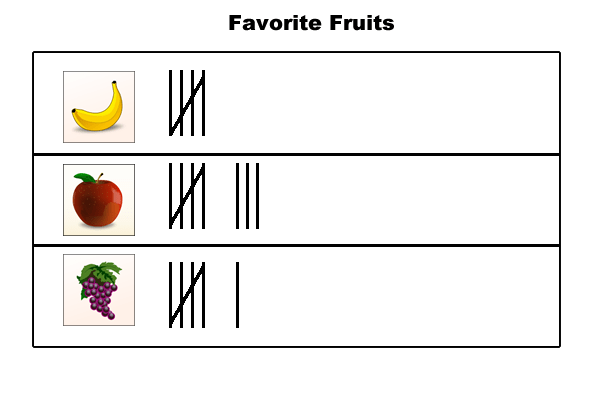
What is the experimental probability of choosing grapes based on the data?
round to the nearest percent
6/19 = 0.32 = 32%
200
Each spinner below is spun once. What is the
probability that the result will be a three or a
consonant?
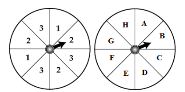
Round to the nearest percent.
9/32 = 0.28 = 28%
200
You have a bag with 20 Skittles. Eight of them are red and 5 of them are green. What is the probability of choosing a red, eating it, then choosing a green?
Round to the nearest percent?
2/19 = 0.11 = 11%
300
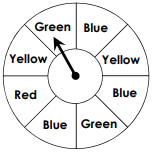
P(green or blue)=
5/8 = 0.625 = 62.5%
300
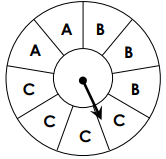
P(C)=
4/10 = 2/5 = 0.4 = 40%
300
A piece of fruit was selected from a basket 40 times. The results are shown in the table below.
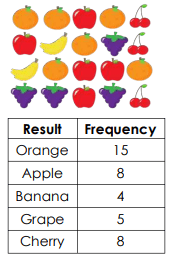
What is the experimental probability of choosing a banana or a cherry?
12/40 = 3/10 = 0.3 = 30%
300
What is the probability that the spinner will land on a 5 then a 1?
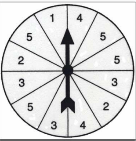
Round to the nearest percent.
1/36 = 0.03 = 3%
300
A box contains 6 yellow, 2 black, and 4 green pencils. What is the probability of pulling a green pencil, keeping it, then pulling another green pencil?
Round to the nearest percent.
1/12 = 0.08 = 8%
400
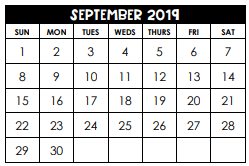
P(a date that is a multiple of 5)=
6/30 = 1/5 = 0.2 = 20%
400
If someone spins a spinner with four spaces labeled A, B, C, D AND rolls a die (numbered 1-6), how many different combinations are possible?
24
400
A marble is picked from a jar 60 times. Results are shown in the table below.
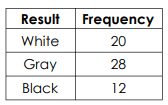
What is the experimental probability of not choosing a black marble?
48/60 = 4/5 = 0.8 = 80%
400
You randomly choose a letter from the word
P R O B A B I L I T Y and replace it each time.
What is the probability you will choose a vowel (not y) then a B?
Round to the nearest percent.
8/121 = 0.07 = 7%
400
You have a deck of 52 cards. You choose a red card, keep it, then choose another red card.
Round the probability to the nearest percent.
(In a deck of cards, 26 are red and 26 are black)
25/104 = 0.24 = 24%
500
What is the probability of pulling a black Jack out of a normal deck of cards?
2/52 = 1/26
500
Create a tree diagram for these compound events:
Flipping a coin and spinning a spinner with the sections labeled 1, 2, 3, 4
H T
1 2 3 4 1 2 3 4
500
A number between 1 and 3 is chosen at random 30 times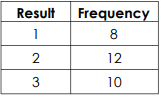
According to this EXPERIMENTAL probability, how many 2's should be expected after 50 choices?
20
500
You throw a number cube three times. What is
the probability that you roll an odd number all
three times?
Round to the nearest percent.
1/8 = 0.13 = 13%
500
You have a bag of 50 jelly beans. 15 are
green. What is the probability of pulling out a
color other than green, eating it, then pulling out a
green?
Round your answer to the nearest percent.
3/14 = 0.21 = 21%