Neurons and Nerve Impulse
Synapses and Neurotransmitters
Anatomy
Genetics and Plasticity
Random
100
The glial cell that make myelin sheaths in the central nervous system.
What is oligodendrocytes?
100
This is the 'pocket' where neurotransmitters are held before being released by the presynaptic neuron into the synapse.
What is a vesicle?
100
The brain can be broken down into these three parts.
What is the hindbrain, midbrain, and forebrain?
100
The common name of deoxyribonucleic acid
What is DNA?
100
The anatomical direction that refers to the front of the spinal cord and brain
What is anterior?
200
The part of the neuron that contains the nucleus, mitochondria, and other important organelles.
What is the soma/cell body?
200
Unlike neurotransmitters, which are released into and act across the synaptic cleft, this chemical messenger circulates throughout the body in the bloodstream.
What is a hormone?
200
This lobe is responsible for processing sensory information like touch, temperature, and pain. It is also helpful in understanding where you are in space.
What is the parietal lobe?
200
This process involves changes in gene expression caused by environmental factors or chemical modifications to DNA or associated proteins, without changing the underlying DNA sequence.
What is epigenetics?
200
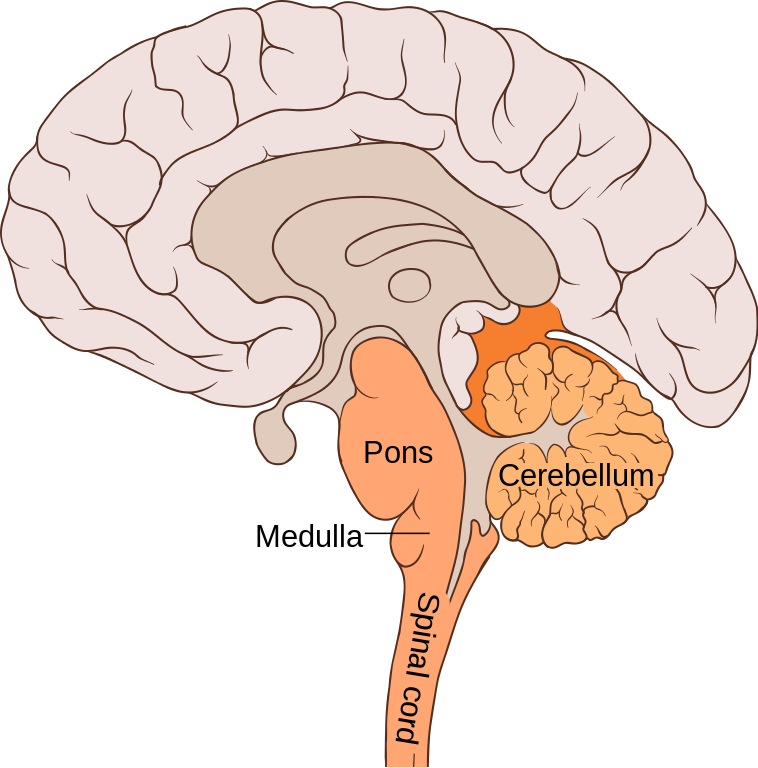 This area of the brain, containing the medulla, cerebellum, and pons.
What is the hindbrain?
300
During repolarization, sodium channels close while this opens up.
What is the potassium channel?
300
Three different presynaptic neurons simultaneously release excitatory neurotransmitters onto different locations of the same postsynaptic neuron. The combined graded potentials bring the axon hillock to threshold. This process allows these inputs to combine.
What is spatial summation?
300
This technique indirectly measures neural activity by detecting localized changes in the oxygenation of blood flowing through the brain, allowing researchers to observe which regions become more active during specific tasks.
What is fMRI?
300
In response to nervous system injury, these proteins increases regrowth of damaged neurons.
What are neurotrophins? (I will also accept nerve growth factor)
300
This enzyme breaks down monoamine neurotransmitters such as serotonin in the presynaptic neuron; inhibiting it can increase the availability of serotonin in the synapse.
What is monoamine oxidase (MAO)?
400
A neuron receives a weak stimulus that causes its membrane potential to increase to 5 mV. A stronger stimulus causes a 15 mV increase. The electrical signal also becomes weaker as it spreads away from the site of stimulation. What type of signal is being described?
What is an excitatory postsynaptic potential (EPSP)? (I will also take graded potential)
400
Explain the 3 main differences between an electrical synapse and a chemical synapse (the contact between neurons, the speed of conduction, and the timing of action potentials).
-Electrical synapses have direct contact between neurons whereas chemical has a gap
-Electrical is faster than all chemical transmissions
-Electrical has depolarization occurring in both cells, resulting in the two neurons acting as if they were one. Chemical occurs one after the next.
400
The 4 ways to study the brain.
1. Examine the effects of brain damage after damage or you can temporarily inactivate a region
2. Examine the effects of stimulating a brain area
3. Record brain activity during behavior
4. Correlate brain anatomy with behavior
400
These two kinds of strokes are different in the certain ways but both result in edema (fluid build up inside of the brain). Name and explain their difference.
What is hemorrhage and ischemia? Hemorrhage is a brain bleed due to a burst blood vessel, ischemia is a clot leading to blockage in a blood vessel.
400
Name the 5 stages of neuronal development, IN ORDER.
What is 1) Proliferation 2) Migration 3) Differentiation 4) Myelination 5)Synaptogenesis?
500
If a neuron reaches threshold, explain what happens to the membrane potential from threshold through depolarization, repolarization, and hyperpolarization.
What is: Na⁺ channels open and sodium enters the neuron causing depolarization, then Na⁺ channels close and K⁺ channels open allowing potassium to exit causing repolarization; continued K⁺ efflux produces hyperpolarization before the membrane returns to resting potential thanks to the sodium-potassium pump?
500
The stages that occur during synaptic transmission are:
What is: synthesis, storage, release, diffusion, activation of receptor, and inactivation/reuptake. (will give full credit if you name at least 4)
500
Name at least 4 components of the limbic system as well as the overall function of the limbic system.
Hypothalamus, thalamus, amygdala, hippocampus, cingulate gyrus, and basal ganglia
Associated with motivation emotions, such as eating, drinking, sexual activity, anxiety, and aggression
500
Exposure to alcohol in the fetus brain suppresses this neurotransmitter and enhances the release of GABA. The consequence is less exposure to less neurotrophins leading to this process of prgrammed cell death.
What is glutamate? and what is apoptosis?
500
Explain the difference between a neuromodulator and neurotransmitter in terms of 1) where they are synthesized 2) where they are released 3) how long their effect lasts 4) what triggers their release and 5) where their effect spreads
Transmitter
1) Presynaptic Terminals 2) Axon Terminals 3) <1 seconds to a few seconds 4) action potential 5) synaptic cleft
Modulator
1) cell body 2) dendrites, axon, cell body (soma) 3) minutes 4) repeated depolarizations 5) wide area