Chapter 9
Chapter 10 part 1
Chapter 10 part 2
Chapter 14 part 1
Chapter 14 part 2
100
People overestimate the frequency of school shootings because such events are highly publicized when they do occur. This illustrates _________
Bonus: what are representative heuristics?
Availability heuristics: estimating the likelihood of events based on their availability in memory
Bonus: estimating the likelihood of events in terms of how well they seem to represent, or match, particular prototypes
100
What is the difference between reliability and validity?
Bonus: what are the two types of validity?
Reliability: the extent to which a test yields consistent results
Validity: the extent to which the test actually measures or predicts what it promises.
Bonus: Content validity and predictive validity
100
What are the two types of intelligence?
Bonus: how are they affected as we age?
Fluid: our ability to reason speedily and abstractly; tends to decrease with age, especially during late adulthood
Crystallized: our accumulated knowledge and verbal skills; tends to increase with age.
100
What is reciprocal determinism?
the interacting influences of behaviour, internal cognition, and environment
100
What is the best way to predict a person's behaviour?
Past behaviour in a similar situation
200
A person would struggle to speak words, yet could sing familiar songs and comprehend speech. Which part of this person's brain is damaged?
Bonus: what is the function of this area?
Broca's area is damaged: directs the muscle movements involved in speech
Recall: Wernicke’s area: involved in language comprehension and expression
200
What is the difference between achievement tests and aptitude tests? give me an example of each.
achievement test: a test designed to assess what a person has learned --> midterm
Aptitude test:a test designed to predict a person’s future performance; aptitude is the capacity to learn -->A college entrance exam, which seeks to predict your ability to do college work
200
In 1932, every child born in Scotland in 1921 was given an intelligence test. At age 80, the survivors were tested again. Finally, at age 90, the remaining survivors were again retested. This investigation exemplifies a________
longitudinal method/ cross-sectional method?
Bonus: explain each.
longitudinal method
Bonus:
longitudinal method: study and restudy the same group at different times in their life span
Cross-sectional: study different groups at one time
200
What is the spotlight effect? explain with an example
Bonus: how can we reduce it?
overestimating others’ noticing and evaluating our appearance, performance, and blunders (as if we presume a spotlight shines on us)
Bonus: 1. know and remember the spotlight effect.
2. take the audience’s perspective
200
Who came up with the idea of the self-centred perspective? what is it?
Bonus: what does a growth-promoting social climate provide?
Rogers’ person-centered perspective held that people are basically good and are endowed with self-actualizing tendencies. Unless thwarted by an environment that inhibits growth
Bonus:
1. Acceptance 2. Empathy 3. Genuineness
300
"How many uses can you think of for a brick?" Norman is asked by the examiner. Norman is taking a test of_______
Hint: (_____thinking)
Bonus: what is the other type of thinking? and what is it used for?
Answer: Divergent thinking: expanding the number of possible problem solutions; creative thinking that diverges in different directions
Convergent thinking: an ability to provide a single correct answer.S AT tests requires it.
300
What are the 4 components of emotional intelligence? explain each
- Perceiving emotions (recognizing them in faces, music, and stories)
- Understanding emotions (predicting them and how they may change and blend)
- Managing emotions (knowing how to express them in varied situations)
- Using emotions to enable adaptive or creative thinking
300
1. What are some metal ability in which female outpace males at
2. What are some metal ability in which males outperform females at
Bonus: reasons behind this difference?
1. Spelling and verbal fluency, detecting emotions, locating objects, sensitivity to touch, taste and colour
2. Complex math problems, spatial ability
Reasons: Evolution and Culture
300
What are Freud's personality structures? explain each briefly
id: strives to satisfy basic sexual and aggressive drives and operates on the pleasure principle, demanding immediate gratification
Ego: mediates among the demands of the id, superego, and reality
Superego: represents internalized ideals and provides standards for judgment (the conscience) and for future aspirations
300
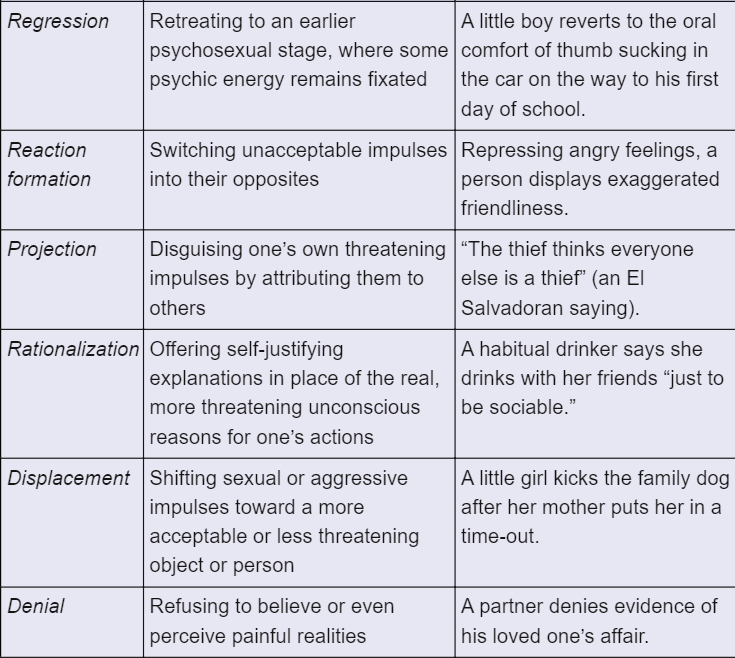
Bonnie is afraid to express anger toward her overbearing and irritating supervisor. Instead, she is critical of her children. A psychoanalyst would suggest that Bonnie's reaction to her children illustrates_____(which defence mechanism?)
List 2 more of the mechanisms and explain each
Displacement
400
What are the language structural components?
Bonus: what is universal grammar?
- Phonemes are the smallest distinctive sound units in a language. To say bat, English speakers utter the phonemes b, a, and t
- Morphemes are the smallest language units that carry meaning. Some morphemes, like bat or gentle, are words. Others—like the prefix pre- in preview or the suffix -ed in adapted—are parts of words.
- Grammar is a language’s set of rules that enable people to communicate. Grammatical rules guide us in deriving meaning from sounds (semantics) and in ordering words into sentences (syntax).
Bonus: Universal Grammer: built-in predisposition to learn grammar rules
400
What are Sternberg’s Three Intelligences?
- Analytical (academic problem-solving) intelligence is assessed by intelligence tests, which present well-defined problems having a single right answer. Such tests predict school grades reasonably well and vocational success more modestly.
- Creative intelligence is demonstrated in innovative smarts: the ability to adapt to new situations and generate novel ideas.
- Practical intelligence is required for everyday tasks that may be poorly defined and may have multiple solutions.
400
What is stereotype threat?
Provide an example.
a self-confirming concern that one will be evaluated based on a negative stereotype
For Example, Black students performed worse after being reminded of their race just before taking verbal aptitude tests.
400
Who created the hierarchy of needs? what is it? what need is at the top of the hierarchy?
Bonus: what is self-concept?
Maslow’s pyramid of human needs, beginning at the base with physiological needs that must first be satisfied before higher-level safety needs and then psychological needs become active.
At the top: self-actualization (the process of fulfilling our potential) and self-transcendence (meaning, purpose, and identity beyond the self).
Self-concept: all our thoughts and feelings about ourselves, in answer to the question, “Who am I
400
What is self-esteem? and what are the two types of self-esteem? explain each.
Bonus: what are some of the negatives of high self-esteem
Self-esteem: one’s feelings of high or low self-worth
Defensive self-esteem is fragile. It focuses on sustaining itself, which makes failure and criticism feel threatening.
Secure self-esteem is less fragile because it is less contingent on external evaluations.
Bonus: inflated self-esteem can lead to self-serving bias, greater aggression and narcissism
500
What are the problem-solving strategies? Explain each (4)
Bonus: what are the obstacles? (2)
Strategies:
1. Trial and error
2. Algorithm: step-by-step procedures that guarantee a solution
3. Heuristics: simple thinking strategy that often allows us to make judgments and solve problems efficiently
4. Insight:a sudden realization of a problem’s solution (Aha moment)
Obstacles:
Confirmation bias: a tendency to search for information that supports our preconceptions and to ignore or distort contradictory evidence.
Fixation: the inability to see a problem from a new perspective
500
List 4 of the 8/9 Gardner’s Multiple Intelligences and describe each
Bonus: list the remaining ones
1. Naturalist: Ability to understand, categorize, and explain patterns encountered in the natural world.
2. Linguistics: Ability to use Language and display sensitivity to the order of things
3. Logical: the ability to see the intelligence of numbers and logic and the ability to handle chains of reasoning and recognize patterns and order.
4. Musical: sensitivity to pitch, rhythm, melody, and tone.
5. Interpersonal 6. Intrapersonal 7. Spatial 8. Kinesthetic 9. existential
500
Who are the Key Proponents for each of the
1. Psychoanalytic theory
2. Psychodynamic
3. Humanistic
4. Trait
5. Social-Cognitive
Who are the Key Proponents for each of the
1. Psychoanalytic theory:Freud
2. Psychodynamic: Adler, Horney, Jung
3. Humanistic: Rogers, Maslow
4. Trait: Allport; Eysenck, H.; Eysenck, S.; McCrae; Costa
5. Social-Cognitive: Bandura
500
List the 4 theories of personality. Give a brief description of each (what did each focus on?)
•1. Psychodynamic Theories:theories that view personality with a focus on the unconscious and the importance of childhood experiences
•2. Humanistic theories: theories that view personality with a focus on the potential for healthy personal growth.
•3. Trait theories: define personality in terms of stable and enduring behaviour patterns (traits)
•4. Social-cognitive theories: views behavior as influenced by the interaction between people’s traits (including their thinking) and their social context