Mr. Willis
Is your brain functioning?
cereBRUH
Are you paying attention?
Double A's
Different Strokes 4 Different Folks
Bruised Brain Syndrome
That's Pretty Palsy
100
Which are the two major arteries entering the skull?
Internal Carotid Artery
Vertebral Artery
100
What are the general functions of the Frontal Lobe?
Motor Control (premotor cortex)
Problem Solving (prefrontal area)
Speech Production (Broca's Area)
100
Where are the two potential spaces in the brain?
Epidural: between outermost dura and skull
Subdural: between innermost dura and arachnoid
100
This highly complex cognitive function resides in the non-dominant side of the brain and refers to the ability to initiate and maintain concentration/alertness on a particular stimulus/set of stimuli
Attention
100
Aphasia and apraxia are most associated with damage to which side of the brain?
L Hemisphere
100
Your stroke patient presents to PT with sequencing difficulties, catastrophic reactions, and impaired logic; which side of the brain is affected?
L Side
100
Your patient presents to PT s/p TBI, your CI reads their presentation as follows:
"Difficulty with identification and categorization of objects, increased aggression, and memory deficits especially in recognizing faces"
Your CI then asks you what lobe you think is likely affected
Temporal Lobe
100
What are some typical tests and measures for individuals with CP related to body structure/function (name at least 2)
Tone
Muscle Strength
ROM
Selective Motor Control
Posture
Joint Contractures
Balance
(other acceptable: CN integrity, ventilation, respiration, aerobic capacity)
200
Which blood vessels contribute to the blood supply of the anterior brain?
Anterior Cerebral Artery (ACA)
Middle Cerebral Artery (MCA)
200
Which part of the brain is responsible for involuntary responses?
Brainstem
200
Your patient has suffered an epidural hematoma, what structure is critically involved given the location of the bleed?
Middle Meningeal Artery
200
Your neuro patient wants to go grocery shopping after their session and ask for written directions to the closest one; the next session they come back and admit that they couldn't make sense of the written directions.
Your directions are definitely impeccable so it has to be their neuro injury. Which side can you infer the injury is on?
Dominant/L Side
200
Which two areas in the brain are responsible for speech production and speech comprehension?
Broca's Area (frontal lobe) - speech production
Wernicke's Area (temporal lobe) - speech comprehension
200
Name at least two appropriate Stroke Outcome Measures
FIM
Fugl-Meyer Assessment (motor performance)
Postural Assessment Scale for Stroke Patients
Stroke Impact Scale
Trunk Impairment Scale
200
Name at least 3 TBI prognostic factors
- Age
- Gender
- Presence if Prior Brain Injury
- Injury Severity
- Length of Coma- Initial GCS
- Injury Etiology
- Rehab Length of Stay
- Duration of Post-Traumatic Amnesia
- Timing of Rehab
- Intensity of Rehab
- Nature of Injury (TBI vs NTBI)
- Presence of Comorbidities
200
Name at least one cause of CP
Hypoxia/Hypoxia-Ischemia
Periventricular White Matter Injury (in sensorimotor pathways - more common in premature infants)
Germinal Matrix HemorrhageDiffuse Encephalopathy
Brain Malformation
Perinatal Stroke
Intrauterine Infection
Genetic Factors
300
What is the blood supply of the corpus callosum and what is the approximate proportion?
Anterior Cerebral Artery (4/5th)
Posterior Cerebral Artery (1/5th)
300
Your patient comes in and strangely complains of auditory processing, language comprehension, and memory/info retrieval...what area of their brain may be affected?
Temporal Lobe
300
Bridging veins are found where in the brain (that we know of)?
Subdural Space
300
You bring your patient out to the gym in order to work on an exercise requiring the parallel bars, as you are explaining the exercise you see the patient glancing around at other patients and getting distracted by colorful equipment. What type of attention is impaired in this patient?
Selective Attention
300
Your patient presents to PT s/p stroke with aphasia, throughout of the course of the treatment they are able to provide short, non-fluent sentences and often struggle to find the appropriate word. At one point, they try to repeat a word you have said but struggle and are unable to do so. What blood supply was likely impacted to result in this aphasia?
Superior Division of MCA (Broca's Aphasia)
300
In terms of the National Institute of Health Stroke Scale, a good prognosis is indicated with a higher/lower score
Lower
300
The primary impairments of the TBI are grossly dependent on location/severity of injury; name at least 3 primary impairments that your patient may present with.
Motor Control
Tone
Sensory Deficits/PerceptionVisual
Pain
Postural Control
Speech/Language/Swallowing
Cognition
Behavioral
300
When is a prenatal infant at most risk of developing a Germinal Matrix Hemorrhage and Periventricular Leukomalacia
GMH: most common before 32 wks (GMH is matured by 34 wks)
PVL: most common after 30 wks
400
While the cortical branches of the PCA supply blood to some of the temporal lobe and the occipital lobe; where do the DEEP branches off the PCA supply blood to?
Parts of Thalamus
Parts of Basal Ganglia
400
If a patient's chart determines they have a lesion in the cerebellum, how might they present?
Impaired Balance and Coordination
400
The subarachnoid space is an actual space due to the adherence of arachnoid mater to the dura and the pia mater to the brain; it contains major arteries and CSF. What is another important structural component to the subarachnoid space?
Creates Cisterns
400
What are the two types of spatial neglect?
Peripersonal: within reach
Extrapersonal: far space
400
Name at least 2 characteristics of Wernicke's Aphasia, oftentimes a result of a stroke involving the inferior division of the MCA
- Severely impaired comprehension
- Fluent, quick speech
- "Empty" speech (verbose verbal output/paraphasia)
- Normal prosody
- Uses word substitutions
- Neologism
- Impaired repetition
- Impaired naming
- Unawareness of communication impairment
400
Which type of stroke has a higher mortality rate?
Intracerebral Hemorrhage
400
You walk into your patient's room in the IRF to introduce yourself, your patient interrupts and starts talking about wanting to stand up. They don't listen to any of your reasoning and are unable to self-identify obstacles to return to ambulating. When you assist them in sitting up, they lurch forward to the RW repeatedly and attempt to stand up despite multiple verbal cues to slow down.
Which side of the brain is likely impaired?
Right Side - decreased insight/awareness of deficits/lack of safety awareness, impulsivity
400
Please state which part of the CNS is associated with the following forms of CP:
- Spastic
- Athetoid (Dyskinetic)
- Ataxic
Spastic: motor cortex or pyramidal tracts
Athetoid/Dyskinetic: basal ganglia and/or cerebellum
Ataxic: cerebellum
500
Other than the MCA and the ACA, name at least one more branch of the ICA
Posterior Communicating Artery
Anterior Choroidal Artery
Opthalamic Artery
500
This lobe of the brain contains the somatosensory cortex
Parietal Lobe
- touch perception
- body orientation
- sensory discrimination
500
These are the main sites for absorption of CSF into the sinuses using villi as one-way valves allowing flow of CSF to venous blood. They project into the sinuses, particularly the sagittal sinus.
Arachnoid Granulations
500
Lesions of the non-dominant parietal association cortex may result in UNL, name at least ONE other way it would present
Difficulties w Visual Spatial Analysis
Personality/Emotional Changes
Difficulty Comprehending/Expressing Emotion in Speech
500
This type of speech disorder refers to a problem with motor programming of speech unrelated to muscle weakness/paralysis and presenting as groping/mouthing, inconsistent/variable errors, speech sound/substitutions, sequencing errors, and awareness of errors
Speech Apraxia
500
Name at least one of the predictors of mortality and poor outcome following an intracerebral hemorrhage
Older Age
Low Glasgow Coma Scale Score and Level of Consciousness
Increased Intracerebral Hemorrhage Volume
Presence of Intraventricular Hemorrhage
Deep/Infratentorial Intracerebral Hemorrhage location
Preceding Anti-Thrombotic Therapy
500
You are conducting an examine of your alert and oriented TBI patient, there are no contraindications; what tests and measures would you conduct. (Name two tests and measures)
Motor Control
Postural Control
Reflex Integrity
Muscle Tone
Functional Mobility
Cranial Nerve Integrity
Joint Integrity/ROM
Sensation/Sensory Integration
Integument Integrity
Pain
500
In one sentence, describe the GMFCS levels
Level 1: child walks (home/outdoors/community), climbs stairs without railing, and runs/jumps - speed, balance, and coordination are limited
Level 2: child walks in most settings (may use AD), climbs stairs w railing - difficulty in open/uneven environments ad minimal running/jumping
Level 3: child walks using handheld AD in most indoor settings, climb stairs w railing - use wheeled mobility for long distances/self-proper for short distances
Level 4: child's method of mobility requires physical assist/powered mobility in most settings - walks short distances at home w A and is otherwise transported in manual w/c or powered mobility
Level 5: child is transported in manual w/c in all settings - limited in ability to maintain antigravity head/trunk postures and control leg/arm mvmts
600
Which two blood supplies contribute to internal capsule?
Deep branches of ACA
Deep branches of MCA
600
Nearly all the pathways that project to the cortex must first synapse in this structure
Thalamus
600
What are the three functions of CSF?
- Bathes external and internal surfaces of the brain and spinal Cord
- Serves as a cushion btwn CNS and surrounding bones
- Involved in nourishment of nervous tissue
600
This term refers to the inattention to the contralesional 1/2 of mental pics
Representational Neglect
600
You instruct your patient to demonstrate to you how to put on a seatbelt, they reach for their seatbelt but do not grasp or pull it across their body. What type of limb apraxia could this be?
Ideational Apraxia - inability to perform a sequence of actions/multistep tasks
600
Can you identify the 5 most common types of Lacunar Syndromes?
Pure Sensory: d/t infarct in thalamus + may have chronic pain
Pure Motor: d/t infarct in post limb of internal capsule
Dysarthria-Clumsy Hand Syndrome: d/t lesion in genu of internal capsule/base of pons + motor speech disorder (no language deficit)Ataxic Hemiparesis: d/t lesion in genu of internal capsule/base of pons
Sensorimotor Stroke: d/t lesion in thalamus/adjacent post limb of internal capsule
600
Your patient is distressed at the start of your session, they say that their doctor mentioned secondary impairments and they have no idea what they are talking about. What are the secondary impairments for TBI that your patient may experience?
Musculoskeletal Impairments
Cardiopulmonary/Cardiovascular Impairments
Integumentary Impairments
600
What are some standardized motor tests used for CP? (Name at least 2)
GMFM-66 or -88: gross motor function measure specific for CP, used for prognosis
Movement-Assessment Battery for Children (M-ABC): manual dexterity/ball skills/static and dynamic balance for school aged kids
Tests for Gross Motor Development (TGMD-2)
Alberta Infant Motor Scale (AIMS): general infant measure for gross motor - only before diagnosis of CP
Peabody Development Motor Scale (PDMS-2): general development measure
Bruininks Oseretsky Test of Motor Proficiency (BOT-2): general gross and fine motor for higher level/older children
700
What is this?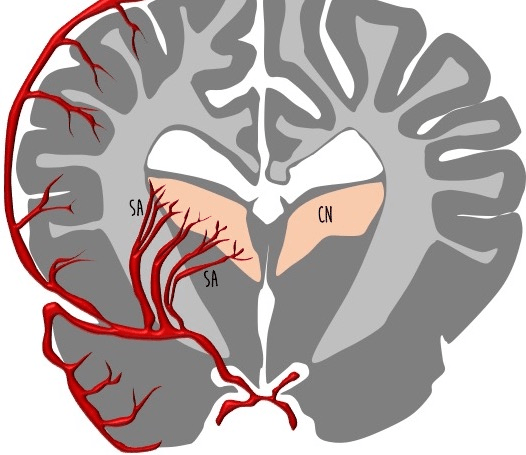
Middle Cerebral Artery
700
These structures modulate the output of the corticospinal tract and other descending motor systems
Cerebellum
Basal Ganglia
700
Your patient's chart states that they have increased intracranial pressure, immediately the three causes of increased ICP come to mind. What are they?
Bleed
Failure of to reabsorb CSF into venous system
Mass
700
Name at least 2 types of motor neglect
Akinesia: absence of movement (even w motor ability)
Hypokinesia: delayed initiation of movement
Motor Impersistence: inability to sustain movement/posture
Hypometria: decreased movement amplitude
Bradykinesia: slow execution of movement
Motor Extinction: pt has difficulty moving both limbs @ the same time
Hemispatial/Directional
700
This refers to a disturbance in motor control of speech resulting in problems w speech execution due to muscle weakness/paralysis. There are various types including flaccid/spastic, ataxic, hypo/hyperkinetic, and mixed
Dysarthria
700
This occurs within minutes of an infarction and can increase intracranial pressure - it is a major problem w large infarcts and is frequently the cause of death in acute strokes
Signs of this may include:
- decreased consciousness/coma
- decreased HR
- irregular respirations
- unreacting pupils
- vomiting
Cerebral Edema
700
There are several mechanisms that may cause damage in the hours-to-days following injury, these are called secondary mechanisms. Name at least one.
Excitotoxicity: toxic actions of excitatory neurotransmitters (glutamate) leading to loss of neuronal function + cell death
Apoptosis: nerve cell death d/t necrosis and inappropriate apoptosis
Edema: leakage of water from blood vessels to brain tissue via damaged BBB - leads to expansion of brain volume + increased ICP
Secondary Ischemia: results from impairment/decline in cerebral blood flow from local edema/space occupying hematomas/herniation of brain tissue/increased ICP
700
Which type of CP presents with reduced muscle tone and abnormal gait w a wide BOS?
Ataxic CP
800
Anterior and Posterior spinal arteries provide direct blood flow to the entire spinal cord while radicular arteries (which feed supply mostly the meninges) are most prominent in what two areas of the spine?
Thoracic
Lumbar
800
This structure describes a region deep in the brain that functions as a communication pathway; it allows communication between areas of the cerebral cortex and areas of the brainstem
Internal Capsule
800
Your CI is super into neuro and wants to talk about hydrocephalus. Unfortunately, she's quizzing you about the 3 most common causes of hydrocephalus...and they are?
Excess CSF production
Obstruction of CSF circulation (in ventricles/subarachnoid space)
Decreased reabsorption of CSF (via arachnoid granulations)
800
What are the 3 possible subtypes of sensory neglect?
Auditory
Somatosensory
Visual
800
Name at least 1 complication that may result from dysphagia
Aspiration
PNA
Malnutrition
Dehydration
800
Match the appropriate etiology to Intracerebral Hemorrhage or a Subarachnoid Hemorrhage
- caused by high blood pressure, burst aneurysm, and illicit drugs
- head injuries, burst aneurysm, and AVM
Intracerebral Hemorrhage: high BP, burst aneurysm, illicit drugs
Subarachnoid Hemorrhage: head injuries (not really considered a stroke if head trauma), burst aneurysm, AVM800
What is the danger of CSF mixing with blood?
Clots forming in the CSF
800
Your teenage CP patient presents to PT with slow and uncontrollable writhing/jerky movements of the hands, feet, arms, and legs usually due to damage to the basal ganglia and/or cerebellum. What type of CP is this?
Athetoid CP