Water
Macromolecules
Enzymes
Cell Theory
Cell Types
Structure & Function of Cells
Cellular Energy
Cell Cycle & Mitosis
Meiosis
DNA & Protein Synthesis
100
This property helps coastal areas maintain stable climates because water absorbs and releases heat slowly.
High Specific Heat Capacity
100
These macromolecules are built from monosaccharides and primarily serve as quick energy sources and structural components in organisms.
Carbohydrates
100
This term describes the energy barrier that enzymes lower, as shown in the graph below where the catalyzed reaction curve has a much smaller peak than the uncatalyzed one.

Activation Energy
100
Louis Pasteur determined that microbes only appeared in sterile broth if the broth was exposed to the air. He concluded that the microbes were found in the air and contaminated the broth. Pasteur’s findings contributed to this part of the cell theory.
All cells come from preexisting cells.
100
This structure is found in plant cells but not animal cells and provides rigidity and protection.
Cell wall
100
This organelle’s double‑membrane structure allows it to efficiently produce ATP for both plant and animal cells.
The powerhouse of the cell!
Mitochondria
100
These two molecules are the main reactants plants take in to perform photosynthesis.
Water and Carbon Dioxide
100
This phase of the cell cycle is where the cell grows, copies its DNA, and prepares for division.
Interphase
100
This is the type of cell division that reduces chromosome number by half to form haploid gametes.
Meiosis
100
DNA replication is described as 'semi-conservative' because each new DNA molecule contains this.
One old strand and one new strand
200
This property of water allows insects like water striders to walk on its surface due to strong hydrogen bonding between molecules.
Cohesion
200
These macromolecules are made mostly of hydrocarbons and function in long-term energy storage, insulation, and membrane structure.
Lipids
200
The graph below shows a steady rise in enzyme activity until about 37°C, followed by a sharp drop. This drop occurs because this happens to the enzyme.
Denaturing
200
Schleiden and Schwann concluded in the 1830s that all plants and animals are made of cells, contributing to this part of the cell theory.
All living things are made of cells.
200
These organelles are present in plant cells for photosynthesis but absent in animal cells.
Chloroplast
200
This large organelle in plant cells stores water and maintains turgor pressure, helping the plant stay upright.
Central Vacuole
200
The primary products of photosynthesis include oxygen and this energy‑rich molecule.
Glucose
200
During this stage of mitosis, chromosomes line up in the middle of the cell.
Metaphase
200
During prophase I, homologous chromosomes exchange genetic material in a process known as this.
Crossing over
200
The purpose of DNA replication in cells is best described as this.
Ensuring genetic information is passed to daughter cells
300
This unusual behavior of water explains why ice floats, insulating aquatic life during winter.
Expansion upon Freezing
300
These polymers are composed of amino acids and perform most of the cell’s work, including catalyzing reactions and providing structural support.
Proteins
300
The graph below shows 3 enzymes that all operate at different optimal pH. List each of their optimal pH
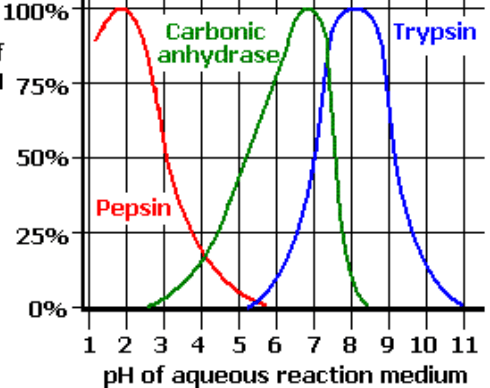
Pepsin 2
Carbonic Anhydrase 7
Trypsin 8
300
This technology invention was the most beneficial for the development of the Cell Theory
Microscope
300
This feature distinguishes prokaryotic cells from eukaryotic cells.
Lack of what?
Lack of a nucleus.
300
This structure’s selective permeability (semi permeable) allows both plant and animal cells to regulate what enters and leaves the cell.
Cell Membrane
300
Aerobic respiration requires these molecules as reactants to efficiently produce ATP.
Oxygen and glucose
300
This event occurs during anaphase and ensures each daughter cell receives an identical set of chromosomes.
Sister chromatids separate.
300
During prophase I, homologous chromosomes exchange genetic material in a process known as this.
Independent assortment
300
Transcription produces this molecule from a DNA template.
mRNA
400
Water’s polarity allows it to dissolve many substances, giving it this key biological role.
Universal Solvent
400
These macromolecules store and transmit hereditary information using nucleotide monomers.
Nucleic Acids
400
The reaction‑rate‑versus‑substrate‑concentration graph below levels off at high substrate levels. This plateau occurs because.
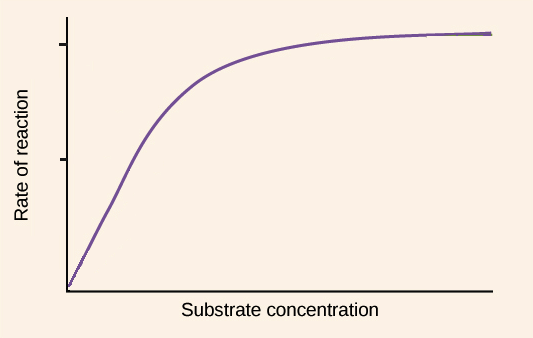
all enzyme molecules have filled active sites.
400
This principle of cell theory states that the cell is the fundamental unit of structure and function in living organisms.
Cells are the basic unit of life.
400
This structure is found in eukaryotic cells but not in prokaryotic cells and is responsible for packaging and modifying proteins.
Golgi Apparatus
400
This type of transport moves molecules from high to low concentration without using cellular energy.
Passive transport
400
This is the main function of cellular respiration in both plants and animals.
Releasing stored energy from food.
400
Mitosis is essential for this type of reproduction, which produces genetically identical offspring.
Asexual reproduction
400
Meiosis differs from mitosis because meiosis produces cells with this chromosome condition.
Haploid cells
400
During translation, each three‑base codon on mRNA corresponds to this.
Specific amino acid
500
This combination of water’s properties—cohesion, adhesion, and surface tension—allows plants to transport water upward through xylem.
Bonus: This property is water molecules sticking to other water molecules.
This property of water is water molecules sticking to other molecules.
Capillary Action
Cohesion
Adhesion
500
List each macromolecule pictured in the correct order.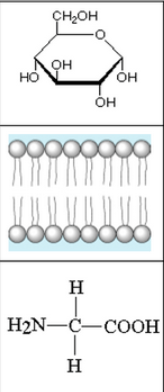
Carbohydrate
Lipid
Protein
500
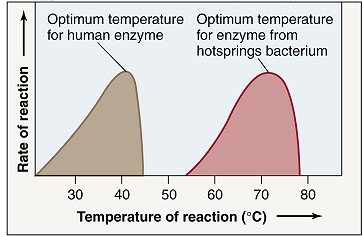
If the human enzyme ended up in the hot spring environment, this would happen to the protein.
Denature
500
Students are observing the physical characteristics of live fruit flies, as shown in the diagram below.
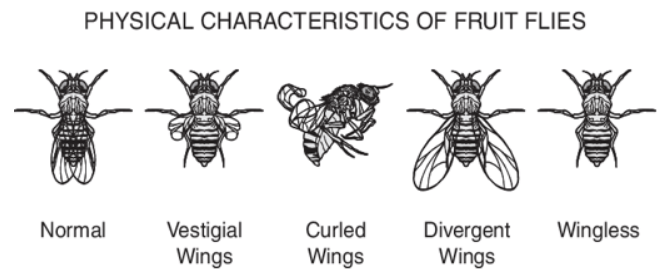 This type of microscope would be best to use to observe the physical characteristics of living fruit flies.
light microscope, dissecting microscope, scanning tunneling microscope or transmission electron microscope
Dissecting microscope
500
This key difference explains why eukaryotic cells can grow larger and become more complex than prokaryotic cells.
They contain membrane- bound organelles.
500
The sodium–potassium pump is an example of this type of transport because it moves ions against their gradients.
Active transport
500
The oxygen released during photosynthesis becomes essential for this process in most living organisms.
Cellular respiration
500
The main purpose of mitosis in multicellular organisms is this.
Growth, repair, and maintaining chromosome number
500
Crossing over and independent assortment both contribute to this important biological outcome.
Genetic variation
500
Gene expression occurs because transcription and translation ultimately produce this.
Protein