Resting and EXS HR and BP
Electrocardiography
Pulmonary Function Testing
Hemodynamics
100
What should happen to SBP, DBP, and MAP during exercise?
SBP increases as intensity increases, DBP stays the same or slightly decrease, MAP increases but not as much as SBP.
100
What are the intrinsic paces set by the SA and AV nodes?
SA = 100 bpm
AV = 40-60 bpm
100
Define ventilation vs. respiration
Ventilation: Moving air into and out of the lungs
Respiration: Gas exchange (O2 and CO2 exchange between alveoli and blood stream)
100
What happens to BP when introduced to a cold stimulus?
Increases: vessels in the extre
200
Mike's resting BP is 129/80. What is his BP category?
Stage 1 hypertension
200
Draw and label a healthy ECG (one heart beat)
200
Define inspiratory reserve volume
The amount of air you breathe in maximally following normal inspiration.
200
Is an increased resting pulse pressure a good or bad and why?
Bad: indicates arterial stifness
300
Why do these changes occur during exercise (explain SBP and DBP).
Increasing O2 demands drive up cardiac output, therefore increasing HR and SV. This causes SBP to increase.
DBP stays stable or slightly decreases due to vasodilation.
300
What electrical activity corresponds with the P wave?
Atrial depolarization
300
Which lung volume increases during exercise?
Tidal volume
300
List 3 CV stressors
Exercise, temperature, postural changes
400
What things influence BP (name at least 3)?
Vessel diameter
Vessel length
Blood viscosity
Vessel integrity (endothelial health, extensibility)
Age
400
What mechanical activity corresponds with the QRS complex?
Ventricular systole and atrial diastole
400
FVC(actual) = 3.0 L, FVC (predicted) = 3.8 L, and FEV1.0 = 2.9 L.
Does this person have a pulmonary disease? Which classification?
FEV1.0% = FEV1.0/FVC x 100
2.9L/3.0L x 100 = 96.7%
FVC(actual) / FVC(predicted) x 100
3.0L/3.8L x 100 = 78.9%
Restrictive: FVC(actual)/FVC(predicted) ≤ 80%
400
Explain how the components of MAP change temporarily after moving from a supine to a standing position.
TPR = MAP / Q and Q = SV x HR
MAP = TPR x SV x HR
SV drops due to gravity and decreased venous return
HR increases to compensate for decreased SV (has to maintain cardiac output to deliver enough O2)
TPR increases due to vasoconstriction in efforts to push blood back to the heart.
500
What are Kortokoff sounds and what does each represent?
The heartbeat sounds when measuring BP. The first kortokoff sound represents SBP and the second represents DBP.
500
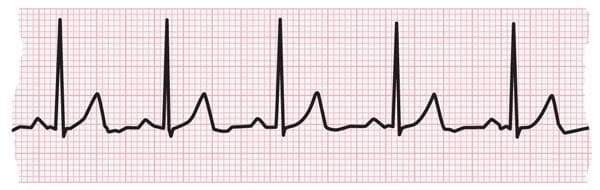
Calculate and classify this heart rate.
~83 bpm, normal HR
500

Letter F represents which lung capacity?
Functional residual capacity.
Significance for bodpod measurements?
500
HR = 62 bpm
SV = 70 mL/beat
BP = 124/68
Calculate TPR
MAP = DBP + (PP/3) = 68 + ((124-68)/3) = 86.7 mmHg
Q (L/min) = HR x SV = (62 bpm x 70 mL/bt) / 1000mL = 4.34 L/min
TPR = MAP / Q = 86.7 mmHg / 4.34 L/min = 20 mmHg/L/min