Location
Place
Region
Movement
Human Environment Interaction
100
What is location?
Where a place is.
100
What is place?
Place tries to explain what a location is like or what kind of place it is.
100
What is region?
An area that shares unifying features. Explains how and why places are similar.
100
What is movement?
The movement of people, goods, and ideas impacting locations around the world. Why and how are they moving?
100
What is human environment interaction?
How humans interact with their environment and adapt or change it to suit their needs.
200
Define absolute & relative location.
Absolute location is the exact location of a place, using latitude and longitude.
Relative location is giving an approximate location in relation to another object or place.
200
Describe the difference between physical geography and political geography.
Physical: landscapes, terrain, environment, climate
Political: international and regional borders, government division
200
What are some unifying characteristics that a region might share? Give at least 3.
Climate, terrain, language, snow fall, industry, people, vegetation, etc.
200
How do ideas travel from one place to another?
People, internet, news, radio, social media, communication, etc.
200
In what ways do humans take their local environment to ensure their survival?
Using resources as food source
Using vegetation and resources as means to trade and sell
300
Give the relative location of Cuba.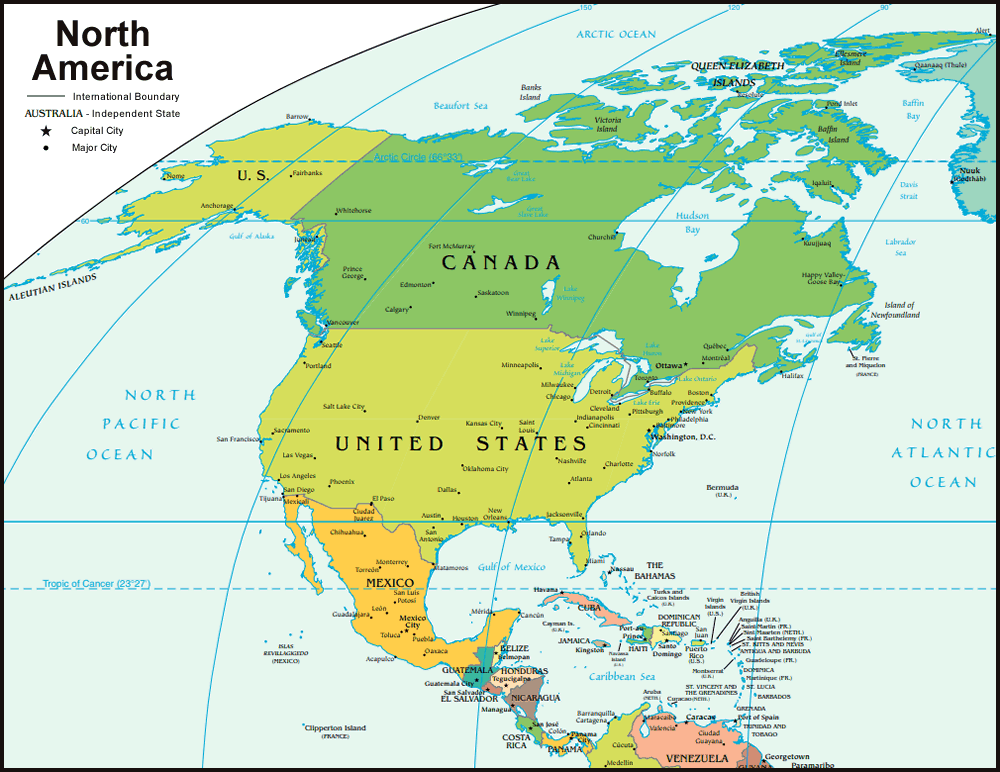
South of Florida, Southeast of United States of America, West of Haiti, etc.
300
Describe the physical characteristics of Canada.
Lakes, forests, snow, etc.
300
Give a name of 3 regions in North or South America.
Caribbean, Midwest, Deep South, Amazon region, Latin America, Rust Belt, Tornado Alley, etc.
300
How are you connected with, and dependent upon, other regions, cultures, and people in the world?
Food, clothing, basic necessities, technology, etc.
300
How has our environment changed over time? Explain some significant changes in our Earth.
Climate change, pangae to present, ice melting, plates moving, etc.
400
Give the absolute location of Belize.
~ 18 N, 89 W
400
Describe the human characteristics of the USA.
Different genres of music, different foods burgers, hot dogs, mix of cultures, english language, other languages, modern clothing, etc.
400
How might a region change over time? What factors might contribute to a change?
Human involvement and impact, natural movement and occurrences of Earth, climate, etc.
400
Give a real life example of each of these types of movement:
Migration, trade, language
Migration: Chinese to America during Gold Rush, Irish to America after famine, Vietnamese to America after war, Arabs to North Africa
Trade: Triangular trade, Silk Road, etc.
Language: Mesopotamian language, French language in Africa, Spanish language in Latin America, English in the US, etc.
400
Name a feature on Earth that has changed the environment and name the positives and negatives of it.
Answers will vary.
Example: Hoover Dam - provided reservoir for water, but flooding wildlife habitats
500
The lines running North and South are called ____.
The lines running West and East are called ____.
The line at 0 going N & S is the ______.
The line at 0 going W & E is the ______.
Longitude
Latitude
Prime Meridian
Equator
500
Describe the physical and human characteristics of Brazil.
Physical: highlands, rainforest, tropical & subtropical climate, mountains, etc.
Human: soccer culture, Portuguese, catholic, dance, etc.
500
Pick a region and describe what characteristics it shares.
Answers will vary.
500
Describe how people might be prevented from the movement of ideas.
Looking for examples with government restrictions, censorship, language barriers, access to technology...
500
2 parts: How does the physical terrain create challenges or benefit people and how do people adapt to the challenges they face from their environment? Give specific examples of how they adapt.
Answers will vary.
-Challenges with climate, lack of water or resources, difficult to farm land, etc.
-Benefits in providing resources and necessities to live
-Adapt with clothing, tools, technology (irrigation, aqueducts, dams, etc.)