Inverses
Solving Square Root Equations
Solving Cube Root Equations
Function Operations
Graphing Radical Functions
100
Find the inverse algebraically.
f(x)=x^3+8
f^-1(x)= root(3)(x-8)
100
sqrt(3p-14) = sqrt(26-2p)
p=8
100
6+(a-3)^(1/3)=0
a=-213
100
Find (f*g)(x) in simplest form.
f(x)=x^2-3x-10
g(x)=x+2
x^2-13x-20
100
What is the domain and range of all cube root functions?
(- ∞, ∞)
200
Using a graphing calculator, graph the following function. Is the inverse a function? Explain how you know.
f(x)=x^3+8
Yes, passes HLT
200
5 sqrt(b-9) = 50
b = 109
200
2 root(3)(2w-6) = 8
w = 35
200
Find (f/g)(x) in simplest form.
f(x)=x^2-3x-10
g(x)=x+2
x-5
200
What is the parent function? Describe the transformations.
f(x)=1/2 root (3)(x-6)+7
Transformations: vertical compression by 1/2, vertical shift right 6, horizontal shift up 7; Parent function:
y= root (3)(x)
300
Find the domain and range of the inverse of the function.
f(x)=-sqrt(x+5)
D: (- ∞, ∞) R: [-5, ∞)
300
-3(2k+5)^(1/2)= 12
No solution
300
root(3)(z^2+9+3z)=root(3)(-3z)
z = -3
300
Find (g(f(-2))).
f(x)=-4x-9
g(x)=3x^2-6x-12
-3
300
Write an equation with the following information. A square root function with a vertical stretch of 3 and a horizontal shift left 9 units.
y=3sqrt(x+9)
400
Write the equation of the inverse.
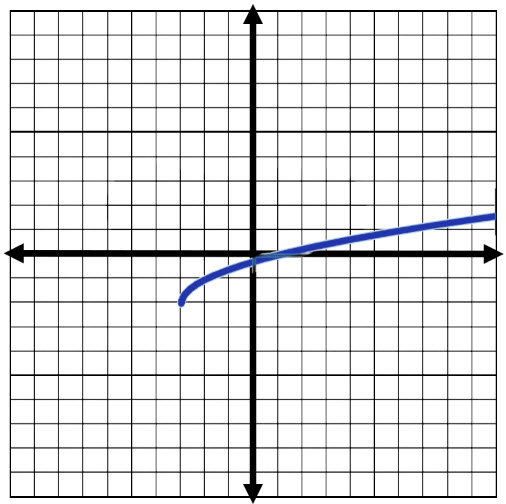
f^-1(x)=(x+2)^2-3
400
sqrt(-9-3x) = x + 3
x = -6 (extraneous) and x = -3
400
root(3)(j^2+3j)=1
j=(-3 +- sqrt13)/2
400
Find (g(f(x))).
f(x)=x+5
g(x)=x^2-4x+8
x^2+6x+13
400
Write an equation for the function graphed below.
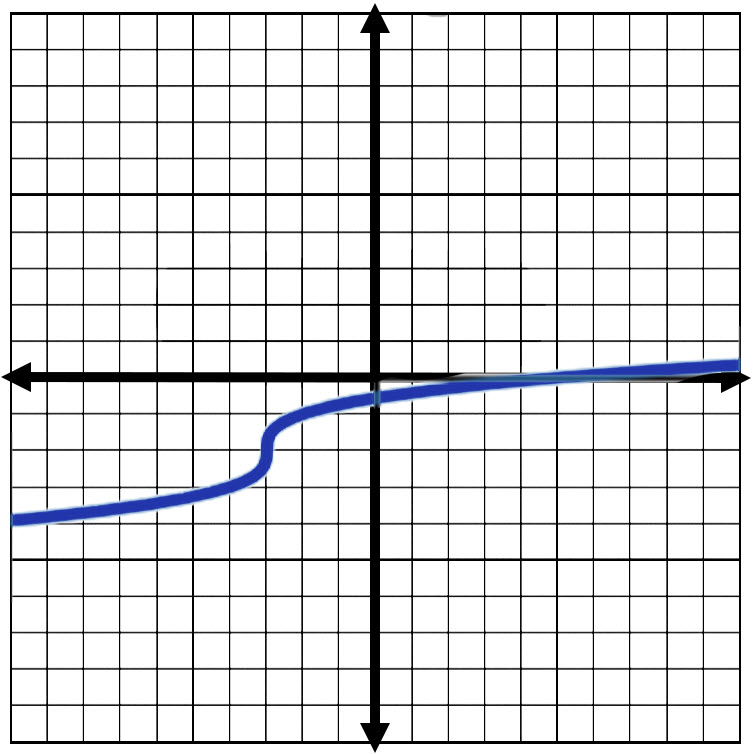
y= root(3)(x+3)-2