A
B
C
D
E
100
Before bronchodilator studies, SABA's should ideally be withheld for how long?
4-6 Hours
100
A subject referred for pulmonary function tests because of shortness of breath has an FEV1% of 82%. This finding is suggestive of:
A. Restrictive lung disease
B. Obstructive lung disease
C. Normal lung function
D. Upper airway abnormality
C. Normal lung function
100
Which answer is consistent with the flow-volume curve shown?
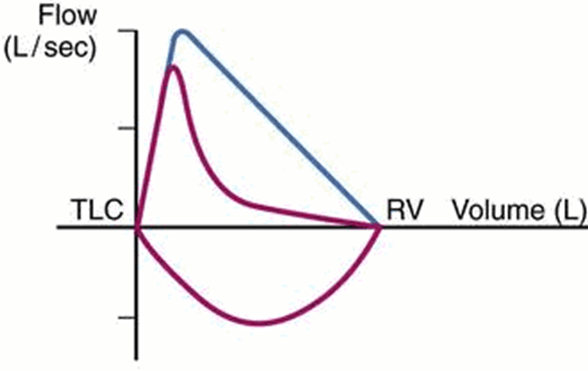
A. Normal forced expiratory flow pattern
B. Variable intrathoracic obstruction
C. Obstructive disease process
D. Fixed extrathoracic obstruction
C. Obstructive Disease Process
100
Which of the following DLCO methods is deemed to provide the most accurate measurement of diffusion?
A. DLCOrb
B. Membrane diffusing capacity
C. DLCOsb
D. DLCOib
A. DLCOrb
100
A subject performing a methacholine challenge test has the following reproducible results:
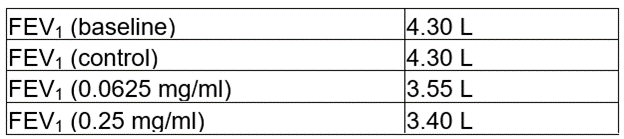
The technologist should do which of the following?
A. Administer the next dose (1.0 mg/ml)
B. Give 10 breaths of the next dose.
C. Give the patient an extra 5 min before the nest dose
D. Stop—the test is positive.
D. Stop—the test is positive.
(P20 3.44 L)
200
A 17-year-old patient with asthma performs three spirometry trials:
Trial 1 Trial 2 Trial 3
FVC (L BTPS) 3.49 3.44 3.30
FEV1 (L BTPS) 2.93 2.91 2.88
What is the patients FEV1%?
FEV1 = 2.93 L
FVC = 3.49
2.93/3.49 = 83.95%
200
The following PFT values were obtained from a 26-year-old male patient who is 6’5” tall and weighs 90 kg (198 lb). Which of the following PFT values is erroneous?
TLC 7.0 L
VC 3.0 L
ERV 2.0L
FRC 1.5L
RV 2.0L
FRC
200
A patient is suspected of having an upper airway obstruction. Which of the following tests should a respiratory therapist recommend to detect this abnormality?
A. FEF 25-75%
B. Nitrogen Washout
C. RV/TLC
D. Flow-Volume Loop
D. Flow-Volume Loop
200
Which of the following is most likely to lead to a decreased DLCO?
A. Polycythemia
B. Pulmonary embolism
C. Asthma
D. Chronic bronchitis
B. Pulmonary embolism
200
A subject performing an FVC and you notice the following result:
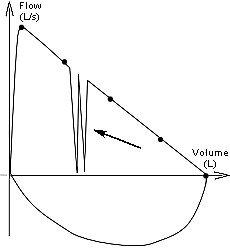
Which of the following likely occurred?
A. Incomplete expiration
B. Patient hesitation
C. Patient didn't fully inhale to TLC
D. Patient cough
D. Patient cough
300
A subject has spirometry repeated before and after inhaled bronchodilators. The following data are obtained:

Which of the following statements best describes these findings?
A. There is mild obstruction with significant response to bronchodilators.
B. There is moderate obstruction without significant change after bronchodilators.
C. There is a moderate obstruction with significant change after bronchodilators.
D. Spirometry is within normal limits with a significant change after bronchodilators.
C. There is a moderate obstruction with significant change after bronchodilators.
300
The main indication for the measurement of lung volumes is to do which of the following?
A. Diagnose or assess the severity of respiratory impairment.
B. Evaluate the severity of pulmonary hypertension.
C. Determine the level of cardiopulmonary fitness.
D. Assess the risk of knee surgery.
A. Diagnose or assess the severity of respiratory impairment.
300
Which answer is consistent with the following three superimposed flow-volume loops?
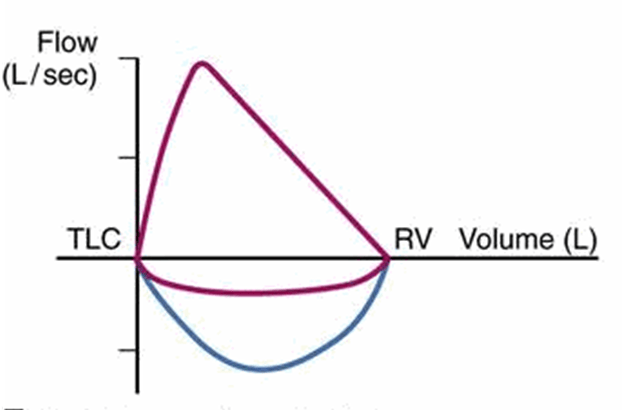
A. Normal
B. Variable intrathoracic restriction
C. Variable extrathoracic obstruction
D. Fixed extrathoracic obstruction
C. Variable extrathoracic obstruction
300
Which of the following results would indicate a smaller residual volume (RV)
A. TLC 130% predicted
B. A decreased He% on helium dilution
C. Increased DLCO
D. A large amount of exhaled N2 detected by the sensor
D. A large amount of exhaled N2 detected by the sensor
300
Review the PFT to answer the question below.
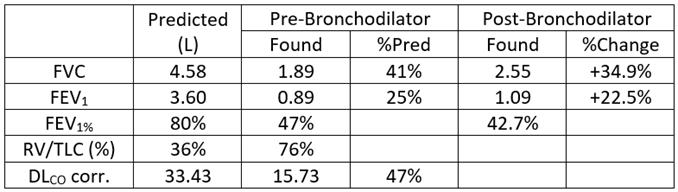
Which of the following is the most likely diagnosis?
A. Emphysema
B. Asthma
C. Pulmonary Fibrosis
D. Sarcoidosis
A. Emphysema
400
How would you interpret the PFT results below?
Pred. Control % Pred.
FVC 5.8 4.8 83%
FEV1 4.3 3.41 79%
FEV1% 71%
a. Normal
b. Mild obstructive disease process
c. Moderate obstructive disease process
d. Mild restrictive disease process
a. Normal
400
The following data were obtained while performing a spirometry test on a 43-year-old patient.

What should the technologist do next?
A. Perform another trial.
B. Report the FVC and FEV1 from Trial 3.
C. Report the FVC and FEV1 from Trial 2.
D. Report the FVC from Trial 3 and the FEV1 from Trial 2.
A. Perform another trial.
400
On what law is the pressure-based body plethysmograph based?
Boyle's Law
400
Three liters of air are injected into a spirometer from a certified-volume standard syringe. The measured value is 2.6 L. Which of the following should the respiratory therapist conclude?
A. The plunger was pushed too slowly
B. Spirometer is ready for patient testing
C. The time scale was incorrectly calibrated
D. Calibration is outside the acceptable range
D. Calibration is outside the acceptable range
400
Which of the following can be used to calculate inspiratory capacity?
A. VC – RV
B. TLC – FRC
C. ERV + VT
D. IRV + RV
B. TLC – FRC
500
The following PFT values were obtained from a 26-year-old male patient. Based on these values, what is the TLC?
VC 5.0 L
IC 3.50 L
ERV 1.50L
FRC 2.50L
RV 1.00L
6.0 L
5.0 (VC) + 1.0 (RV) = 6.0
3.5 (IC) + 2.5 (FRC) = 6.0
500
The following pulmonary function results are obtained for a patient:
Predicted Observed % Predicted
FVC 5.90 3.40 57.6
FEV1 4.00 0.50 12.5
FEV1/FVC 70 14
A respiratory therapist should recommend a treatment plan for
A. Severe obstructive lung disease
B. Severe restrictive lung disease
C. Mild obstructive lung disease
D. Mild restrictive lung disease
A. Severe obstructive lung disease
500
A 40-year-old female is referred for pulmonary function testing for shortness of breath. Results reveal a reduction in all lung volumes and a normal diffusion. Which of the following tests should be ordered next to help assess the etiology of the above findings?
A. MIP/MEP
B. spirometry with bronchodilator
C. 6-minute walk
D. methacholine challenge
A. MIP/MEP
500
A 3L syringe is used for calibration. The following results are seen:
Trial 1 2.85 L
Trial 2 3.1 L
Trial 3 3.2 L
Which of the following statements is accurate?
A. The spirometer is both precise and accurate
B. The spirometer is precise, but not accurate
C. The spirometer is accurate, but not precise
D. The spirometer is adequately calibrated
C. The spirometer is accurate, but not precise
500
What is the maximum error allowed by ATS/ERS recommendations when calibrating a spirometer with a 3-liter syringe?
A. +- 2%
B. +- 3.5%
C. +- 5%
D. +-7.5%
B. +- 3.5%