A
B
C
D
E
100
Your patient’s art line transducer is below the level of their heart. Their monitored systemic blood pressure will be higher or lower than their actual systemic blood pressure?
Higher
100
On a pulmonary artery catheter, what must be done to measure a capillary-wedge pressure?
a. The balloon at the distal tip must be inflated
b. Cold saline must be injected
c. The patient must perform a Valsalva maneuver
d. The pulmonary artery catheter must be replaced with a central venous catheter
a. The balloon at the distal tip must be inflated
100
What method is commonly used to measure cardiac output with a pulmonary artery catheter?
a. Plethysmography
b. Thermodilution
c. Fick Equation
d. Shunt Equation
b. Thermodilution
100
Which line cannot be used to administer medication?
a. Arterial line
b. Central line
c. Swan Ganz
a. Arterial line
100
Use the following parameters to answer determine if the patient is hypoxic or hypoxemic.
Hb 10 gm/dL, SaO2 99%, PaO2 98 mmHg
CaO2 13.56 mg/dL
a. Hypoxic
b. Hypoxemic
c. Hypoxic and Hypoxemic
d. Neither
a. Hypoxic
200
Which intervention may help improve the issue shown here?
CVP 6 mmHg, MPAP 30 mmHg, PCWP 8 mmHg, CO 5 L/min
a. Administration of inhaled pulmonary vasodilator (Nitric Oxide)
b. Administration of IV Heparin
c. Administration of IV Epinephrine
d. A bolus of normal saline
a. Administration of inhaled pulmonary vasodilator (Nitric Oxide)
200
Your patient has a BP of 122/82 mmHg. HR is 80 and SV is 50 mL. CVP is 2 mmHg. Calculate the SVR.
1867 dynes
200
What intervention should be performed when a patient has a large cardiac tamponade?
a. Thoracentesis
b. Pericardiocentesis
c. Escharotomy
d. Bronchoscopy
b. Pericardiocentesis
200
Which patient has the highest PVR?
a. MPAP 18 mmHg, PCWP 10 mmHg, CO 5 L/min
b. MPAP 18 mmHg, PCWP 12 mmHg, CO 5 L/min
c. MPAP 18 mmHg, PCWP 10 mmHg, CO 10 L/min
d. MPAP 18 mmHg, PCWP 10 mmHg, CO 2.5 L/min
d. MPAP 18 mmHg, PCWP 10 mmHg, CO 2.5 L/min
200
Calculate the DO2.
SpO2 98%
PaO2 94 mmHg
Hb 14 mg/dL
CO 5.5 L/min
SvO2 76%
PvO2 40 mmHg
1028.5 mL/min
300
Which of the following interventions would help reduce pre-load in a CHF patient?
a. Administer Furosemide
b. Administer Epoprostenol
c. Administer IV fluids
d. Place the patient in the Trendelenburg position
a. Administer Furosemide
300
While inserting a Swan-Ganz catheter, which waveform indicates the catheter is reading pressure from the pulmonary artery?
1 2 3 4
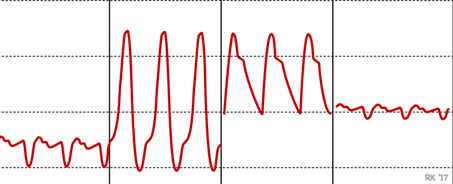
a. 1
b. 2
c. 3
d. 4
c. 3
300
Your patient is recovering from cardiac arrest. Given the following hemodynamics, the RT should recommend the administration of:
CVP 14 mmHg
MPAP 18 mmHg
PCWP 15 mmHg
CO 3.2 L/min
BSA 2 mm2
HR 86 bpm
BP 99/68 mmHg
a. Nitric Oxide (Pulmonary Vasodilator)
b. Nitroprusside (Vasodilator)
c. Dobutamine (inotrope)
d. Lasix (diuretic)
c. Dobutamine (inotrope)
300
Given the patient’s hemodynamics, which possible disease could be present?
CVP 14 mmHg
MPAP 18 mmHg
PCWP 18 mmHg
CO 2.8 L/min
BP 103/76 mmHg
a. COPD
b. High Peep
c. CHF
d. Hypervolemia
c. CHF
300
The patient has an SvO2 of 40%. What does this indicate?
a. Increased O2 delivery to the tissues
b. Decreased O2 delivery to the tissues
c. Increased O2 consumption by the tissues
d. Decreased O2 consumption by the tissues
b. Decreased O2 delivery to the tissues
400
A patient with an arterial blood pressure of 70/41 mmHg has presented with massive hemorrhaging from a farming accident? Staff are stopping the origin of the hemorrhage and a bolus of NS fluid is being administered via IV rapidly. What is the most appropriate next response?
a. Administer NS bolus
b. Administer blood products
c. Administer antibiotics
d. Administer inotrope
b. Administer blood products
400
You notice your patients’ Art line reading shows the following overdamped waveform, while their manual blood pressure reading shows no change from the patients’ previous values. What would you recommend?
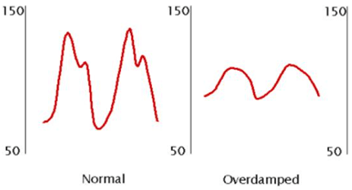
a. Administer blood products
b. Check the art line for clots and attempt to flush it with normal saline
c. Hold pressure over the art line insertion site to minimize blood loss
d. Evaluate for a pneumothorax
b. Check the art line for clots and attempt to flush it with normal saline
400
Which patient shows signs of inadequate tissue perfusion?
a. BP 118/90, spo2 92%, lactic 1 mmol/L
b. BP 88/56, spo2 86%, lactic 7 mmol/L
c. BP 90/60, spo2 90%, lactic 0.7 mmol/L
d. BP 110/72, spo2 88%, lactic 0.9 mmol/L
b. BP 88/56, spo2 86%, lactic 7 mmol/L
400
Given the patients’ hemodynamics, which disease could be present?
CVP 2 mmHg
MPAP 6 mmHg
PCWP 3 mmHg
CO 3.4 L/min
BP 66/42 mmHg
a. COPD
b. CHF
c. Hypervolemia
d. Septic Shock
d. Septic Shock
400
Your patient has a PAP of 23/12 mmHg, a PCWP of 6 mmHg, and a cardiac output of 6L/min. Calculate the PVR.
129 dynes
500
Which of the following is a common insertion site for the insertion of a central venous catheter?
a. Subclavian artery
b. Internal jugular vein
c. Radial artery
d. Radial vein
b. Internal jugular vein
500
The Dicrotic notch represents_____
a. Closure of the pulmonary semilunar valve
b. Diastole of the left atrium
c. closure of the aortic semilunar valve
d. Systole of the right atrium
c. closure of the aortic semilunar valve
500
What line is shown in this chest x-ray?
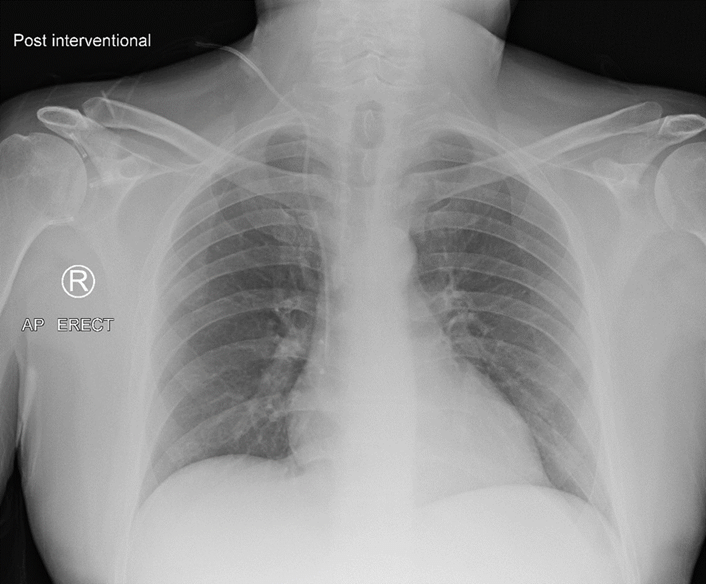
a. Pulmonary Artery Catheter
b. Chest Tube
c. Arterial Line
d. Central Line
d. Central Line
500
A patient with chronic kidney failure presents to the emergency department with complaints of food poisoning. 4 hours into his treatment, he has received 3 Liters of normal saline via IV and his measured urine output is 10 mL/hour. Which set of hemodynamics would you expect to see?
CVP MPAP PCWP CO BP
mmHg mmHg mmHg L/min mmHg
a. 2 6 4 4.2 90/54
b. 4 15 10 5 126/84
c. 9 22 16 8 145/98
C
500
Calculate the C(a-v)O2.
SpO2 93%
PaO2 64 mmHg
Hb 15 mg/dL
CO 9 L/min
SvO2 49 %
PvO2 28 mmHg
9 mL/dL