Module 2
Module 4
Module 5
Formulas
Theory (mix)
100
According to the VSEPR theory, the geometry of the NH3 (ammonia) molecule is
a. Trigonal Pyramidal
b. Bent
c. Tetrahedral
d. Trigonal planar
e. Linear
f. None of the above.
a. Trigonal pyramidal
100
Hydrogen bonding is a type of intramolecular force that occurs within a single water molecule. a) True ; b) False ; c) More information is needed ; d) It is both intermolecular and intramolecular;
False
100
What is the molarity of 2.0 L of a solution with an osmotic pressure of 2.5 atm at 20 °C?
a) 0.052 M ; b) 0.104 M ; c) 0.821 M ; d) 2.5 M ; e) 1.25 M
0.104 M
100
Osmotic Pressure
What R constant is used in this equation?
pi=iMRT
R= 0.0821 L atm/ K mol
100
Which of the following substances would be expected to be most soluble in liquid water (H2O)?
a. CCl4 (Carbon tetrachloride)
b. CH3CH2CH2CH2CH3 (Pentane)
c. CH3OH (Methanol)
d. I2 (Iodine)
e. CO2 (Carbon dioxide)
c. CH3OH (Methanol)
200
Where is the most electropositive region in an IF5 (iodine pentafluoride) molecule?

a. On the central I atom
b. On the equatorial F atoms
c. On the axial F atom
d. It has no positive regions
e. Equally distributed across all atoms
a. On the central I atom
200
Which of the following can form hydrogen bonds with water molecules?
I) CH3OH (Methanol)
II) CH4 (Methane)
III) HF (Hydrogen fluoride)
IV) CO2 (Carbon dioxide)
a. I and II
b. I and III
c. II and III
d. II and IV
e. III and IV
b. I and III
200
How many grams of methanol do you need to make a 0.50m solution with 15.0g of CaCl2?
(Density of methanol = 0.792 g/mL)
270g
200
% by mass (with correct units)
Dilution formula
% by mass= Mass of solute (g)/ mass of solution (g) times 100
Dilution formula: M1V1=M2V2
200
Nitrogen molecules weakly attract other nitrogen molecules through
a) hydrogen bonding
b) ion-dipole forces
c) nitrogen bonding
d) dispersion forces
e) None of the above
d) dispersion forces
300
What is the name of the molecular geometry of an AB6 type molecule that contains one lone pair of electrons? a. Trigonal planar
b. Octahedral
c. Square pyramidal
d. T-shaped
e. Square planar
c. Square pyramidal
300
What type of primary intermolecular interactions are experienced by two molecules of carbon dioxide (CO2)? a) Dipole-dipole ; b) Dipole induced – dipole induced (London dispersion) ; c) Ion-dipole ; d) Ion-dipole induced ; e) Hydrogen bonding
b) Dipole induced – dipole induced (London dispersion)
300
Calculate the approximate freezing point of a solution made from 21.0 g NaCl and 1.00 × 10^2 g of H2O.
[Kf of water is 1.86°C/m.]
A) 3.59°C
B) 6.68°C
C) –13.4°C
D) –6.68°C
E) –3.59°C
C) –13.4°C
300
Freezing point Depression
change in T= -ikfm
300
Dissolving a solute such as KCl in a solvent such as water results in a solution. In comparison with the pure solvent (water), the solution shows:
A) an increase in the melting point.
B) a decrease in the boiling point.
C) a decrease in the vapor pressure.
D) no change in the boiling point.
E) none of the above.
c: decrease in the vapor pressure
400
The hybridization of the central atom and the geometry of the carbonate ion (CO3^2-) are:
a. sp3 and tetrahedral
b. sp2 and trigonal pyramidal
c. sp3 and trigonal planar
d. sp2 and trigonal planar
e. sp and linear
d. sp2 and trigonal planar
400
Which of the following statements concerning the phase diagram below are CORRECT
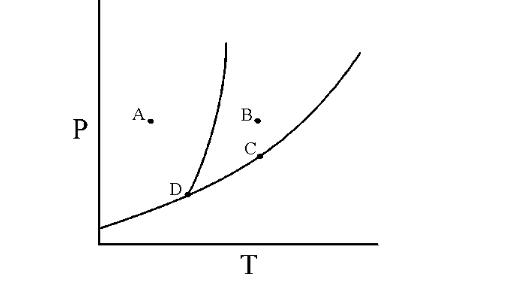
I) Moving from point B to A results in a phase transition from liquid to gas
II) Point D lies at the critical point
III At point C, liquid and gas phases coexist at equilibrium
Correct Answer: c. III only
400
A 20.0 % by mass solution of phosphoric acid (H3PO4) in water has a density of 1.114 g/mL at 20°C.
What is the molarity of this solution?
A) 0.0114 M
B) 0.0568 M
C) 0.114 M
D) 11.4 M
E) none of these
E) none of these
400
Formula for (with correct units)
Molarity
molality
density
Molarity= Moles of solute/ L of solution
molality= moles of solute/kg of solvent
Density = mass of solution (g)/ volume of solution (ml)
400
During a dialysis or filtration process involving a semipermeable membrane:

a. Pure solvent diffuses through a semipermeable membrane but solutes do not

b. Solutes diffuse freely through the membrane while solvent remains stationary

c. Both solvent and solute particles diffuse across the membrane at identical rates

d. Large colloidal particles pass through the membrane while small molecules are blocked.

e. None of the above
a. Pure solvent diffuses through a semipermeable membrane, but solutes do not.
500
Assuming the octet rule is obeyed, how many covalent bonds and how many lone pairs will atoms of oxygen and carbon have in molecular structures in order to have formal charges of 0?
a. Oxygen: 1 bond, 3 lone pairs and Carbon: 4 bonds and 0 lone pairs
b. Oxygen: 3 bonds, 1 lone pair and Carbon: 3 bonds and 1 lone pair
c. Oxygen: 1 bond, 3 lone pairs and Carbon: 3 bonds and 1 lone pair
d. Oxygen: 2 bonds, 2 lone pairs and Carbon: 4 bonds and 0 lone pairs
e. None of these
d. Oxygen: 2 bonds, 2 lone pairs and Carbon: 4 bonds and 0 lone pairs
500
Assume both axes are linear in the phase diagram for substance X below:
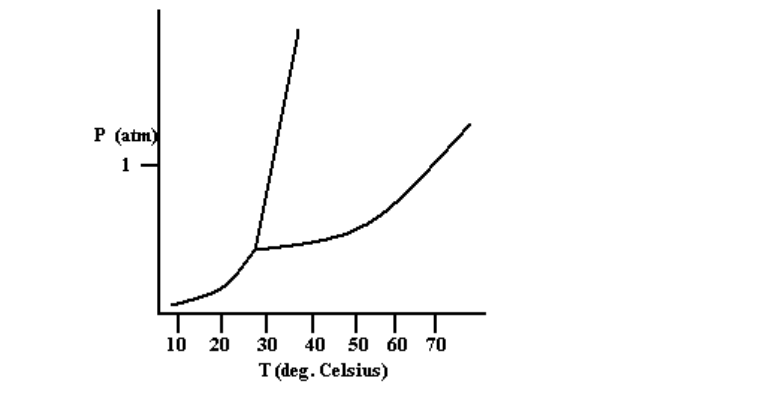
Assume both axes are linear in the phase diagram for substance X below:
d. About 20 °C
500
Ethanol has a ΔH_vap = 38.6 x 10^4 J/mol at 1 atm, where its normal boiling point is 78.4 °C (351.55 K). What is its boiling point temperature on a high-altitude plateau where the atmospheric pressure is 0.50 atm? a) 65.2 °C
b) 72.1 °C
c) 81.3 °C
d) 58.4 °C
e) 78.4 °C
a) 65.2 °C
500
What is the Clausius- Clapeyron Equation
ln (P2/P1) = -changeHvap/R (1/T2 - 1/T1)
500
Which of the following compounds would you expect to have the highest boiling point?
a. CH4 (Methane)
b. CH3CH2CH3 (Propane)
c. CH3OCH3 (Dimethyl ether)
d. CH3CH2OH (Ethanol)
e. CH3CH2CH2CH3 (Butane)
d. CH3CH2OH (Ethanol)