Exponential Graphs
Transformations of Exponential Functions
Logarithms
Vocab
Mix
100
Is this function represent exponential GROWTH or DECAY?
f(x) = 1.2(0.99)x
EXPONENTIAL DECAY
100
Consider the function:
f(x)=2(x-1) +5.
What is the parent function?
f(x) = 2x
100
What is the OUTPUT of a LOGARITHMIC function? Use one word!
an EXPONENT
Logarithms are the inverse of exponential functions and used when solving exponential equations where the exponent is unknown. The output of a logarithm is an exponent.
100
What do you call of 2 value in the exponential equation?
f(x)=2∙5^x
INITIAL VALUE
When the base of this function is raised to an input of 0, the result is 1. So your are left with the coefficient being multiplied by 1. This means the coefficient is the INITIAL VALUE or what you started with before the function began to grow or decay.
100
Every time Pinocchio lies his nose grows about 12% of its size. Originally his nose was 2 inches long. Write an equation to model the situation.
y = 2(1.12)x
200
Given the equation y = 3(0.45)x-7 + 9, what is the horizontal asymptote?
Horizontal asymptote is y = 9
200
Consider the function: f(x) = 3(x+2) - 8.
What is the parent function? Describe all transformations the function has undergone from the parent function.
Parent function: f(x) = 3x
Transformations:
Horizontal translation: 2 units left
Vertical translation: 8 units down
200
Evaluate the logarithms below:
a) log2(64) = __
b) log5(125) = __
a) 6
b) 3
200
What do you call of 5 value in the logarithmic equation?
y = log5 x
Base
200
A town with a population of 5,000 grows 3% per year. Find the population at the end of 10 years. *Round to the nearest person
6720 people in the population of this town
5000(1.03)10 = 6719.58
300
Does this exponential function model GROWTH or DECAY?
y=0.75(7/6)^x+3
GROWTH
The common ratio (r) in this equation is greater than 1 which indicated decay (the outputs are getting bigger by a factor of 7/6 for every increase of 1 in the input.
300
Identify the TRANSFORMATIONS applied to f(x) in order to create g(x). Be specific.
f(x) = 4x
g(x) = 2(4)x-3 - 5
HORIZONTAL SHIFT (TRANSLATION): 3 units right
VERTICAL SHIFT (TRANSLATION): down 5 units
VERTICAL STRETCH by a factor of 2
300
Write the logarithm in EXPONENTIAL form.
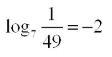
7^-2=1/49
300
What types of values would indicate that an exponential model was decaying? - Be specific!
b-values that are less than one but bigger than zero
0 < b < 1
300
Solve for x:
log3 x = -4
x = 1/81
Solution:
3-4 = (1/3)4 = 1/81
400
Write the exponential equation for the table below.
f(x) = 5(3)x
400
The blue graph is of f(x)=2x. Find the equation of the green graph g(x) which has been transformed.
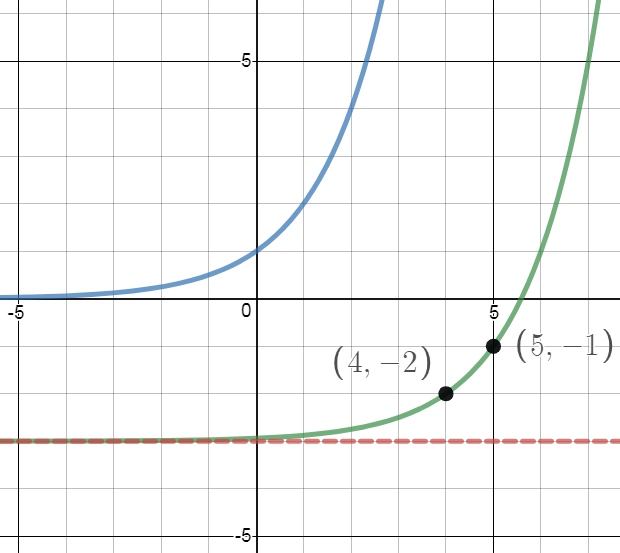
g(x)=2^((x-4))-3
400
Find the value x.
logx (512) = 3
x = 8
since, (8)3 = 512
400
Convert to exponential form: log3 81 = 4
34 = 81
400
Solve for x:
log4 (-16) = x
undefined
The domain of the logarithmic function is any positive number.
500
Write the equation of the exponential graph.
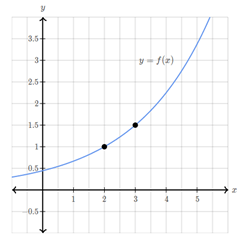
y=0.5(1.5)^x
500
Write the equation of an exponential function that goes through the point (0,5), has a horizontal asymptote at y = 2 and decays at rate of 25%.
f(x)=5(0.75)x + 2.
500
A national park has a population of 5000 deer in the year 2016. Conservationists are concerned because the deer population is decreasing at the rate of 7% per year.
If the population continues to decrease at this rate, how long will it take until the population is only 3000 deer? *Round to the nearest hundredth.
After 7.04 years, there are 3000 deer.
500
Convert this to logarithmic form: 45=1024
log4 1024 = 5
500
A $12,500 depreciates 9% every year. How long until the car is worth $2000?
*Round to the nearest tenth.
about 19.4 years