Economics
Geography
Colonial Times
Civics
America Revolution
100
This is the term for a person who buys and uses goods and services.
Consumer
100
This imaginary line circles the Earth halfway between the North and South Poles, dividing the globe into the Northern and Southern Hemispheres.
equator
100
This European country established all 13 of the original colonies along the Atlantic coast of North America.
England (Great Britain )
100
To prevent any one person or group from having too much power, the United States government is divided into these three branches.
Executive, Legislative, Judicial
100
a well-organized Patriot organization in secret, was established to undermine British rule in colonial America and was influential in organizing and carrying out the Boston Tea Party.
Sons of Liberty
200
This economic problem occurs when there are not enough resources to satisfy all of the people's wants and needs.
scarcity
200
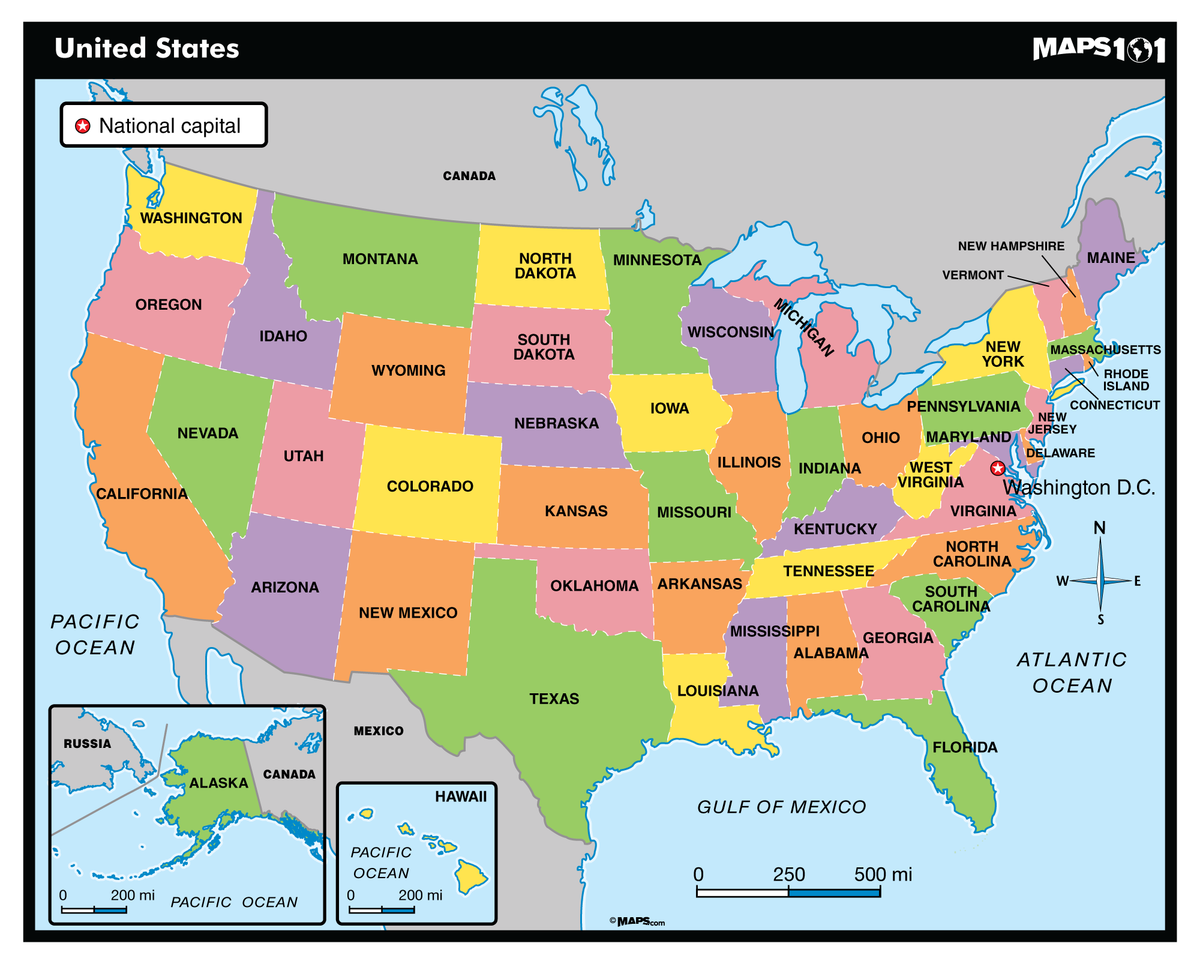
what is this map called?
political map
200
Which of three groups of colonies had the most slaves and why?
Southern
Plantations
200
This is the name for the first ten amendments to the Constitution, which were added to protect the individual rights of citizens.
Bill of Rights
200
This document is made of three parts: preamble, articles, amendments
constitution
300
This is when a business or country focuses on producing only a few specific types of goods rather than trying to make everything themselves.
Specialization
300
The exact latitude and and longitude points. GPS uses this to get people to a specific location.
Absolute Location
300
Known as the "Breadbasket Colonies," this region had a mild climate and fertile soil that allowed farmers to grow large amounts of wheat and grain.
Middle Colonies
300
The title of the person who serves as the "Chief Executive" of Kentucky.
Governor
300
This French man is credited with saving the continental army.
Marquis De Lafayette
400
This is what you give up (the next best alternative) when you make a choice to buy or do one thing instead of another.
Opportunity Cost
400
This is the specific term for an area of land that shares similar characteristics
region
400
This document was the first written form of government in North America. It was established by puritans.
Mayflower Compact
400
While voting is a voluntary responsibility, give two specific duties that a U.S. citizen is required by law to perform, or they may face legal consequences.
obeying laws, paying taxes, or serving on a jury
400
This man was a great speaker for the patriots. He owned the Pennsylvania Gazette that published news promoting patriotism.
Benjamin Franklin
500
In a market economy, the price of a product and the amount produced are primarily determined by these two "forces" of supply and what?
demand
500
During the Industrial Revolution, many people moved to Northern cities in the U.S. because there were plenty of factory jobs available. The promise of a steady paycheck was a (push or pull) factor.
pull factor
500
Explain two differences between the Puritans an the Quakers.
1. The Source of Religious Authority
The most striking divide was where these groups looked for "Truth."
Puritans (The "External" Word): Puritans were people of the Book. They believed in Sola Scriptura, meaning the Bible was the final, infallible authority on everything. To understand God, one needed to study scripture intensely and listen to learned ministers who could interpret it.
Quakers (The "Internal" Light): Quakers believed in the "Inner Light"—the idea that a piece of the divine resides within every individual. They argued that God could speak directly to anyone's soul without the need for a Bible or a preacher. Because of this, Quaker meetings often involved sitting in silence until someone felt moved by the Spirit to speak.
2. Social Hierarchy and Equality
Their theological views led to very different ways of treating other people.
Puritans (Strict Hierarchy): The Puritans believed in a structured social order. They saw a clear hierarchy: Husbands over wives, parents over children, and the "Elect" (those predestined for heaven) over the "unregenerate." They also maintained a professional clergy and expected the community to defer to religious and civic leaders.
Quakers (Radical Equality): Because Quakers believed everyone possessed the "Inner Light," they viewed all people—regardless of gender, race, or social status—as spiritual equals.
They refused to bow or remove their hats for nobles.
They used the informal "thee" and "thou" for everyone, rather than formal titles.
They allowed women to speak and lead in meetings, a practice the Puritans found scandalous and even dangerous.
500
This is the specific power the Legislative Branch has to remove a President or federal official from office if they are suspected of "High Crimes and Misdemeanors."
impeachment
500
Name three causes of the American Revolution
Answers may vary
Some options:
Taxation without representation
Boston Tea Party
Boston Massacre