Cell Theory
Properties of Water
Biomolecules/DNA/enzyme
Osmosis/Cell Energy
Cells/Cell Division/Biotechnology
100
What does the cell theory state?
What is:
The Cell theory states that all living organisms are composed of one or more cells, cells are the basic unit of structure and function in organisms, and all cells arise from pre-existing cells.
100
Explain the property of water related to specific heat capacity.
What is:
Water has a high specific heat capacity, meaning it absorbs or releases large amounts of heat with minimal temperature changes.
This high capacity, driven by hydrogen bonding, acts as a heat sink that stabilizes aquatic ecosystems, climates, and body temperatures
https://www.youtube.com/watch?v=cFiw5UeUGMQ&t=1s
100
Explain DNA replication as described by Watson & Crick
DNA replication occurs when the DNA strands “unzip,” and the original strands of DNA serve as a template for new nucleotides to join and form a new strand.
- During DNA replication, the DNA helix unwinds and the two single strands of DNA then each serve as a template for a new stand to be created.
- DNA replication is semi-conservative: the new DNA molecule consists of half of the parent DNA molecule.
100
Diffusion is the passive, random movement of molecules or particles from an area of higher concentration to an area of lower concentration until equilibrium is reached. It is a form of passive transport, meaning it requires no energy, and continues until particles are evenly distributed
What is osmosis? How is it related to diffusion?
Osmosis is the diffusion of water molecules across a selectively permeable membrane from an area of higher water concentration to an area of lower water concentration.
It is a vital cellular process that requires no energy, helping cells maintain balance by adjusting to hypertonic or hypotonic environments.
It requires no energy.
100
In what ways are prokaryotic and eukaryotic cells similar?
Prokaryotic and eukaryotic cells share fundamental components necessary for life, including a plasma membrane, cytoplasm, DNA as genetic material, and ribosomes for protein synthesis. Both cell types utilize ATP for energy, possess similar basic metabolic processes, and can be enclosed by a cell wall
200
What theory did the cell theory replace?
What is:
Cell theory replaced the widely accepted belief in spontaneous generation, which held that living cells and organisms could arise spontaneously from non-living matter
200
Explain the polarity of water and why it is called the universal solvent.
What is:
Polarity: Water molecules have a bent shape, with a partial positive charge on the hydrogen atoms and a partial negative charge on the oxygen atom, enabling them to form hydrogen bonds and dissolve many substances, earning the nickname "universal solvent"
200
Name the biomolecules and tell their function.
The four major biomolecules are carbohydrates, lipids, proteins, and nucleic acids, which are essential for all living organisms. They serve critical functions: carbohydrates provide energy, lipids store energy and form membranes, proteins provide structure and catalyze reactions, and nucleic acids encode genetic information
200
What happens to a cell when it is placed in a hypotonic solution?
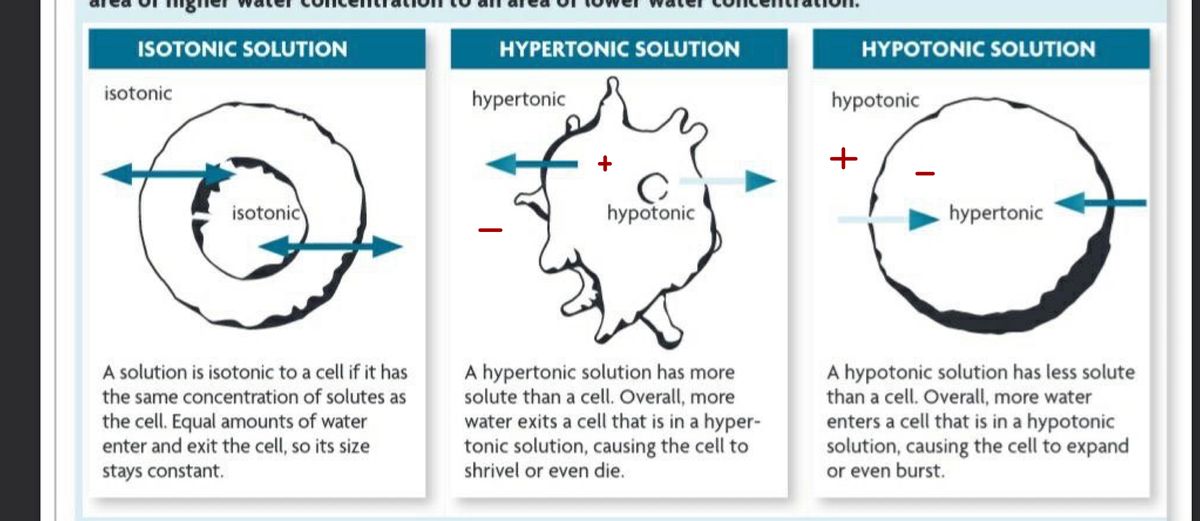
What is
Key Effects of Hypotonic Solutions:
- Water Movement: Water enters the cell. Water moves from the surrounding solution into the cell because the solute concentration is lower outside the cell than inside.
- Animal Cells: Cells swell and can rupture (lyse) due to excessive water intake.
- Plant Cells: The cell becomes firm and turgid, pushing against the cell wall, which provides structural support.
- Microorganisms: Prokaryotes and fungi also swell but are typically protected from bursting by their rigid cell walls.
- Examples: Red blood cells placed in distilled water will burst
200
What type of cell division produces 2 identical cells? Give example.
What is:
Mitosis is the type of cell division that produces two genetically identical daughter cells from a single parent cell. It is essential for growth, tissue repair, and asexual reproduction, ensuring new cells have the same chromosome number as the original.
300
What innovation did scientists use to support the cell theory of life?
What is:
The development and refinement of microscopes allowed scientists to observe, for the first time, that living organisms are composed of small, functional units called cells.
300
How does water move from the roots of plants to the leaves?
https://www.youtube.com/watch?v=5lI_FJP4jRg&t=13s
Water moves from roots to leaves through the xylem, driven primarily by transpiration pull, cohesion, and adhesion. Transpiration creates a negative pressure (tension) at the leaves, pulling water upward, while cohesion (water sticking together) and adhesion (water sticking to xylem walls) maintain a continuous column against gravity.
300
How has biotechnology helped people with diabetes?
Bacteria can recognize and express human genes because the genetic code is universal across almost all living organisms, meaning DNA is transcribed and translated using the same basic machinery. Because of this, bacteria can treat inserted human DNA (via plasmids) as their own, producing human proteins like insulin.
300
What happens to a cell when placed in a hypertonic solution?
Key Effects of Hypertonic Environments:
- Water Loss: The net movement of water is out of the cell.
- Shrinkage: The cell loses volume and shrinks.
- Animal Cells: Become shriveled (crenation), which can lead to cell death.
- Plant Cells: The cell membrane shrinks away from the rigid cell wall, a process called plasmolysis.
- Structural Impact: Plant cells lose turgor pressure and wilt
300
What type of cell division produces 4 daughter cells?
Meiosis is the type of cell division that produces four daughter cells. It involves one round of DNA replication followed by two successive divisions (Meiosis I and II), resulting in four genetically unique, haploid gametes (sperm or egg cells) containing half the number of chromosomes as the parent cell.
They are NOT identical.
400
What is the difference between a dissection and compound light microscope?

Dissecting and compound light microscopes are similar in that they both use lenses and a light source to view live or dead specimens. However, a dissecting microscope is used to get a better view of larger objects, while a compound light microscope is used to view objects that cannot normally be seen.
400
Why does ice float?
Density of Ice: Unlike most substances, water expands upon freezing, making ice less dense than liquid water, allowing it to float
Why Ice Floats: When water freezes, hydrogen bonds lock molecules into a rigid, open, hexagonal lattice. This structure keeps molecules farther apart than when they are in a liquid state, creating more volume for the same mass, thus lower density.
- Ecological Significance: Because ice is less dense, it floats, insulating the water beneath. If ice were denser than liquid water, it would sink to the bottom, freezing lakes and oceans solid and destroying aquatic ecosystems.
400
What are enzymes and how do they work?
Enzymes are proteins, and their functionality is highly dependent on their shape (Lock and key).
Enzymes are biological catalysts that speed up chemical reactions by lowering the activation energy
They play an essential part of digestion, blood clotting, and growth.
400
What is the reactants and products of photosynthesis?
Photosynthesis converts water, carbon dioxide, and light energy into glucose and oxygen. The primary reactants are CO2 (from the air) and H2O (from the soil) processed via light energy. The products are glucose, which powers the plant, and oxygen, released as a byproduct
400
In meiosis, crossing over occurs. Why is this important for species?
What is:
Crossing over is the exchange of genetic material between paired homologous chromosomes during meiosis, resulting in new combinations of alleles. This process is crucial for increasing genetic diversity within a species
500
What kind of electron microscope was used for this image?
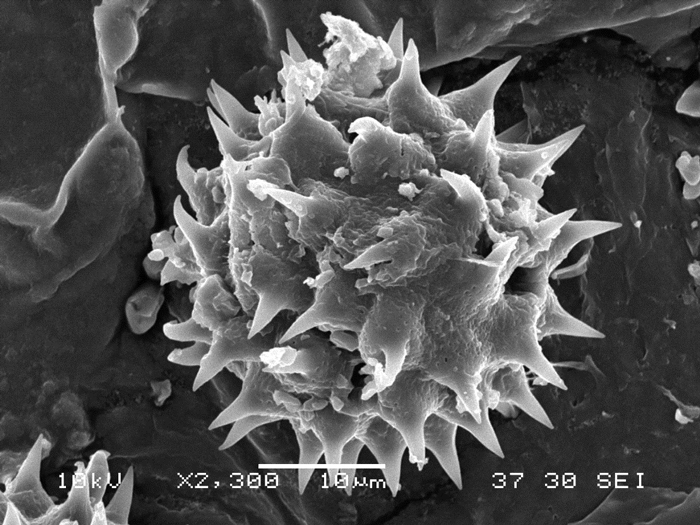
What is Scanning electron Microscope, SEM.
Transmission Electron Microscopes (TEM) and Scanning Electron Microscopes (SEM) both use electron beams for high-resolution imaging but differ fundamentally: TEM transmits electrons through ultra-thin samples for 2D internal structure at atomic resolution, while SEM scans electron beams over surfaces for 3D topological, composition-sensitive imaging
500
Water is known as the "universal solvent"
What is:
Its polar molecular structure allows it to dissolve more substances than any other liquid, making it essential for life. It acts as a transport medium for nutrients and waste in blood, facilitates chemical reactions in cells, and enables nutrient uptake in plants, supporting biological processes.
500
What are factors that affect an enzyme?
- Factors: Enzyme efficiency is influenced by temperature, pH, and substrate concentration
500
What are the reactants and products of cellular respiration?
The reactants of cellular respiration are oxygen and glucose, and the products are carbon dioxide, water, and ATP. The overall chemical reaction for cellular respiration is: glucose + oxygen -> carbon dioxide + water. The Krebs cycle and the electron transport chain generate most of the ATP in cellular respiration
500
What are plasmids? How are they used in biotechnology?
Plasmids are small, circular, extrachromosomal DNA molecules in bacteria used extensively in biotechnology as vectors to carry foreign genetic material into cells. They are essential for gene cloning, producing recombinant proteins (e.g., insulin), creating vaccines, and engineering genetically modified organisms (GMOs).